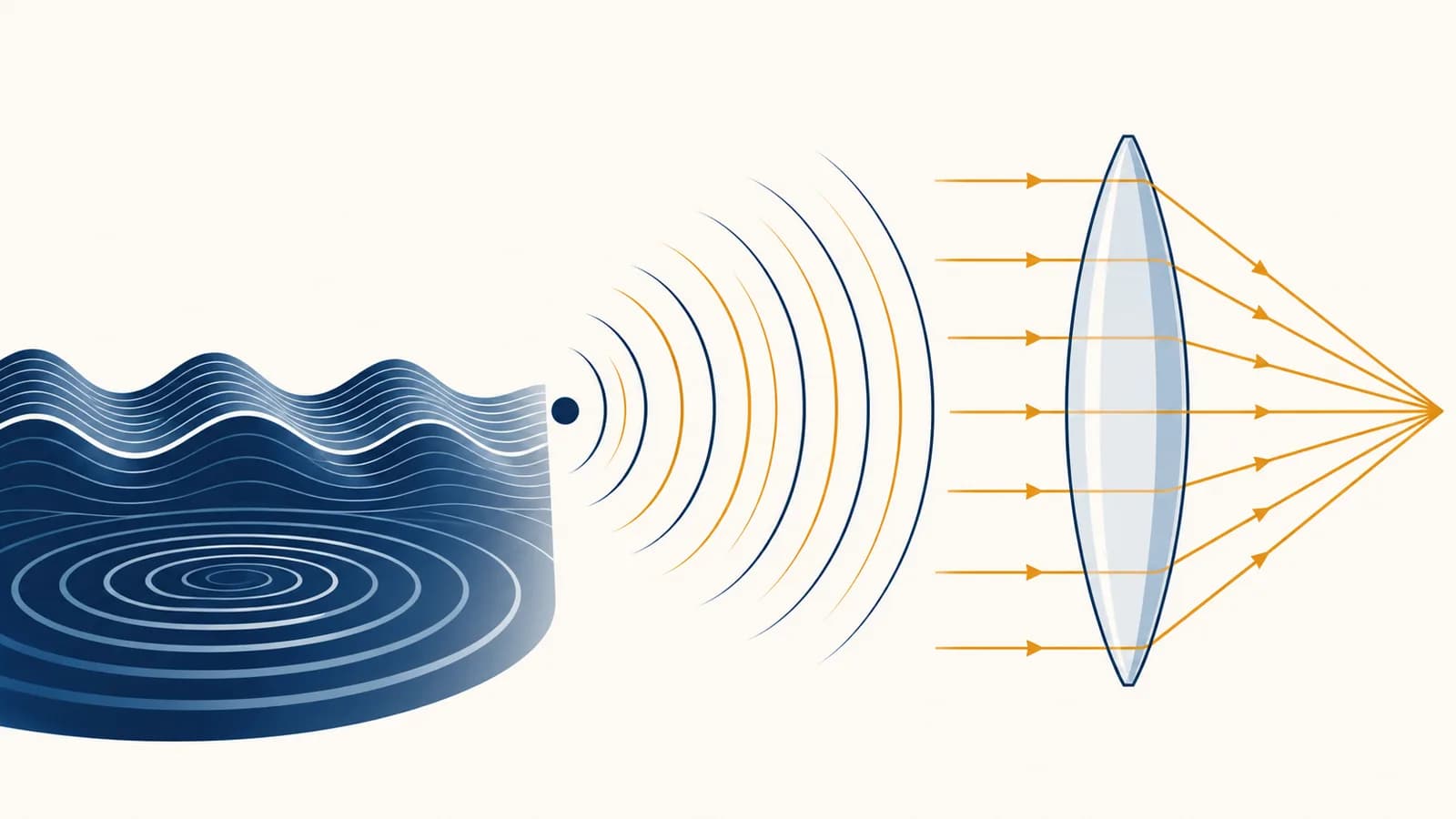
Waves and optics is a branch of physics that explains how disturbances carry energy and how light travels, changes direction, and forms images. It connects the meaning of wavelength, frequency, amplitude, and wave speed with reflection, refraction, diffraction, interference, sound, light, mirrors, and lenses. The subject exists because many signals and sensations reach us through waves: speech moves through air, a radio receives electromagnetic waves, and an eye focuses light. Its equations let us predict where energy goes and what an observer or detector will receive.
What a wave actually is
A wave is a traveling disturbance that transfers energy and information without carrying the material of its medium along with it over the whole distance. Each part of the medium usually moves around a resting position while the disturbance progresses elsewhere.
Picture a cork floating on water as ripples pass. The cork rises, falls, and may trace a small loop, but it does not ride each crest all the way across the pond. Its motion shows that the water received energy. The moving pattern shows that neighboring parts of the water passed that energy onward.
A mechanical wave needs matter whose particles can interact. Sound needs a gas, liquid, or solid. Waves on a string need the string. Seismic waves need rock. An electromagnetic wave does not need a material medium. Light from the Sun crosses the near vacuum of space because changing electric and magnetic fields sustain one another. The connection between those fields belongs to electric and magnetic fields, circuits, and induction.
Particles vibrate near their equilibrium positions and interact with nearby particles.
A crest, compression, pulse, or field change travels and carries energy through the system.
A single pulse counts as a wave. A repeating wave has recognizable cycles. The highest displacement is the amplitude. The distance between matching points on consecutive cycles is the wavelength, written . The time for one complete cycle at a point is the period, written . The number of cycles per second is the frequency, written and measured in hertz.
How waves carry energy without carrying matter
A wave carries energy because one moving part of a system does work on the next part. Restoring forces pull displaced particles or fields back toward equilibrium, inertia carries them past it, and repeated interactions move the disturbance forward.
On a stretched string, your hand pulls the first section sideways. Tension from the neighboring section pulls it back. At the same time, the first section pulls its neighbor sideways. That neighbor then pulls the next. The pulse advances even though each small piece of string travels only a short distance.
The same bookkeeping works for sound. A loudspeaker cone pushes nearby air molecules closer together, producing a region of increased pressure called a compression. Those molecules collide with and repel nearby molecules, so the pressure change moves outward. Behind it comes a rarefaction, a region of lower pressure. The individual molecules jostle over tiny distances compared with the distance that the sound travels.
Energy can fade while frequency stays fixed. Absorption and spreading reduce a wave's amplitude. They do not automatically make the source oscillate more slowly.
Amplitude often controls how much energy a wave carries, but the exact relation depends on the system. For many familiar linear waves, intensity is proportional to the square of amplitude. Doubling the amplitude then makes the intensity four times as large. Intensity means power delivered per unit area, so it also falls when a fixed amount of power spreads over a larger area.
A wave can also carry information. A microphone converts pressure changes into an electrical signal. A transmitter changes, or modulates, a radio wave so that features of that signal are represented in the wave. A receiver extracts the pattern. Energy makes detection possible; controlled variation gives the signal meaning.
How wavelength, frequency, period, and speed fit together
Wave speed equals frequency multiplied by wavelength because each cycle advances the pattern by one wavelength. Frequency and period describe the source's timing, while wave speed depends mainly on the medium and the type of wave traveling through it.
A 5.0 Hz water wave with a 0.80 m wavelength travels at .
The equation is a count. If five crests pass a marker every second and neighboring crests are 0.80 metres apart, five crest spacings move past the marker in one second. The pattern therefore advances 4.0 metres in that time.
Period and frequency are reciprocals. A 4 Hz vibration completes four cycles each second, so one cycle lasts one quarter of a second.
For , the period is .
When a wave crosses into a new medium, its speed can change. Its frequency normally does not, because the source still sends the same number of cycles each second and the boundary must respond to each incoming cycle. The wavelength changes instead. If a 500 Hz sound travels at 340 m/s, its wavelength is 0.68 m. If its speed in another material were 1,360 m/s, the same frequency would have a wavelength of 2.72 m.
Transverse waves versus longitudinal waves
In a transverse wave, the disturbance points across the direction of travel; in a longitudinal wave, it points along that direction. The classification describes the direction of oscillation, not the path drawn by a crest or compression.
A pulse sent along a horizontal rope can move to the right while every piece of rope moves up and down. That is transverse motion. A sound wave can move to the right through air while molecules move briefly right and left. That is longitudinal motion, seen as alternating compressions and rarefactions.
| Feature | Transverse wave | Longitudinal wave |
|---|---|---|
| Oscillation | Perpendicular to travel | Parallel to travel |
| Visible pattern | Crests and troughs | Compressions and rarefactions |
| Example | Wave on a taut string | Sound in air |
| Polarization | Possible | Not possible for a purely longitudinal wave |
Electromagnetic waves are transverse. Their electric field and magnetic field oscillate perpendicular to the direction of travel and perpendicular to each other. Because the electric field can favor one transverse direction, light can be polarized. Polarizing sunglasses block much of one field orientation, which can reduce glare reflected from a horizontal surface.
Real surfaces complicate the neat categories. Water surface waves combine vertical and horizontal motion. Earthquakes also produce several wave types. Primary waves are longitudinal body waves, while secondary waves are transverse body waves. Surface waves can involve still more complicated particle paths. The simple categories remain useful because they identify the principal direction of disturbance.
How superposition creates interference and standing waves
Superposition means that overlapping waves add their displacements point by point. Waves in step reinforce one another through constructive interference, waves out of step can cancel through destructive interference, and repeated reflections can form a stationary pattern called a standing wave.
Suppose two pulses meet on a rope. If each pulls the rope 2 centimetres upward at the same place and time, the combined displacement is 4 centimetres upward. If one pulls 2 centimetres upward and the other 2 centimetres downward, the displacement at that instant is zero. After the overlap, ideal pulses continue on their original paths. Cancellation did not destroy the pulses; addition briefly made their total displacement zero.
Crest meets crest, or compression meets compression. The displacements have the same sign and the resulting amplitude grows.
Crest meets trough, or compression meets rarefaction. Opposite displacements reduce or cancel the result.
Phase describes position within a cycle. Sources oscillating together are in phase. A half-cycle difference puts identical sinusoidal waves in opposite phase, giving cancellation if their amplitudes match. Intermediate phase differences give partial reinforcement or cancellation.
A standing wave forms when two waves with the same frequency and similar amplitude travel in opposite directions. Some positions, called nodes, never move because destructive interference always occurs there. Positions called antinodes have maximum oscillation. A guitar string fixed at both ends must have nodes at those ends, so only wavelengths that fit the string can persist strongly.
For a 0.65 m string with wave speed 260 m/s, the fundamental is .
Higher values of are harmonics. Their mixture shapes the instrument's timbre, the quality that helps distinguish the same note played on a guitar and a violin. Air columns in pipes also resonate, although open and closed ends impose different displacement and pressure conditions.
How reflection, refraction, and diffraction redirect waves
Reflection sends a wave back from a boundary, refraction changes its direction when its speed changes, and diffraction spreads it around edges or through openings. Each effect follows from how a wave meets a boundary or enters a different medium.
Reflection returns energy from a boundary
Reflection occurs when a boundary sends some or all incoming wave energy back into the original medium. For a flat reflecting surface, the angle of reflection equals the angle of incidence, with both angles measured from the normal, an imaginary line perpendicular to the surface.
An echo is reflected sound. A mirror produces a regular reflection because its smooth surface keeps neighboring light rays in an orderly pattern. Paper looks visible from many directions because its microscopic roughness scatters reflected light. Both obey reflection locally, but the surface structure controls the outgoing directions.
Refraction follows a change in wave speed
Refraction is the change in direction that occurs when a wave enters a region where its speed differs. One side of an angled wavefront changes speed first, causing the wavefront to rotate while frequency remains continuous across the boundary.
One edge enters the second medium before the rest.
It advances a different distance while the trailing edge is still in the first medium.
The direction of travel, perpendicular to the wavefront, changes.
For light, refractive index is , where is light speed in vacuum and is its speed in the material. Snell's law predicts the angles.
Entering a higher-index material from a lower-index one makes the ray bend toward the normal, so .
Optical behavior depends on how a material's charged particles respond to electromagnetic fields. That makes refraction, absorption, and transparency part of the wider study of how structure gives materials their physical properties.
Diffraction reveals the importance of wavelength
Diffraction is the spreading of a wave after it passes an edge or opening. The spreading is strongest when the opening or obstacle has a size comparable to the wavelength, and weaker when the opening is much wider than the wavelength.
Sound can bend around a doorway enough for you to hear someone who is out of sight. Visible light has a far shorter wavelength than ordinary doorways, so it casts much sharper shadows. A narrow slit makes light spread, and multiple slits produce an interference pattern. This is direct evidence that light behaves as a wave.
How light works as an electromagnetic wave
Light is electromagnetic radiation: linked oscillating electric and magnetic fields that travel through vacuum at a fixed speed and interact with charged matter. Visible light is only the narrow portion that human eyes detect within a much broader electromagnetic spectrum.
299,792,458 m/s is the exact speed of light in vacuum fixed by the SI definition of the metre. In matter, light's effective propagation speed is lower.
The electromagnetic spectrum is ordered by frequency or wavelength. Radio waves, microwaves, infrared, visible light, ultraviolet, X rays, and gamma rays are the same type of field disturbance. Their different frequencies lead to different interactions with matter. A microwave oven, a thermal camera, a lamp, and an X ray system therefore use different bands of one spectrum, not unrelated kinds of radiation.
In vacuum, every electromagnetic wave obeys . Red visible light has a lower frequency and longer wavelength than blue visible light. Frequency also sets photon energy according to , where is Planck's constant. This quantum description explains why raising intensity and raising frequency are not interchangeable. More intensity can mean more photons arriving, while greater frequency means more energy per photon. Those ideas lead into photons, atoms, relativity, and quantum physics.
A black shirt warms in sunlight because its pigments absorb much of the incoming visible radiation and transfer that energy into microscopic motion in the fabric. A white shirt reflects more visible light. Color describes which wavelengths reach your eye, while heating depends on the radiation absorbed across relevant wavelengths.
Objects acquire visible color in several ways. Pigments absorb some wavelengths and scatter others. A red object under white light sends more red light toward the eye than other visible wavelengths. A display works differently: red, green, and blue subpixels emit light, and the eye's cone responses combine those signals into many perceived colors. A soap bubble produces shifting color mainly through thin-film interference, where reflections from its front and back surfaces reinforce different wavelengths at different thicknesses and viewing angles.
How lenses and mirrors form images
Lenses and curved mirrors form images by redirecting many rays from each object point so that the rays meet, or appear to meet, at another point. Image position and size follow from geometry and the surface's focal length.
A converging lens is thicker near its center and bends parallel incoming rays toward a focal point. A diverging lens spreads parallel rays so they appear to have come from a focal point on the incoming side. A concave mirror can converge reflected rays; a convex mirror makes them diverge.
With and , , so the image is 15 cm away.
Here is focal length, is object distance, and is image distance under the chosen sign convention. The magnification is . In the worked example, . The real image is inverted and half the object's height.
A real image forms where rays actually converge, so it can appear on a screen. A virtual image forms where diverging rays appear to originate, so placing a screen there does not catch the image. Your reflection behind a flat mirror is virtual. The light reaching your eyes comes from the mirror's surface, but your visual system traces the rays backward in straight lines.
Actual rays converge at the image. A camera sensor or screen can intercept it.
Rays only appear to come from the image. It is visible to an eye but cannot be projected at that position.
The eye uses a cornea and lens to focus a real image on the retina. Muscles change the lens shape to focus at different distances. Nearsightedness places the relaxed focus too far forward relative to the retina and is corrected with a diverging lens. Farsightedness involves insufficient converging power for the eye's length or for close focus and is commonly corrected with a converging lens. A camera performs similar ray control with a lens, an aperture, and a light-sensitive detector.
How waves show up in medicine, communication, and measurement
Applied wave systems send a controlled signal into a material or through space, then infer information from its travel time, frequency change, absorption, reflection, or phase. The same small set of wave effects supports imaging, communication, navigation, and sensing.
Ultrasound turns echoes into an image
Medical ultrasound uses sound above the range of human hearing. A transducer sends short pulses into the body and detects returning echoes. Boundaries between tissues with different acoustic properties reflect different fractions of the pulse. Travel time estimates depth because distance equals speed multiplied by the round-trip time, divided by two.
If an echo returns in using , then .
The division by two matters because the pulse travels to the boundary and back. Gel between probe and skin removes most of the air gap, which would otherwise reflect a large part of the sound before it entered the body.
Wireless systems encode information onto carriers
A wireless link uses an electromagnetic carrier with controlled changes that represent data. An antenna converts oscillating electrical signals into traveling electromagnetic waves and performs the reverse conversion at the receiver. Tuning circuits and signal processing select the intended band and reconstruct the message.
Obstacles, reflections, and diffraction affect reception. Two copies of a radio signal can reach an antenna by different paths and interfere. Moving a phone a short distance may improve or worsen reception because the path difference changes. Engineers manage this multipath behavior with antenna placement, coding, and systems that use several antennas.
The Doppler effect measures relative motion
The Doppler effect is the observed frequency change caused by motion between a source and receiver. Approaching motion makes wavefronts arrive more often, while separating motion makes them arrive less often. An ambulance siren sounds higher before it passes and lower after it passes.
Radar can infer speed from the frequency shift of reflected radio waves. Doppler ultrasound uses shifts in returning sound to estimate motion such as blood flow. Astronomers identify shifts in known spectral lines to measure motion along the line of sight. The mechanism is the same: relative motion changes the rate at which cycles reach the detector.
How sound level, pitch, and timbre differ
Sound level relates mainly to wave intensity, pitch relates mainly to frequency, and timbre depends on waveform and harmonic content. They describe different features, so a sound can become louder without changing note, or change instrument quality without changing either note or level.
A larger pressure amplitude usually produces a greater sound intensity. Human hearing spans a wide intensity range, so sound level is commonly expressed on a logarithmic decibel scale. For intensity relative to reference intensity , the level difference follows . Multiplying intensity by ten adds 10 decibels. Doubling intensity adds about 3 decibels because . Perceived loudness is more complicated because the ear's sensitivity varies with frequency.
Pitch usually rises with fundamental frequency. Timbre depends on how strongly different harmonics occur, how the sound begins and decays, and how its spectrum changes with time. That is why a flute and clarinet playing the same pitch remain distinguishable. Their air columns and shapes support different mixtures of resonances.
Decibels report a ratio. A decibel value is meaningful only with a stated reference or comparison. Adding decibel levels requires converting back to intensities, adding those, then taking the logarithm.
Rooms alter sound through reflection and absorption. Hard parallel surfaces can support strong echoes or resonances. Soft porous materials convert some organized sound energy into disordered microscopic motion, reducing reflections. Concert halls and recording studios shape surfaces and choose materials to control clarity, reverberation, and unwanted standing waves.
How optical resolution reaches a physical limit
Optical resolution is the ability to distinguish nearby details, and diffraction sets a lower limit even for a perfect lens. A wider aperture and a shorter wavelength produce a narrower diffraction pattern, allowing two close image points to remain distinguishable.
A lens does not map an ideal point object to an infinitely small point. Because light diffracts at the finite aperture, the image is a central bright region surrounded by dim rings. Two nearby points become hard to distinguish when their patterns overlap too strongly. For a circular aperture, a common estimate of the minimum angular separation is the Rayleigh criterion.
Doubling aperture diameter halves the diffraction-limited angle for the same wavelength .
This explains why a large telescope can separate finer angular detail than a small one, apart from atmospheric and engineering limits. It also explains a microscope's need for short wavelengths and a light-collecting system with a suitable numerical aperture. Magnifying a blurred image makes the blur larger; it does not restore detail that the optical system never resolved.
Resolution and brightness are related but not identical. A larger telescope aperture collects more light and narrows the diffraction pattern. A longer camera exposure gathers more light but cannot by itself reverse diffraction, poor focus, motion blur, or detector limits. Good measurements require identifying which part of the imaging chain lost the information.
Four mistakes people make with waves and optics
Most wave errors come from mixing up the moving material with the moving pattern, treating linked quantities as independent, or tracing only one ray or cycle. Separating source, medium, boundary, and detector prevents these four common mistakes.
1. A wave carries its medium forward
A traveling wave transfers energy, but the medium normally oscillates locally rather than moving with the pattern across the full distance. Water currents can transport water, and wind can drive waves, but those bulk flows are different processes from wave propagation.
2. Frequency changes because a wave enters a slower medium
The boundary receives cycles at the rate the source sends them, so frequency stays the same for a stationary boundary. Speed and wavelength change together. The relation shows that a lower speed at fixed frequency requires a shorter wavelength.
3. A mirror reverses left and right
A flat mirror reverses the direction perpendicular to its surface, usually described as front to back. It does not single out left and right. Your image raises the hand opposite yours from your viewpoint because you imagine turning around to occupy its orientation, and that imagined rotation swaps left and right.
4. A ray diagram shows the only light present
A ray diagram samples a continuous spread of light paths. Principal rays are selected because their directions after a lens or mirror are easy to construct. Many other rays from the same object point reach the same image point in an ideal system. The drawn lines are a reasoning tool, not separate threads inside the beam.
The takeaway: Track what oscillates, what travels, what stays fixed at a boundary, and what the detector measures. Those four questions resolve most problems about sound, light, and images.
Waves connect motion, energy, matter, and information
Wave physics turns repeated local interactions into predictions about distant effects. It joins motion and energy to material response and measurement, showing how a source can influence a receiver without sending the source itself across the intervening space.
The same habits work across physics. Identify the system. Find the restoring effect and inertia. Track energy through boundaries. State what the instrument actually detects. The broader set of physics explanations and applications shows these habits in mechanics, fields, heat, matter, and other connected topics.
There is plenty to notice before using laboratory equipment. Listen for a pitch drop as a vehicle passes. Watch a straw appear displaced at a water surface. Compare your reflection in the inner and outer faces of a spoon. Look at colored bands on a soap film. Each observation can be traced to a specific mechanism: Doppler shift, refraction, curved reflection, or interference.
Then make a prediction and test it. Change one quantity, such as string tension, water depth, slit width, or lens distance. Decide first what should happen to speed, wavelength, pattern, or image. Measurement turns a familiar effect into physics because it forces the explanation to produce a checkable result.