




Physics explains how matter and energy behave
Physics is the study of matter, energy, motion and forces that explains how physical systems behave, in the context of nature and technology. It answers questions such as why objects fall, how engines transfer energy, what makes light bend, how electric circuits work, and why atoms emit particular colours. Physics connects events that look unrelated by describing them with measurable quantities and testable models. Its main branches cover motion, forces, energy, heat, fluids, waves, electricity, magnetism, materials, gravity, atoms and nuclei.
A physical explanation links a cause to an observable effect. A force changes an object's momentum. A temperature difference drives energy transfer. A changing magnetic field can produce an electric field. These statements do more than name patterns: they specify what changes, what remains conserved, and what measurement could show the model to be wrong.
Models have a limited range. Treating a football as a point mass can predict its flight well enough for many purposes, but it cannot explain the ball's spin or deformation. Newton's laws describe ordinary vehicles accurately, while particles moving near light speed require relativity. Choosing the simplest model that preserves the important features is part of doing physics.
Quantities make comparisons exact. Distance and displacement are different because displacement includes direction. Speed tells how fast position changes, while velocity includes the direction of that change. Units also carry meaning: a newton is the force that gives a one kilogram mass an acceleration of one metre per second squared. Unit checks often expose a broken equation before any experiment does.
How do forces change motion?
Motion changes when a net force acts. Forces can alter an object's speed, direction, or both, while balanced forces leave its velocity unchanged. Mechanics turns position, velocity, acceleration, mass and force into a model that predicts where an object will go next.
Newton's first law describes inertia: without a net external force, an object stays at rest or moves at constant velocity. The second law connects net force and acceleration. The third says that interacting objects exert equal and opposite forces on each other. These paired forces act on different objects, so they do not automatically cancel.
A net force of 12 N on a 3 kg trolley gives an acceleration of .
A free-body diagram isolates one object and shows each external force on it. For a book resting on a table, Earth pulls downward through gravity and the table pushes upward through contact. If those forces balance, the book has zero acceleration. The table does not remove gravity; it supplies an opposing force.
Momentum provides another view of motion. It equals mass multiplied by velocity, and the total momentum of an isolated system stays constant. That makes collision problems manageable even when the forces during impact vary too quickly to measure. Impulse, force multiplied by the time over which it acts, equals the change in momentum. Airbags reduce injury by extending the stopping time, which reduces the average force for the same momentum change.
The study of forces, momentum and straight-line motion develops these tools for vehicles, projectiles, collisions and structures. It also shows why friction is sometimes a loss mechanism and sometimes the force that makes controlled motion possible.
A car rounds a bend at steady speed. Its speedometer reading is constant, but its velocity changes because the direction changes. Tyre friction supplies the inward force responsible for that acceleration. On ice, insufficient friction means the car follows a straighter path than the driver intends.
Rotation uses the same logic with different quantities. Force becomes torque, mass has a rotational counterpart called moment of inertia, and linear momentum is joined by angular momentum. A force applied farther from a hinge produces more torque, which is why a door handle is placed near the outer edge. The principles behind wheels, gears and spinning machinery belong to circular motion, torque and rotation.
Energy tracks change without describing every detail
Energy is a conserved accounting quantity that lets physicists compare possible changes. It can be stored in motion, height, stretched materials, chemical arrangements and fields, then transferred by forces, electrical currents, heating or radiation without being created or destroyed.
Kinetic energy depends on mass and the square of speed. Gravitational potential energy near Earth's surface depends on mass, gravitational field strength and height. During a fall, gravitational energy decreases while kinetic energy increases. Air resistance transfers some energy into the internal energy of the air and object, so the mechanical energy alone is not conserved even though total energy is.
Power measures the rate of energy transfer, not the total amount transferred. A powerful motor can lift a load quickly, but a less powerful motor could transfer the same energy over a longer time. Efficiency compares useful energy output with total energy input. An inefficient device does not destroy energy; more of the input ends in unwanted stores, often as thermal energy.
The topic of energy transfers, efficiency and power connects batteries, engines, appliances, electricity bills and food energy. Conservation gives a boundary on what any machine can do: no output device can continuously deliver more energy than it receives or releases from storage.
Energy is conserved, but usefulness is not. Friction can spread organised motion into random molecular motion. The same total energy remains, yet recovering all of it as useful work is not possible in practice.
What determines heat, temperature and the direction of change?
Temperature describes how a system distributes energy among its microscopic degrees of freedom, while heating is energy transferred because of a temperature difference. Thermal processes tend toward equilibrium, and their direction is constrained by the second law of thermodynamics.
In a simple solid, added energy makes atoms vibrate more strongly and can raise the temperature. During melting or boiling, energy can instead change the arrangement of particles while temperature remains constant under fixed pressure. Specific heat capacity measures the energy needed per unit mass for a one-degree temperature rise. Latent heat measures energy per unit mass for a change of state.
Energy moves by conduction, convection and radiation. Conduction transfers energy through microscopic interactions within a material. Convection carries energy with moving fluid. Thermal radiation is electromagnetic radiation and therefore needs no material medium. A vacuum flask slows all three routes with insulating walls, a vacuum gap, reflective surfaces and a narrow stopper.
A state variable measured with a thermometer. It helps determine which way energy will flow when systems can exchange heat.
A process caused by a temperature difference. It continues spontaneously from hotter regions toward colder ones until equilibrium is reached.
The microscopic account explains gas pressure too. Gas molecules collide with container walls and change momentum, exerting force over an area. Heating a sealed rigid container raises the average molecular kinetic energy, making collisions more forceful and increasing pressure. The broader study of heat, gases and entropy applies this particle picture to refrigerators, engines, weather systems and industrial processes.
Fields explain forces that act across space
A field assigns a physical value to every position and tells an object what force it would experience there. Gravitational fields act on mass, electric fields act on charge, and magnetic fields act on moving charges and magnetic materials.
Gravity attracts masses. Near Earth's surface, the gravitational field is nearly uniform over small height changes, so falling objects have nearly constant acceleration when air resistance is negligible. Across astronomical distances, the inverse-square law matters: doubling the distance between two point masses reduces their gravitational force to one quarter.
If the separation becomes , the force becomes .
An orbit is continuous free fall. A satellite has sideways velocity, so as gravity bends its path downward, Earth's curved surface falls away beneath it. The satellite needs no engine thrust to keep moving in an ideal orbit, though low satellites can lose energy through atmospheric drag. The treatment of orbits, weight and gravitational fields connects falling objects with moons, planets and satellites.
Electric charge comes in positive and negative forms. Like charges repel and unlike charges attract. An electric field can transfer energy to a charge, while electric potential difference gives the energy transferred per unit charge between two points. Current is the rate of charge flow. Resistance links potential difference and current for components whose behaviour may depend on temperature and other conditions.
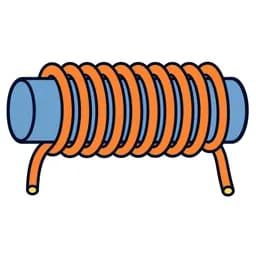
Magnetism and electricity are parts of one electromagnetic interaction. Electric current creates a magnetic field. A changing magnetic flux through a circuit induces an electromotive force, which is the operating principle of generators and transformers. Motors use forces on current-carrying conductors to convert electrical input into rotation. These connected mechanisms are developed in circuits, electric fields and electromagnetism.
Fields are models with measurable consequences, not invisible ropes. A compass maps magnetic field direction. A small test charge can define electric field strength, although the ideal test charge must be small enough not to disturb the arrangement being measured. Field lines are a drawing convention: their tangent shows direction and their spacing suggests strength, but no physical threads fill the space.
How do waves carry energy and information?
A wave is a travelling disturbance that transfers energy and information without transporting matter along the entire route. Its frequency is set by the source, its speed depends on the medium or field, and its wavelength follows from speed divided by frequency.
In a transverse wave, oscillation is perpendicular to travel, as with an ideal wave on a stretched string. In a longitudinal wave, oscillation is parallel to travel, as with sound in air. Sound consists of pressure variations moving through matter, so it cannot cross a vacuum. Electromagnetic waves are oscillations of electric and magnetic fields and can cross empty space.
A wave travelling at with frequency has wavelength .
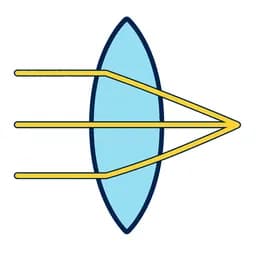
Reflection occurs when a wave returns from a boundary. Refraction is a change in direction caused by a change in wave speed, although a wave entering along the normal does not bend. Diffraction is spreading around obstacles or through openings, and it is most noticeable when the opening is comparable with the wavelength. Interference occurs where overlapping waves add by superposition.
Light can be described as a wave when explaining diffraction, interference and polarisation. Geometrical optics treats light as rays, which is efficient for mirrors, lenses and image formation. The right model depends on the scale and question. The page on wave behaviour, sound and optical systems follows these ideas into cameras, glasses, musical instruments, fibre links and medical imaging.
299,792,458 m/s The International System of Units fixes this exact value for the speed of light in vacuum, using it in the definition of the metre.
Matter responds as a solid, fluid and collection of particles
A material's behaviour depends on its particles, bonds, structure and conditions. Solids resist changes of shape, fluids flow under shear, and every material can deform, fracture, expand or change state when forces, temperature or pressure alter its internal arrangement.
Stress measures force per unit area, while strain measures fractional deformation. In the elastic region, a material returns to its original dimensions when the load is removed. Beyond that region, it may deform permanently or fail. Stiffness, strength and toughness name different properties: a stiff material resists deformation, a strong one resists failure, and a tough one absorbs substantial energy before fracture.
Microscopic structure explains why equal-sized samples can behave differently. Metals contain mobile electrons that conduct electricity and thermal energy. Ceramics often resist compression and heat but can fracture with little plastic deformation. Polymers consist of long molecular chains whose arrangement affects flexibility. The study of stress, strain and material behaviour supports decisions about bridges, sports equipment, electronic components and medical implants.
A bicycle frame should not be chosen by density alone. Designers compare stiffness, yield behaviour, fatigue resistance, joining methods, corrosion, cost and geometry. A lower-density material may require thicker tubes, so the finished structure, rather than a single material number, decides the result.
Fluids transmit pressure and move in response to pressure differences, gravity and viscosity. Pressure is force per unit area and, in a stationary fluid, increases with depth because deeper layers support more fluid above them. A hydraulic system uses pressure transmitted through a confined fluid to produce a larger output force over a larger piston area, while the larger piston moves a shorter distance.
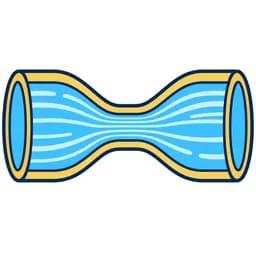
Flow brings several effects together. Continuity relates flow speed to cross-sectional area for steady incompressible flow. Viscosity resists relative motion between fluid layers. Turbulence produces irregular eddies and mixing. Buoyancy results from pressure increasing with depth, so the lower surface of an immersed object experiences a larger pressure force than the upper surface. These ideas form the basis of pressure, buoyancy and fluid flow.
Mass divided by volume. It is a property of a sample under stated conditions and helps predict buoyancy.
Normal force divided by area. In a fluid it varies with depth, motion and external conditions.
An object floats when it displaces enough fluid for the upward buoyant force to balance its weight. A steel ship can float because its hollow shape gives the whole vessel a lower average density than the solid metal and lets it displace a large volume of water. If water enters the hull, the average density rises and the available buoyancy may no longer balance the weight.
What changes when physics reaches atoms and high speeds?
Classical physics stops giving complete answers at atomic scales, at speeds near the speed of light, and in very strong gravity. Quantum theory and relativity replace familiar assumptions while preserving classical results as accurate approximations in ordinary conditions.
Quantum physics describes systems through states and probabilities. Energy is exchanged in discrete amounts in many atomic processes. Electrons in atoms occupy allowed states, and light emitted or absorbed during a transition has energy equal to the difference between those states. This produces characteristic spectra that identify elements in laboratory samples and stars.
Light behaves in ways associated with both waves and particles. A photon carries energy proportional to frequency, which explains why increasing intensity and increasing frequency have different effects in the photoelectric effect. Matter also has wave properties. These are not claims that an electron secretly switches between two everyday objects; wave functions and quantum measurements require their own mathematical rules.
For , the rest energy is about , using .
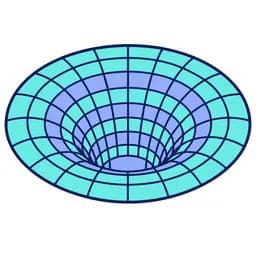
Special relativity says that measurements of time, distance and simultaneity depend on relative motion, while every inertial observer measures the same vacuum speed of light. Its effects become prominent at speeds close to that speed. General relativity describes gravity through curved spacetime and is needed for the most precise account of planetary motion, black holes and the expanding universe.
Atomic nuclei contain protons and neutrons, held by the strong interaction, while unstable nuclei can decay. Fission splits heavy nuclei and fusion joins light nuclei, with energy released when the final products have lower total mass energy. The broader treatment of quantum, nuclear and relativistic physics explains semiconductors, lasers, medical tracers, stars and particle experiments.
Physics is commonly misunderstood as formula collection
Physics is not a catalogue of equations to match with numbers. An equation states a relationship under particular assumptions, and solving a problem requires choosing a system, identifying interactions, defining directions, tracking units and checking whether the result could describe reality.
Every problem has one formula, diagrams are optional, and a calculator result is the answer.
The model comes first. Diagrams expose forces and boundaries, assumptions set the equation's range, and units and limiting cases test the result.
A sound solution starts by naming the object or system. For a falling ball, that might mean the ball alone, the ball and Earth together, or the ball plus surrounding air. Each boundary changes which transfers count as internal and which forces are external. There is no universally best boundary; there is a useful boundary for the question being asked.
State what is included, choose axes and mark the interval of interest.
Draw the forces, energy stores, rays, circuit or field relationships that govern the event.
Use equations whose assumptions fit, keep units attached and avoid rounding too early.
Check dimensions, sign, scale and behaviour in a simple limiting case.
Idealisation is another frequent source of confusion. A frictionless surface, massless string or point charge is not a claim that such an object exists. It is a controlled simplification. The model earns trust if its ignored effects are small enough for the required accuracy. When they are not, the model must be extended.
Uncertainty does not mean ignorance. A measurement reports a best estimate plus a range reflecting instrument resolution, calibration and variation. Repeated measurements help reveal random variation, while repetition alone cannot remove a consistent calibration error. Agreement should be judged against uncertainty, not by demanding identical final digits.
Mathematics is the language that keeps these relationships consistent, but physical judgement decides what to calculate. A negative velocity can indicate direction rather than an impossible speed. A negative energy may reflect the chosen zero. Meaning comes from definitions and the model, not from the sign in isolation.
Physics connects measurement to other school subjects
Physics shares tools and questions with mathematics, chemistry, biology, Earth science, computing and engineering. It supplies models of energy, forces, fields and measurement, while those subjects provide structures and systems whose behaviour cannot be explained by physical laws alone.
Mathematics expresses change through algebra, geometry, trigonometry, vectors and calculus. A graph's slope can represent velocity or electrical conductance, depending on its axes. An integral can total changing force over time or power over time. Physics gives the symbols operational definitions, which connect the calculation to an experiment.
Chemistry depends on quantum physics for electron states, bonding and spectra, and on thermodynamics for energy and equilibrium. Yet chemical explanations also track composition, reaction pathways and molecular structure. Physics can state energy constraints on a reaction without identifying every useful intermediate or predicting how a catalyst changes the route.
Biology uses diffusion, fluid flow, electricity, optics and mechanics. Nerve signals involve ion movement across membranes. Eyes form images with refracting surfaces. Blood flow depends on pressure, vessel geometry and viscosity. Living systems also involve regulation, evolution and information, so describing an organism as particles obeying forces is true but rarely sufficient.
Earth and space science combine gravitation, radiation, fluids, heat transfer and materials. Weather emerges from solar heating, rotating fluid motion, water phase changes and pressure differences. Geology adds mineral chemistry and long historical records. Astronomy extracts information from light, then uses mechanics, nuclear physics and relativity to explain what produced it.
Computing helps physicists simulate systems, control instruments and analyse measurements. Physics supports computing through semiconductor devices, electromagnetism and information carried by signals. Engineering then turns physical models into designs under constraints such as safety, cost, maintenance and manufacturing. A physically possible design can still be a poor engineering choice if it fails those constraints.
Physics turns observations into limits and predictions
The lasting strength of physics is its disciplined connection between observation, mathematical model and test. It tells us what a proposed machine must conserve, how a signal can travel, which measurements can distinguish explanations, and where an approximation will fail.
Its branches fit together through a few recurring ideas. Conservation laws track energy, momentum, charge and angular momentum. Fields describe interactions across space. Particle models link microscopic motion to pressure, temperature and material behaviour. Waves describe repeated disturbances and information transfer. Symmetry helps explain why certain quantities are conserved.
These ideas guide real decisions. A household circuit must keep current within safe limits. A bridge needs forces traced through its members and materials kept within acceptable stress. Medical images require a balance between signal quality and interaction with tissue. Climate measurements require radiation, fluid motion, energy balance and uncertainty to be handled together.
The takeaway: Physics builds testable models of matter, energy and interaction. Start with the system, identify what changes and what is conserved, then choose the branch whose model matches the scale and evidence.
A reader does not need every branch at once. A collision calls for momentum, an orbit calls for gravity, a lens calls for optics, and a power bill calls for energy and rate. The field becomes coherent when each tool is tied to the question it can answer and the conditions under which its answer is reliable.
Physics therefore offers more than calculations. It supplies a method for separating a plausible story from a prediction that can survive measurement. Its best answers state their assumptions, preserve the relevant conservation laws, include uncertainty and remain open to replacement when a better experiment reveals their limit.