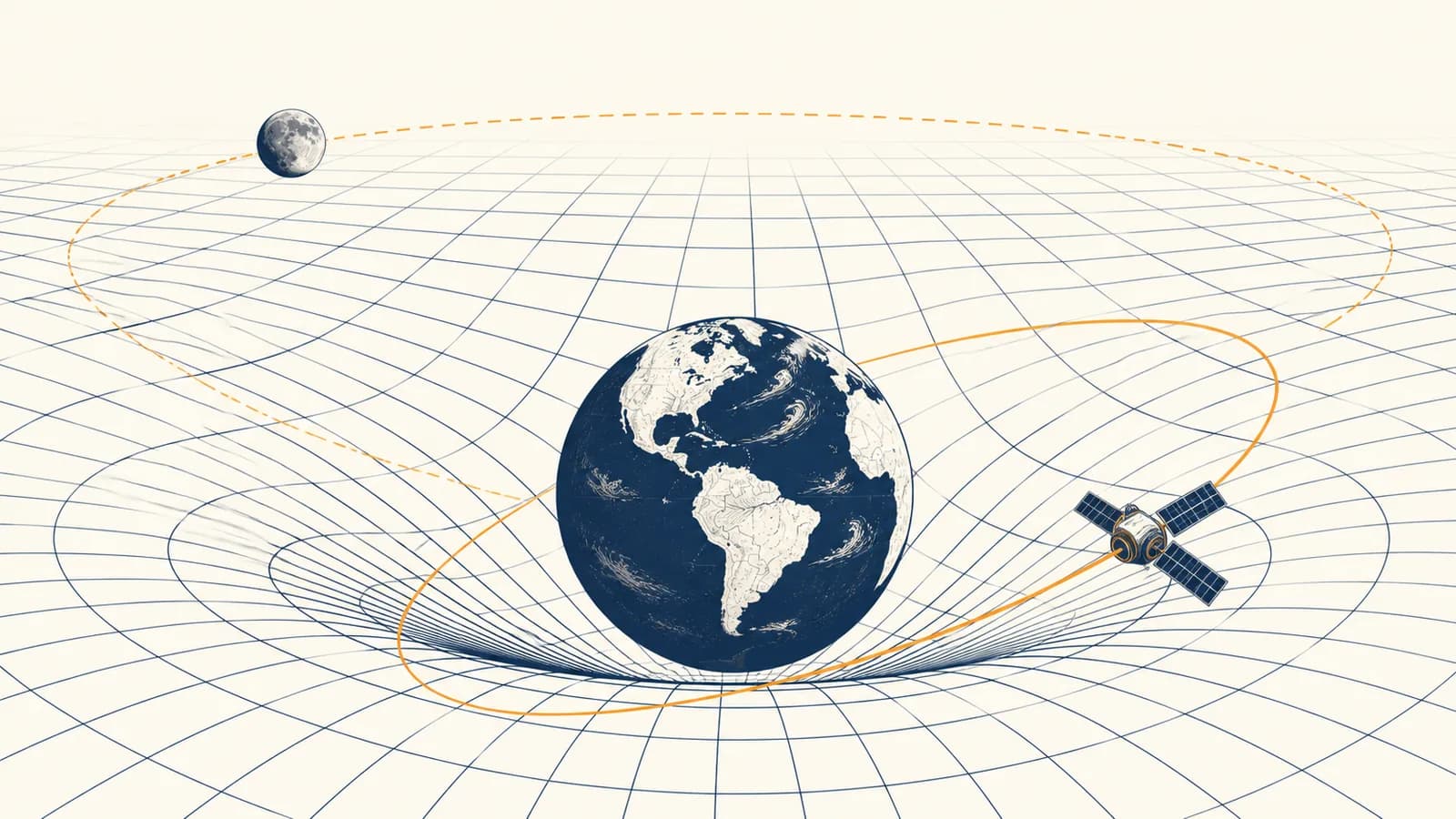
Gravitation is a fundamental interaction that makes objects with mass and energy attract one another, in the context of physics and astronomy. Gravity, gravitational force, weight, free fall, orbits, and the law of universal gravitation all describe parts of the same idea. The interaction exists because mass and energy shape how objects move through space and time. Near Earth, gravitation pulls falling objects downward and gives them weight. Across space, it holds moons, planets, stars, and galaxies in organized motion. The effect can look simple, but its strength, direction, and consequences depend on distance, mass, motion, and the model being used.
What gravitation actually is
Gravitation is the universal attraction associated with mass and energy. In Newton's model, any two masses exert equal and opposite forces on each other. In Einstein's model, matter and energy curve spacetime, and freely moving objects follow paths through that geometry.
The word universal matters. A stone attracts Earth, Earth attracts the stone, and two people standing apart attract each other. Most everyday gravitational forces between small objects are too weak to notice because gravity is much weaker than the electric forces that hold matter together. The attraction between a person and Earth is obvious because Earth has an enormous mass.
Newton's description treats gravity as a force acting along the line between two masses. It predicts falling motion, projectile paths, tides, and most spacecraft trajectories with excellent accuracy. Einstein's general theory of relativity gives a deeper description. It becomes necessary where gravity is very strong, speeds are very high, or measurements demand exceptional precision.
Masses attract through a force whose strength changes with mass and distance. This is the working model for most school problems, structures, aircraft, and satellite planning.
Mass and energy curve spacetime. Objects in free fall follow the straightest available paths in that curved geometry. This model explains effects that Newton's model cannot.
The models are not rival guesses of equal scope. Newtonian gravity is an extremely useful approximation within familiar conditions. General relativity includes a wider range of conditions and reduces to results close to Newton's when gravitational fields are weak and speeds are low compared with light.
How the law of universal gravitation works
The law of universal gravitation calculates the force between two point masses by multiplying their masses, multiplying by the gravitational constant, and dividing by the square of their separation. Greater masses strengthen the force; greater separation weakens it rapidly.
Here, is force in newtons, and are masses in kilograms, and is the distance between their centres in metres.
The gravitational constant is approximately . Its tiny numerical value helps explain why the gravitational attraction between ordinary objects is hard to detect. The constant does not tell gravity which way to act. Direction comes from the line joining the centres of the two masses.
Use kilograms. If an object is much smaller than a spherical planet, treating each as a point mass at its centre gives the correct external force for the spherical case.
Use the distance between centres, not the gap between surfaces. For an object on Earth's surface, this distance is approximately Earth's radius.
Square the separation before dividing. Doubling the separation makes the force one quarter as large, while tripling it makes the force one ninth as large.
Each body is pulled toward the other. The forces have the same size and opposite directions, even if their resulting accelerations differ greatly.
Consider two masses of whose centres are apart. The force is . That is far below what a hand can sense. Replace one mass with a planet, however, and the product of the masses becomes vast.
The inverse square comes from geometry. At a distance , a spherical surface has area . A spherically spreading gravitational field is distributed over surfaces whose areas grow with , so field strength falls in the same proportion.
What a gravitational field actually is
A gravitational field assigns a force per unit mass to every position around a source mass. It describes what acceleration a small test object would have there, without requiring that the test object already be present.
Field strength is written and measured in newtons per kilogram. Since , the same number also describes free-fall acceleration. Around an isolated spherical mass, the field points inward toward the centre.
A test mass cancels from the calculation, so all freely falling test objects at the same location have the same acceleration if air resistance is absent.
Near Earth's surface, field strength is commonly approximated as . Its exact local value varies slightly with altitude, latitude, Earth's rotation, and nearby geology. Many school calculations round it to or even , but the chosen approximation should be stated.
Fields combine as vectors. The gravitational field at a point between Earth and the Moon is the vector sum of Earth's field and the Moon's field. At one location along the line between them, the two contributions can have equal magnitudes and opposite directions. That does not mean gravity has vanished everywhere nearby. A small displacement changes both contributions.
Field strength depends on location, not on the falling object's mass. A heavier object feels a larger gravitational force, but it also has proportionally more inertia, so its free-fall acceleration is unchanged.
Field diagrams use arrows to show direction and relative strength. Closely spaced field lines represent a stronger field, but the lines are a drawing convention, not physical threads. The broader study of forces and motion appears in the guide to Newton's laws and motion, where gravitational force becomes one input to a complete force diagram.
How gravity turns mass into weight
Weight is the gravitational force acting on an object, while mass measures the object's inertia and amount of matter. Mass stays nearly constant when location changes; weight changes whenever the local gravitational field strength changes.
For a person where , .
A bathroom scale usually reports kilograms, but it does not directly measure mass. It measures the support force between the scale and the person, then converts that reading using an assumed value of . If the person stands still on a level floor, the upward support force matches weight, so the conversion works.
An elevator begins accelerating upward. The floor must push on a passenger with a force greater than the passenger's weight, so the scale reading rises. When the elevator accelerates downward, the support force and scale reading fall. The passenger's mass and Earth's pull have barely changed.
This distinction explains apparent weightlessness. An astronaut in orbit still experiences strong terrestrial gravity. The astronaut and spacecraft fall together with the same acceleration, so the floor does not need to support the astronaut. A scale between the astronaut and floor would read zero even though gravitational force remains.
Measured in kilograms. It resists acceleration and acts as a source of gravitation. Ordinary travel between Earth, the Moon, and orbit does not change it.
Measured in newtons. It is the gravitational force . Its value depends on the field strength at the object's location.
How free fall and projectiles work
Free fall is motion under gravity alone. Near Earth's surface, an object in free fall accelerates downward at almost constant ; a projectile combines this vertical acceleration with horizontal motion that continues through inertia.
If an object starts from rest and air resistance is negligible, its downward speed after time is , and its distance fallen is . After using , it has fallen and reached .
A horizontal launch does not delay gravity. Drop one ball while launching another horizontally from the same height, and both have the same vertical acceleration. With a level landing surface and negligible air resistance, they reach the ground together. The launched ball travels farther sideways because it also has horizontal velocity.
The curved path of a projectile is a parabola only under the usual near-surface assumptions: constant downward gravitational acceleration, flat ground coordinates, and negligible drag. Over much greater distances, Earth's curvature and the changing direction of gravity matter.
Air resistance changes real falls. Drag depends on shape, area, air density, and speed. A crumpled paper ball can fall faster than a flat sheet even though both have almost the same gravitational acceleration. The difference comes from drag relative to mass, which is why vacuum demonstrations are so useful. The pressure and flow behind drag connect gravitation to how fluids exert forces on moving objects.
How an orbit works
An orbit is continuous free fall in which an object's sideways motion carries it around a curved body as gravity bends its path inward. The object keeps missing the surface instead of escaping gravity or hovering beyond its reach.
Imagine launching an object horizontally from high above the atmosphere. A slow launch reaches the ground nearby. A faster launch travels farther before impact. At a particular speed, the surface curves away at the same rate that the object falls, so the path closes around Earth.
This follows by setting gravitational acceleration equal to circular acceleration .
A higher circular orbit has a larger radius and a lower orbital speed. It also takes longer to complete a circuit. This can feel backward because climbing usually suggests gaining speed, but an orbit is a balance between sideways motion and inward acceleration. A satellite moved to a higher circular orbit gains gravitational potential energy while settling into a slower circular speed.
Most orbits are ellipses rather than perfect circles. In an elliptical orbit, an object moves fastest when closest to the body it orbits and slowest when farthest away. Total mechanical energy remains constant if no engines, drag, or other bodies add significant effects. Kinetic energy and gravitational potential energy trade back and forth.
Orbit does not mean no gravity. At the altitude of many artificial satellites, gravity is still the force continually turning the satellite's velocity. Without it, the satellite would move along a straight tangent.
Engineers do not normally point a rocket straight at a final orbit and stop. A rocket first gains altitude and substantial sideways speed. Later burns change the orbit by changing velocity. Mission planners calculate these burns using conservation laws, gravitational models, atmospheric constraints, and the motion of the destination.
Gravitational force versus gravitational potential energy
Gravitational force describes the instantaneous pull and its direction, while gravitational potential energy describes energy stored by an arrangement of masses. Moving masses farther apart can increase potential energy even as the attractive force becomes weaker.
Near Earth's surface, a useful approximation is . Raising a object by with increases its gravitational potential energy by . If it then falls without losses, that energy becomes kinetic energy.
For large changes in distance, the constant approximation fails. The general Newtonian expression for two point masses is:
The zero is chosen at infinite separation. At every finite separation, the energy is negative because work must be supplied to separate the masses completely.
The negative sign records a bound system, not a negative amount of motion. A satellite in a stable orbit has positive kinetic energy and negative gravitational potential energy. For a circular orbit, its total mechanical energy is negative. An escaping object has enough total energy to reach an indefinitely large distance without falling back.
Escape speed at distance from a spherical mass is , assuming no atmosphere and no further propulsion. It is a speed condition, not a demand for a particular upward direction. Air resistance and the need to avoid the ground make real launches more complicated.
Energy accounting also explains hydroelectric generation, pendulums, roller coasters, and falling water. Gravity transfers energy, while turbines or other devices convert some of it into useful forms. Heat produced by friction remains in the accounting because it is an energy transfer, not a disappearance of energy.
How gravitation shows up in tides, engineering, and measurement
Gravitation appears in daily systems through weight, changing water levels, structural loads, surveying, timekeeping, and navigation. Engineers and scientists use local gravitational acceleration, potential differences, and orbital models rather than treating gravity as one fixed downward number.
Tides come from differences across Earth
Tidal effects are caused by differences in gravitational pull across an extended body. The side of Earth nearer the Moon is attracted slightly more strongly than Earth's centre, while the far side is attracted slightly less strongly. Relative to Earth's centre, these differences produce two broad tidal bulges.
The Sun also raises tides. Lunar and solar tidal effects reinforce near new moon and full moon, producing spring tides. They partly oppose near the quarter moon phases, producing neap tides. Coastlines, seabed shape, water depth, and basin resonance then determine the actual time and height of tides at a port, so a simple bulge picture cannot replace local tide tables.
Structures carry gravitational loads
Buildings, bridges, shelves, cranes, and aircraft must support weight. Engineers trace loads through beams, columns, cables, joints, and foundations. A designer distinguishes permanent loads such as the structure's own weight from changing loads such as occupants, stored goods, rainwater, or vehicles.
Gravity also drives slopes and flows. Soil can fail when downhill components of weight exceed friction and cohesion. Water pressure increases with depth because lower layers support the weight of water above. The material response to these loads depends on stiffness, strength, density, and fracture behavior, topics treated in the guide to how materials respond to forces.
Gravity reveals what cannot be seen directly
Surveyors and geophysicists can measure small variations in gravitational field strength. Dense rock, underground cavities, changes in elevation, and the shape of Earth all affect a reading. Interpreting those changes requires corrections and models because several causes can produce similar signals.
A weighing instrument can also measure mass by comparison. Laboratory balances compare an unknown mass with calibrated standards or infer mass from a force under controlled local gravity. Precision work must account for buoyancy in air, vibration, temperature, and instrument calibration as well as gravitation.
Navigation satellites depend on more than orbital mechanics. Their atomic clocks tick at rates affected by both their motion and their position in Earth's gravitational field. Satellite navigation systems apply relativistic corrections; without the correct clock model, timing and position errors would accumulate.
3 mistakes people make with gravity
Common errors treat gravity as absent in orbit, confuse mass with weight, or assume a larger gravitational force always means a larger falling acceleration. Each mistake disappears once force, inertia, field strength, and support force are kept separate.
1. “There is no gravity in space”
Gravity extends through space and never reaches a sharp cutoff in Newton's model. It weakens with distance. Astronauts float in an orbiting craft because they and the craft are falling together, not because Earth's gravitational field has ended.
A spacecraft rises beyond the atmosphere, leaves gravity behind, and then floats.
The spacecraft gains enough sideways speed to keep falling around Earth. Gravity supplies the inward acceleration required by the orbit.
2. “Heavier objects must fall faster”
In a vacuum at the same location, objects with different masses have the same free-fall acceleration. A heavier object has more gravitational force on it, but it has proportionally greater inertia. In air, unequal drag can produce different observed accelerations and terminal speeds.
3. “The force on the smaller body is larger”
Earth pulls a falling apple with exactly the same force magnitude that the apple pulls Earth. Their accelerations differ because . Earth's enormous mass makes its acceleration toward the apple immeasurably small in an ordinary observation.
Equal force does not mean equal motion. The same interaction force acts on each body, but acceleration depends on each body's own mass.
How strong is gravity on other worlds?
Surface gravity on another world depends on that world's mass and radius through . A more massive world does not automatically have stronger surface gravity because a larger radius places the surface farther from its centre.
For the Moon, standard reference values give a surface gravitational acceleration of about , roughly one sixth of Earth's usual near-surface value. A person therefore still has a mass of on the Moon but weighs about , compared with about using on Earth.
There is no ordinary solid surface on a gas giant, so a quoted “surface gravity” needs a defined reference level, commonly a level in the atmosphere. Rotation can also reduce apparent weight, especially near an equator, because the ground and observer follow a curved path around the rotation axis.
Can gravity be blocked, reversed, or switched off?
No known material shields ordinary gravity, and gravity cannot be switched off with a barrier. Its effect can be balanced by another force, or its felt support force can vanish during free fall, but the gravitational interaction remains.
A table prevents a book from falling by exerting an upward contact force equal to the book's downward weight. A magnet can suspend a suitable object by supplying an electromagnetic force. Buoyancy can support a balloon because the surrounding fluid has a pressure gradient. None of these cases blocks Earth's field.
Rotating spacecraft are sometimes described as making artificial gravity. Rotation does not create a new gravitational attraction. The wall pushes occupants inward to keep them moving in circles, and occupants interpret the resulting support force as weight. The effect can be useful because human bodies respond to support and loading even when the cause is rotation.
Gravitation connects motion on Earth with motion across the universe
Gravitation unifies falling objects, weight, projectiles, tides, planetary systems, and the large-scale structure of space through rules that can be calculated and tested. Its clearest lesson is that the same interaction can produce very different motion under different conditions.
How did Newton and Einstein change the explanation?
Newton turned terrestrial falling and celestial motion into one quantitative law, while Einstein replaced instantaneous gravitational force with curved spacetime governed by matter and energy. Newton predicts most ordinary motion; Einstein explains additional observations and precision effects.
Newton's Principia presents laws of motion and universal gravitation, connecting falling objects, the Moon, and planetary paths through one mathematical framework.
Einstein's theory describes gravitation through spacetime geometry and accounts for the unexplained part of Mercury's orbital precession.
Measurements of apparent star positions near the eclipsed Sun support the prediction that gravitation bends the path of light.
General relativity predicts gravitational time dilation: clocks deeper in a gravitational field tick more slowly relative to clocks higher up, once they are compared in a defined way. It also predicts gravitational waves, travelling changes in spacetime geometry produced by accelerating masses with changing mass distributions.
Black holes are regions where spacetime is curved so strongly that, beyond an event horizon, no future-directed path leads back out. They do not vacuum up everything indiscriminately. Far from a spherically symmetric body, the external gravitational effect depends on its total mass, so replacing the Sun with a black hole of the same mass would not make Earth's orbit suddenly plunge inward. The loss of sunlight would be another matter.
Newtonian calculations remain standard because they are simpler and sufficiently accurate for many tasks. A good physical model is chosen by scale and required precision. The same habit applies across the wider collection of physics explanations and applications: state the system, identify the interactions, select an adequate model, and check the result against reality.
The next time a lift starts, rain falls, the Moon changes the tide, or a navigation app finds a position, identify what gravity is doing. Ask which mass creates the dominant field, what forces oppose weight, and whether the object is supported or freely falling. For an orbit, look for sideways velocity as well as inward acceleration. For a scale reading, separate support force from mass.
The takeaway: Gravitation is universal attraction, but its visible result depends on distance, inertia, motion, and other forces. Use for the interaction, for the field, and for weight, then test which assumptions the situation permits.
That routine turns gravity from a vague downward pull into a working part of physics. It lets you predict a fall, explain weightlessness, estimate energy changes, and understand why a satellite can remain above Earth while continually falling toward it.