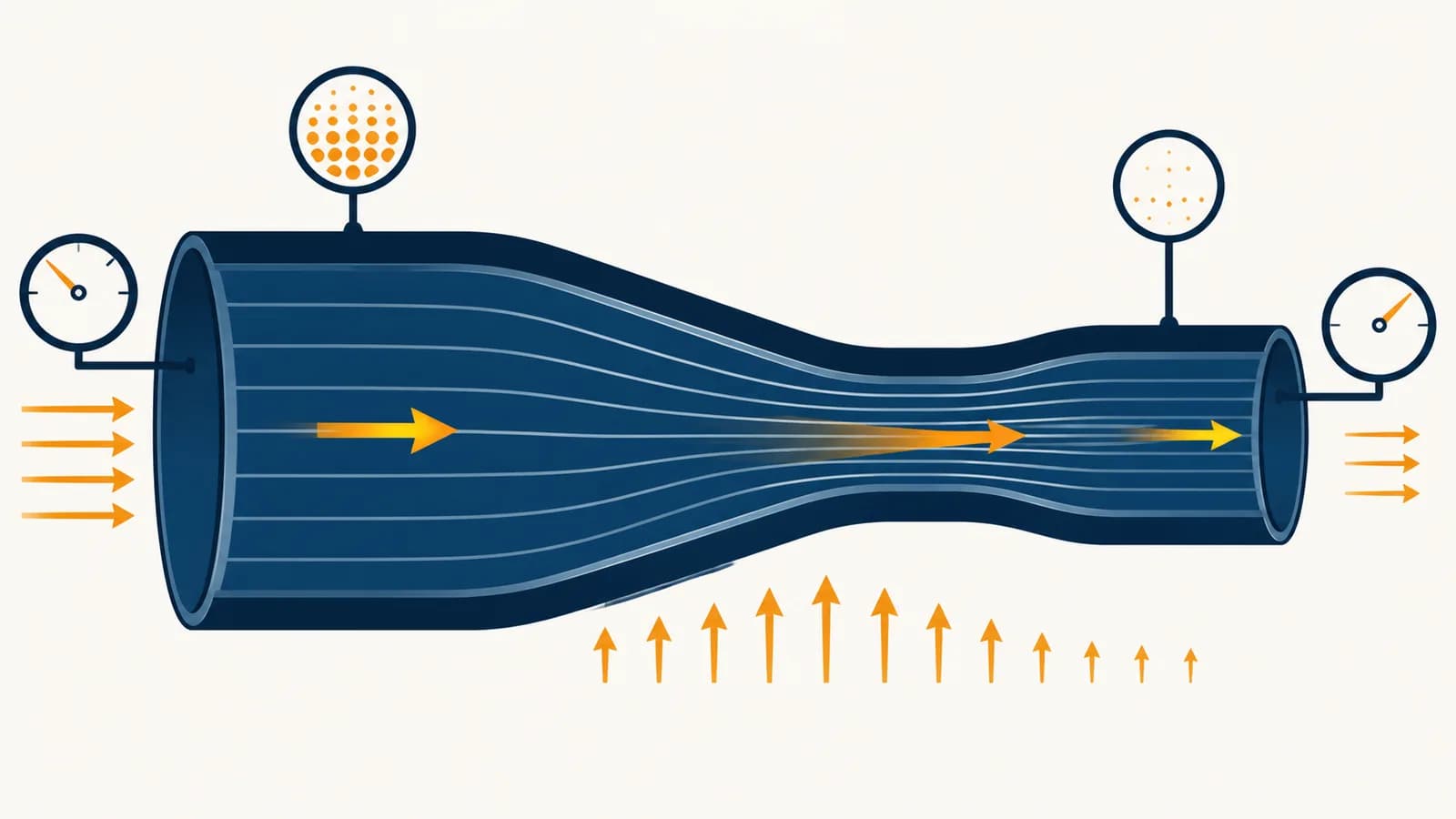
Fluid mechanics is a branch of physics that explains how liquids and gases respond to force, pressure, and motion, in the context of fluids at rest and in motion. It answers the practical questions behind fluid pressure, buoyancy, viscosity, airflow, water flow, lift, drag, and turbulence. The subject exists because fluids carry force, energy, heat, and matter through systems that range from blood vessels to storm clouds. A fluid can push on a wall while apparently still, or accelerate through a narrowing pipe while its pressure changes. The same few conservation laws connect those effects, which makes fluid mechanics useful in engineering, medicine, weather forecasting, transport, and ordinary decisions such as choosing a pump or understanding why an object floats.
What a fluid actually is
A fluid is a material that continuously changes shape under any sustained shear force, however small that force is. Liquids keep nearly fixed volumes, while gases expand to fill their containers, but both flow because their particles can move past one another.
A force can act perpendicular to a surface or along it. The perpendicular part creates normal stress, which is experienced in a fluid as pressure. The parallel part creates shear stress. A solid can hold a static shear stress by deforming slightly and then stopping. A fluid cannot. If the shear continues, the fluid continues to deform.
A rubber block pushed sideways changes shape and can settle into a new static shape while resisting the push.
Oil between sliding plates keeps changing shape for as long as one plate moves relative to the other.
Liquids and gases differ mainly in compressibility and free surfaces. A liquid is usually treated as nearly incompressible in ordinary flows, so a given mass occupies almost the same volume as pressure changes. A gas is readily compressed because its molecules are much farther apart. A liquid in an open cup forms a surface against the air. A gas has no comparable boundary inside its container.
The basic quantity connecting mass and volume is density.
A 2.0 kg sample occupying 0.0020 m³ has density 1,000 kg/m³.
Density tells you how much inertia and weight are packed into a volume. It does not tell you how easily the fluid flows. Honey and water can have comparable densities while moving very differently because viscosity, not density, controls resistance to shear.
How pressure works
Fluid pressure is normal force divided by area, and at a point in a fluid at rest it acts equally in every direction. Pressure rises with depth because lower layers must support the weight of the fluid above them.
A 200 N normal force spread over 0.010 m² produces 20,000 Pa of pressure.
The SI unit of pressure is the pascal, equal to one newton per square metre. The same force produces more pressure when concentrated on a smaller area. This is why a narrow hydraulic piston can create useful pressure with a modest input force.
In a stationary fluid of uniform density, a thin horizontal layer is in vertical balance. Pressure pushing upward on its bottom must exceed pressure pushing downward on its top by enough to support the layer's weight. Adding many layers gives the hydrostatic relation.
Five metres below a water surface, the pressure above surface pressure is about .
The depth matters, not the container's shape. At the same depth in connected stationary water, the pressure is the same. A narrow tube and a wide tank can therefore have equal bottom pressure even though the tank holds much more water. The tank does exert more total force on a broad floor because that pressure acts over a larger area.
Gauge pressure is not absolute pressure. A tyre gauge reports pressure above the surrounding atmosphere. Absolute pressure includes atmospheric pressure and cannot fall below zero.
Pascal's principle says that a pressure change applied to a confined fluid is transmitted throughout the fluid. In a hydraulic lift, equal pressure acts on pistons of different areas. If the output piston has ten times the area, it produces ten times the force. It also moves one tenth as far when fluid volume is conserved, so the machine does not create energy. It trades distance for force, just like other simple machines described through force and motion in Newtonian mechanics.
How buoyancy works
Buoyancy is the upward force caused by fluid pressure being greater on the lower surface of an immersed object than on its upper surface. Its magnitude equals the weight of the fluid displaced by the object.
Pressure increases with depth, so the bottom of a submerged block receives a stronger upward push than the top receives downward. Sideways pressure forces cancel when the shape and fluid are symmetric. Adding the pressure forces across any fully or partly immersed shape leads to Archimedes' principle.
An object displacing 0.0020 m³ of water receives about upward.
An object sinks if its weight exceeds the maximum buoyant force available when fully submerged. It floats if it can displace its own weight of fluid before becoming fully submerged. Average density is therefore more useful than material density for hollow objects. A steel ship floats because the steel hull encloses air, making the ship's total mass divided by its total volume less than the density of water.
A cargo ship sits lower after loading. Its weight has increased, so equilibrium requires a larger buoyant force. The hull sinks until the added underwater volume displaces water whose added weight matches the cargo's weight.
Floating stability is a separate question from floating ability. When a boat tilts, the shape of its displaced volume changes, shifting the line through which buoyancy acts. If buoyancy creates a restoring torque, the boat tends to right itself. If it creates a torque in the same direction as the tilt, capsizing can follow.
How fluid motion is described
Fluid motion is described by assigning velocity, pressure, density, and temperature to locations in space and tracking how those fields change with time. A useful flow description separates the path of one particle from the pattern formed by many particles.
A streamline is a curve tangent to the local velocity direction at one instant. Fluid does not cross a streamline at that instant. A pathline is the actual route taken by one marked particle. In steady flow, where conditions at each location do not change with time, streamlines and pathlines coincide. In unsteady flow they can differ.
Volume flow rate measures how much volume crosses a section each second. For uniform speed perpendicular to an area, it is the area multiplied by speed.
Water moving at 2.0 m/s through a 0.0030 m² opening has a flow rate of 0.0060 m³/s.
Real velocity often varies across a pipe. Fluid at a solid wall normally matches the wall's velocity, a condition called no slip. In a stationary pipe, speed is zero at the wall and greater toward the centre. The more general flow calculation adds the contributions from all small pieces of the cross-section rather than using one speed everywhere.
Rotating flow can also be measured. Vorticity describes the local spinning tendency of a fluid element. A visible curved path does not always mean strong local rotation, and a tiny paddle wheel is a better mental test: if it spins as it travels, the flow has vorticity there.
Viscosity versus density
Density measures mass per volume, while viscosity measures a fluid's resistance to layers sliding past one another. A dense fluid is not automatically viscous, and a viscous fluid is not automatically dense because the properties describe different physical responses.
For a Newtonian fluid, shear stress is proportional to how quickly velocity changes across neighboring layers. The dynamic viscosity is the constant of proportionality.
If adjacent layers differ in speed by 3 m/s across 0.002 m, the velocity gradient is 1,500 s⁻¹.
A high dynamic viscosity means a larger shear stress is needed to maintain the same velocity gradient. Water and air are often modeled as Newtonian over ordinary conditions. Ketchup, paint, blood, and mixtures containing long molecules or suspended particles can behave as non-Newtonian fluids. Their apparent viscosity may change with shear rate or with the time spent shearing.
How much mass occupies this volume, and therefore how much inertia or weight does it carry?
How strongly does the fluid resist neighboring layers moving at different speeds?
Temperature affects viscosity, but liquids and gases respond differently. Heating a typical liquid weakens the effect of intermolecular attractions and lowers its viscosity. Heating a gas increases molecular momentum exchange between layers and raises its dynamic viscosity. Temperature also changes density and can create convection, linking fluid motion with the physics of heat, temperature, and engines.
How conservation laws control flow
Fluid motion is governed by conservation of mass, momentum, and energy. These laws connect conditions at different places: mass cannot vanish in a pipe, forces change momentum, and pressure or height energy can become motion, heat, or mechanical work.
Draw an imaginary boundary around the pipe section, nozzle, turbine, wing, or region of air being studied.
Track mass, momentum, and energy entering and leaving through every opening.
Include accumulation inside, pressure and body forces, heat transfer, and mechanical work as the situation requires.
Steady, incompressible, inviscid, or one-dimensional are useful only when the actual flow makes them reasonable.
Mass conservation sets the continuity relation
Mass conservation requires the mass flow entering a steady one-inlet, one-outlet device to equal the mass flow leaving it. The mass flow rate is density times area times average speed.
For incompressible flow, halving a pipe's area doubles the average speed because density stays constant.
Diameter and area must not be confused. Since circular area is proportional to diameter squared, halving the diameter makes the area one quarter as large. Under the same steady incompressible flow rate, the average speed becomes four times as large.
Momentum conservation connects forces to turning and acceleration
Momentum conservation says that the net external force on a control volume equals the rate at which momentum changes inside plus the net momentum carried out. A jet that speeds up or turns must experience a force, and it exerts an equal opposite force on the nozzle or blade.
A garden hose pushes backward when it sends water forward. A curved pipe needs supports because turning the flow changes its momentum even if its speed stays constant. Jet engines, propellers, sprinklers, and turbine blades all rely on this force and momentum exchange.
Energy conservation produces Bernoulli's relation under strict conditions
Bernoulli's equation states that pressure energy, kinetic energy, and gravitational potential energy per unit volume remain constant along a streamline for steady, incompressible, nonviscous flow with no added or removed shaft work.
At equal height, an ideal flow that speeds up from 2 m/s to 4 m/s loses pressure equal to Pa.
Bernoulli's equation is an energy statement, not a universal rule that fast fluid always has low pressure. A pump can raise both speed and pressure by adding energy. Friction can reduce pressure along a constant-width pipe even if average speed hardly changes. Comparing two points is valid only after checking the assumptions and accounting for pumps, turbines, and losses. This accounting also connects to how energy transfer determines power requirements.
How fluid mechanics shows up in pipes, bodies, and flight
Fluid mechanics turns pressure differences and moving mass into practical predictions for plumbing, blood circulation, vehicles, weather, and machines. The same balances apply in each setting, but geometry, viscosity, compressibility, and flow regime decide which effects dominate.
Pipes trade pressure for flow and friction
A pump creates a pressure increase that drives fluid through a system. Viscous shear at the walls removes mechanical energy from the organized flow and converts it into internal energy. Longer pipes, rougher walls, sharper fittings, and higher speeds usually demand a larger pressure difference.
For steady laminar flow of a Newtonian fluid through a straight circular pipe, the Hagen-Poiseuille relation reveals an unusually strong radius effect.
With pressure difference, viscosity, and length fixed, doubling the radius multiplies flow rate by .
The fourth-power result does not apply to every pipe flow. It assumes a straight, rigid, circular tube and fully developed laminar motion. Turbulence, flexible walls, entrances, bends, branching, and non-Newtonian behavior require other models. Still, it explains why a small narrowing can greatly increase resistance in a suitable laminar system.
Blood flow couples a pump to flexible branching tubes
The heart supplies pressure and flow to an elastic network. Blood vessels stretch, branch, narrow, and actively change diameter. Blood also contains cells, so treating it as a simple Newtonian fluid can fail in small vessels or low-shear conditions.
A blood-pressure cuff does not directly watch individual cells move. It applies external pressure to an artery and uses changes in flow or cuff oscillation as cuff pressure is released. The measurement is reported as pressure, while the biological result depends on the interaction among heart action, vessel resistance, elasticity, and total circulation.
Wings and vehicles exchange momentum with fluid
A wing produces aerodynamic force by changing the pressure and shear-stress distribution over its surface while turning air. The force component perpendicular to the incoming flow is lift, and the component parallel to it is drag. Angle, shape, speed, air density, viscosity, and flow separation all matter.
Pressure and momentum descriptions are two views of the same interaction. Integrating surface pressure and shear gives the force on the wing. Examining a large region around it shows air leaving with changed momentum. Neither view requires the claim that two parcels split at the front edge and must reunite at the rear edge. They do not have to take equal travel times.
Weather begins with density differences in a gravitational field
Sunlight heats Earth's surface unevenly, and surfaces transfer heat to nearby air. Warmer air often becomes less dense at similar pressure, while gravity and surrounding pressure gradients influence its motion. Earth's rotation, water phase changes, terrain, and friction then shape the flow into winds, clouds, fronts, and storms.
Weather models divide the atmosphere into many computational cells and advance equations for mass, momentum, energy, and water content. They cannot track every eddy or droplet. Measurements set the starting state, while numerical approximations and smaller-scale models estimate changes the grid cannot resolve directly.
Four mistakes people make with fluid mechanics
Most fluid-mechanics errors come from applying a correct equation outside its assumptions or confusing pressure, speed, force, and flow rate. Four recurring mistakes can be prevented by defining the system, checking units, and stating what is being conserved.
1. Treating pressure as total force
Pressure is force per area, so equal pressure on unequal areas produces unequal forces. A hydraulic system can multiply force because the larger piston supplies more area, while its shorter travel preserves volume and energy after losses are included.
2. Assuming faster flow must always mean lower pressure
Bernoulli's relation can connect higher speed with lower pressure along a suitable streamline at equal height, but only when its assumptions hold and no device adds energy. A fan, pump, viscous loss, unsteady flow, or comparison across unrelated streamlines changes the analysis.
Speed alone determines pressure everywhere in a moving fluid.
Pressure follows momentum and energy balances together with height, density, viscosity, geometry, and any added work.
3. Using displaced object volume for every floating calculation
A floating object usually displaces only the submerged part of its volume. Its buoyant force equals its weight in equilibrium. The full object volume is used only when the object is fully submerged, and even then other forces such as a tether can affect equilibrium.
4. Ignoring scale and units
A water model of an aircraft does not automatically reproduce the aircraft's airflow. The important ratios of inertial, viscous, gravitational, and compressibility effects must be comparable. Unit checks catch simpler failures: density is mass per volume, pressure is force per area, and flow rate is volume per time.
What changes when flow becomes turbulent
Turbulent flow contains irregular, interacting motion across many length and time scales, so velocity and pressure fluctuate even when the average flow is steady. It mixes momentum, heat, and material more rapidly than an otherwise comparable laminar flow.
Laminar flow moves in smooth, orderly layers. Turbulence develops when disturbances grow instead of being damped by viscosity. The Reynolds number compares inertial effects, which tend to carry and amplify motion, with viscous effects, which tend to smooth velocity differences.
Doubling speed doubles Reynolds number when density, length, and dynamic viscosity stay fixed.
There is no single Reynolds number that separates laminar and turbulent flow in every geometry. In a long straight circular pipe with controlled inlet conditions, flow below roughly 2,300 is commonly laminar, flow above roughly 4,000 is commonly turbulent, and the interval between is transitional. Surface roughness and incoming disturbances influence when transition occurs.
Turbulence raises mixing and often raises drag or pumping losses. It can also be useful. Mixing fuel and air supports combustion, turbulent heat transfer cools machinery, and small dimples on a golf ball alter the boundary layer and delay large-scale separation over part of the surface. Engineers do not simply try to remove turbulence. They manage where it forms and what it does.
How compressible flow changes the rules
Compressible flow is motion in which density changes are large enough to affect the result. It is central to fast gas flow, sound, nozzles, shocks, compressors, and explosions, while many slower liquid flows can treat density as nearly constant.
In an incompressible flow, continuity changes speed mainly through area. In a compressible gas, density can change too, so area, speed, pressure, and temperature become coupled. A narrowing passage can accelerate a subsonic gas, but the behavior near and above sound speed requires compressible energy and momentum relations.
Mach number compares flow speed with local sound speed. . The sound speed depends on the medium's state, so Mach 1 is not one universal speed under all conditions.
A sound wave is a moving pattern of compression and expansion. Fluid particles oscillate around their local positions while the disturbance carries energy. A shock wave is different: pressure, density, and temperature change sharply across a thin region, and entropy increases. Treating a shock with incompressible Bernoulli theory gives the wrong answer.
Compressibility also matters in slower systems when a gas pocket is compressed, as in a syringe with trapped air, and during rapid liquid events such as water hammer. Closing a valve suddenly sends a pressure disturbance through the pipe because the moving liquid and pipe walls are not perfectly rigid. The resulting forces can damage plumbing.
How surface tension controls small fluid systems
Surface tension is the surface energy required per unit area created, or equivalently the force per unit length acting along a surface. It becomes especially influential for droplets, bubbles, narrow tubes, insects, and porous materials.
Molecules within a liquid are surrounded by neighboring molecules, while molecules at the surface have a different molecular environment. Creating more surface requires energy. The surface therefore tends to reduce its area, which is why a freely suspended small droplet tends toward a sphere, the shape with the least area for a given volume.
A curved interface supports a pressure difference. Smaller droplets and bubbles require larger pressure differences for the same surface tension because their curvature is greater. Soap lowers water's surface tension and stabilizes thin films through additional molecular effects, which helps water spread and lets bubbles persist.
Place one drop of water on clean glass and another on a waxed surface. The balance among liquid cohesion and attraction to the solid changes the contact angle. The drop spreads more where attraction to the surface is stronger relative to its tendency to contract.
Capillary action occurs when surface forces and pressure differences pull a liquid through a narrow space while gravity opposes or assists the motion. Water rises in a thin glass tube when it wets the glass. Mercury behaves differently in glass because the balance of cohesive and adhesive interactions produces a different contact angle. Paper towels, soil, plant tissues, ink channels, and some medical tests all use flow through small pores or channels.
Fluid mechanics makes the rest of physics visible
Fluid mechanics makes forces, energy transfer, material properties, and conservation laws visible as jets, vortices, waves, pressure changes, and floating motion. Observing one fluid system carefully is a practical way to connect equations with measurable behavior.
Watch water leave a tap. At low flow it can form a smooth stream. Increase the rate and fluctuations grow. Notice that the falling stream narrows as gravity speeds it up: for nearly steady incompressible flow, the same volume must pass each cross-section each second, so greater speed requires smaller area. Put a spoon into the stream and feel momentum change as water turns.
Then choose one boundary and account for it. Mark what mass enters and leaves. Identify pressure forces, gravity, and wall shear. Ask where energy enters, where it becomes motion, and where viscosity converts it into internal energy. This habit connects fluid mechanics with the wider set of physics ideas and applications.
The takeaway: A fluid's behavior is not a collection of unrelated effects. Pressure, buoyancy, lift, pipe flow, turbulence, and surface tension follow from forces, material response, geometry, and conservation laws applied at the right scale.