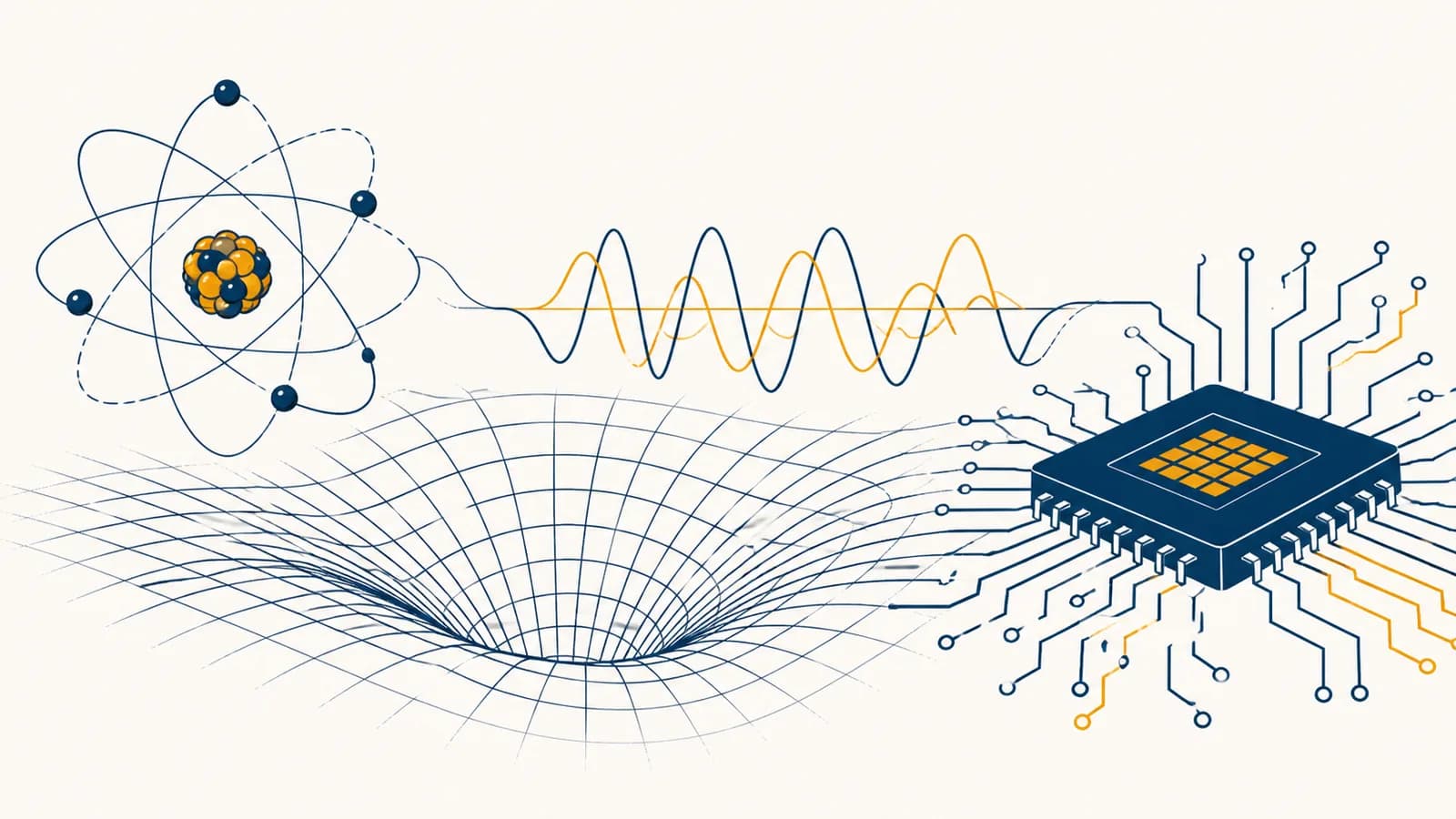
Modern physics is a branch of physics that explains matter, energy, space, and time where classical laws stop giving accurate predictions, especially at atomic scales, near light speed, and inside nuclei. Its main frameworks are quantum mechanics, special relativity, general relativity, atomic physics, and nuclear physics. They account for photons, wave-particle duality, radioactive decay, and the relation between mass and energy. Modern physics exists because experiments exposed effects that Newtonian mechanics and classical electromagnetism could not explain.
What modern physics actually is
Modern physics is the set of theories developed to describe phenomena that classical physics misses, including quantized energy, probabilistic measurement, relativistic time, curved spacetime, and changes within atomic nuclei. It does not replace classical physics everywhere. It identifies classical physics as a highly useful approximation.
The word modern refers mainly to ideas that began reshaping physics around the start of the twentieth century. It does not mean every recently discovered fact. The decisive change was a new set of rules for scales and speeds far outside ordinary human experience.
Max Planck finds that a successful model of thermal radiation requires energy to be exchanged in discrete amounts.
Space and time become linked, and the measured speed of light remains the same for every inertial observer.
Gravity becomes the geometry of spacetime rather than a force transmitted instantly across distance.
Wave mechanics and matrix mechanics produce testable predictions for atoms, radiation, and measurement.
These theories cover different conditions. Quantum mechanics governs very small systems, although its consequences can appear in large devices. Special relativity matters when relative speeds approach the speed of light. General relativity matters when gravity is intense or extremely precise timing is required. Nuclear physics handles changes in atomic nuclei.
299,792,458 metres per second The SI definition fixes the speed of light in vacuum at this exact value. Relativity treats that speed as the same for all inertial observers.
The theories also overlap. A particle accelerator requires quantum physics to predict particle interactions and relativity to connect energy, momentum, and speed. A star needs nuclear physics for its energy source, quantum physics for the behavior of its particles, and relativity when its gravity becomes extreme.
Classical physics versus modern physics
Classical physics predicts continuous motion, fields, heat, fluids, and waves at ordinary scales, while modern physics handles quantized interactions, relativistic motion, and nuclear change. Classical laws remain accurate when objects are large, speeds are low compared with light, and gravitational fields are modest.
An object has a definite position and velocity. Energy can vary continuously. Time passes at the same rate for everyone. A wave and a particle are distinct kinds of thing.
A quantum state supplies probabilities for possible outcomes. Bound systems have allowed energy levels. Measured time depends on motion and gravity. Matter and radiation show both wave-like and particle-like behavior.
The dividing line is not a fixed object size. A virus is small but can often be tracked with classical mechanics. A superconducting circuit is visible to the eye but can preserve a collective quantum state. The useful question is which physical effects survive environmental noise and measurement.
Classical results usually emerge as limits of modern theories. If a speed is tiny compared with light speed, the relativistic momentum approaches the familiar expression . If very many quantum particles interact with their surroundings, interference between alternatives becomes difficult to observe, and classical probabilities become an effective description.
This relationship explains why engineers still use Newton's laws to design bridges and why astronomers still use them for many orbits. The older equations are simpler and accurate within known limits. The study of forces and rotation in ordinary motion supplies the classical baseline against which relativistic corrections can be recognized.
How quantization works
Quantization means that a physical system permits certain discrete measurement outcomes instead of every imaginable value. In atoms, electrons occupy allowed energy states. When an atom changes state, it absorbs or emits a photon whose energy equals the difference between those states.
Planck's relation connects a photon's energy to its frequency:
For light at , using the exact SI value gives per photon.
Frequency is not the number of photons. Brighter light can contain more photons without changing the energy of each one. Higher-frequency light gives each photon more energy. This difference explains the photoelectric effect, in which light can knock electrons out of a material.
The photon carries energy fixed by its frequency through .
An electron must overcome the work function , which depends on the material and surface condition.
If , an electron can escape with maximum kinetic energy . Below that threshold, greater brightness adds photons but does not make any one photon energetic enough.
Suppose a surface has work function and receives photons of . The largest possible electron kinetic energy is . The electron volt is defined by the energy gained by one elementary charge across one volt, so exactly under SI definitions.
Quantization is not a claim that all physical quantities come in equal chunks. Position can have a continuous range in many models. Energy levels are discrete for a bound electron in an atom but can form a continuous range for a free electron. The allowed outcomes come from the structure and boundary conditions of the system.
How wave-particle behavior works
Wave-particle behavior means that quantum objects propagate through amplitudes that can interfere, yet interactions produce localized detection events. An electron is not secretly switching between a classical bead and a classical wave. One quantum model predicts both the interference pattern and each recorded impact.
In a two-slit experiment, the quantum state has alternatives associated with both openings. Their amplitudes combine. At some detector positions they reinforce, and at others they cancel. Each electron arrives as one localized mark, but many marks build the interference pattern predicted by the combined amplitudes.
Measurement changes what can interfere because a usable record of the path becomes correlated with the quantum system. The interference is lost if the apparatus, surrounding air, or emitted light preserves enough path information. A conscious observer is not required. A physical interaction that leaves distinguishable records is enough.
Louis de Broglie's relation assigns a wavelength to momentum:
An electron with momentum has wavelength close to , comparable with atomic spacing in crystals.
That scale makes electron diffraction practical. A crystal's regularly spaced atoms act like a diffraction structure, so measured electron angles can reveal atomic arrangement. The same broad wave ideas also appear classically, and interference, diffraction, and optical imaging show how phase relationships shape observable patterns.
Quantum theory predicts probabilities, but the calculation is precise. A quantum state evolves according to an equation, and the Born rule converts its amplitude into probabilities for specified measurement results. Random individual outcomes can coexist with extremely stable statistics across repeated, identically prepared trials.
How relativity changes measurements
Relativity changes measurements by making distances, time intervals, momentum, and energy depend on the observer's motion, while preserving the same physical laws and vacuum light speed for every inertial observer. General relativity adds that mass and energy curve spacetime, producing gravitational motion and clock-rate differences.
Special relativity starts with two statements: inertial observers use the same laws of physics, and each measures light in vacuum at the same speed. To make both statements compatible, observers moving relative to one another cannot agree on every distance or time interval. They do agree on spacetime relationships and on which events can causally affect others.
At , . A moving clock accumulates as much proper time between the relevant events.
Relativistic time dilation does not mean one clock is defective. Different paths through spacetime can contain different amounts of proper time. If the clocks reunite, they can directly compare elapsed readings. Accelerators observe this effect through unstable particles that travel farther in the laboratory than a nonrelativistic lifetime estimate allows.
Mass and energy are connected by the rest-energy relation . The equation does not say an object moving faster gains ordinary rest mass. Modern treatments keep invariant mass fixed and describe rising total energy and momentum. For a particle, the complete relation is . A photon has zero invariant mass, so its energy follows .
A navigation receiver estimates distance from the travel time of radio signals sent by satellites. Satellite clocks move relative to Earth and sit higher in Earth's gravitational field. Special and general relativity shift their rates in opposite directions. The system applies relativistic clock corrections because an uncorrected timing error becomes a growing position error.
General relativity explains gravity as curved spacetime. A freely falling object follows the straightest available path through that geometry. In weak fields and at low speeds, Einstein's equations reproduce Newtonian gravity closely, so gravitational fields, orbits, and potential energy remain the practical starting model for many problems.
How atoms and nuclei work
Atoms work because electrons occupy quantum states bound by electric attraction to a nucleus, while nuclei work through a balance of nuclear interactions and electric repulsion among protons. Transitions between states produce spectra, and changes in unstable nuclei produce radiation, fission, fusion, or decay.
An atom is not a miniature solar system. An electron in a stationary atomic state does not trace a defined planetary path. Its wavefunction gives a spatial probability distribution and other measurable properties. The Pauli exclusion principle prevents identical electrons in an atom from occupying the same complete quantum state, helping generate shell structure and chemistry.
Atomic spectra act like fingerprints because each element has a characteristic set of energy differences. When an electron moves to a lower state, the atom can emit a photon with . Spectrometers separate wavelengths, letting laboratories identify elements in a sample and astronomers infer which atoms exist in a distant star's atmosphere.
A nucleus can be unstable when a different arrangement has lower energy and a permitted decay path exists. Alpha decay emits a helium nucleus. Beta decay changes a neutron into a proton, or a proton into a neutron, through the weak interaction and emits other particles. Gamma decay releases excess nuclear energy as a high-energy photon.
After three half-lives, . This predicts the fraction of a large population remaining, not the exact decay time of one nucleus.
Fission splits a heavy nucleus into smaller nuclei and free neutrons, releasing energy because the products have greater binding energy per nucleon. Fusion combines light nuclei under conditions that let them approach closely enough for nuclear attraction to bind them. In both cases, the mass difference between initial and final systems appears as other forms of energy.
How modern physics shows up in medicine, electronics, and energy
Modern physics appears in medical imaging and treatment, semiconductor electronics, lasers, solar cells, nuclear power, and precision sensors. Each application controls a quantum transition, detects radiation, exploits energy bands, or corrects relativistic timing. The devices work because the theory predicts measurable outputs, not because their parts are merely small.
Medical scanners convert hidden interactions into images
Medical imaging distinguishes tissues by measuring how matter interacts with fields or radiation. An X-ray image uses the different attenuation of X-rays through bone, air, and soft tissue. A detector records transmitted intensity, and computation turns many measurements into a visible structure.
Magnetic resonance imaging uses the quantum magnetic behavior of nuclei, especially hydrogen nuclei abundant in water and fat. A strong magnetic field creates a preferred alignment, radio-frequency pulses disturb the nuclear spin system, and receiver coils detect signals as it relaxes. Magnetic field gradients encode position. MRI does not use ionizing X-rays.
Positron emission tomography begins with a radiotracer that undergoes beta-plus decay. The emitted positron soon meets an electron, and their annihilation commonly produces two gamma photons traveling in nearly opposite directions. Detectors register coincident arrivals around the patient, letting software infer lines along which the events occurred.
Semiconductors control which electrons can move
A semiconductor is a solid whose quantum energy-band structure allows conductivity to be controlled. In a crystal, many atomic states combine into bands of allowed energies separated by gaps. Adding selected impurities changes the available charge carriers. Electric fields then steer those carriers through transistors and diodes.
In a light-emitting diode, electrons and holes recombine across an energy gap and release photons. In a solar cell, absorbed photons create mobile charge carriers, and an internal electric field separates them to produce current. The useful link between a material's microscopic arrangement and bulk behavior is developed further in how structure determines material properties.
Nuclear processes move energy through power systems
A fission reactor maintains a controlled chain reaction. Some neutrons released by one fission cause later fissions. Control systems alter how many neutrons remain available, while coolant carries thermal energy away. The heat produces steam, the steam turns a turbine, and a generator converts rotational energy into electrical energy.
A smoke alarm that uses an ionization chamber contains a small sealed radioactive source. Its radiation ionizes air between electrodes, allowing a tiny current. Smoke changes that current, and the circuit triggers the alarm. The device turns nuclear decay into an electrical signal that can be monitored.
Radiation risk depends on radiation type, energy, route of exposure, absorbed dose, and tissue. The word radioactive does not by itself specify a complete risk. Safety practice uses shielding, distance, time control, containment, and measurement suited to the source.
3 mistakes people make with modern physics
Three recurring mistakes distort modern physics: treating quantum probability as ordinary ignorance, interpreting relativity as pure opinion, and assuming quantum effects matter only for tiny objects. Each mistake takes a limited everyday analogy and extends it beyond the conditions where it works.
1. Quantum probability is only missing information
A shuffled card has a definite identity even when no one knows it. A quantum superposition is not generally equivalent to that kind of hidden classical state. Interference depends on phase relations between alternatives, and experiments testing Bell inequalities rule out broad classes of local hidden-variable explanations.
The card is already one suit. Ignorance describes the observer's lack of access to a pre-existing classical fact.
The state supplies amplitudes for outcomes. The measurement arrangement determines which observable is tested, and incompatible observables cannot all possess arbitrarily sharp distributions in one state.
2. Relativity means every claim is equally valid
Relativity does not make physics subjective. Observers can disagree about elapsed time, length, and simultaneity while using exact transformation rules that connect their measurements. They agree on the laws, light speed in vacuum, causal order for events that can influence each other, and the spacetime interval.
3. Quantum effects belong only to microscopic objects
Quantum laws apply to all matter, but large systems interact strongly with their environments. Those interactions disperse observable phase relationships into many uncontrolled degrees of freedom, a process called decoherence. Specially prepared larger systems can still display quantum behavior, as superconductors, lasers, and interference experiments demonstrate.
“Quantum” does not mean unlimited. Quantum theories make constrained numerical predictions. Using the word to justify faster-than-light messages, energy without a source, or effects with no testable mechanism is not an application of quantum physics.
A reliable check is to ask for the state being prepared, the interaction being proposed, and the quantity being measured. If those pieces are absent, a quantum-sounding explanation may contain no physical model at all.
How black holes fit into modern physics
Black holes are regions where spacetime curvature creates an event horizon, a boundary from inside which no signal can reach distant observers. General relativity predicts their large-scale behavior, while quantum field theory predicts particle effects near horizons. Their deepest description remains an active physics problem.
A black hole is not a material vacuum cleaner pulling more strongly than any equal mass. Far from it, an object orbits according to the same total mass. If the Sun could somehow be replaced by a black hole of equal mass without disturbing velocities, Earth's orbit would remain approximately the same, although sunlight would disappear.
The event horizon is not a solid surface. It marks a causal boundary. The central singularity in the simplest classical solutions signals that general relativity predicts extreme curvature and becomes incomplete there. Physicists expect a successful theory of quantum gravity to handle conditions where quantum effects and spacetime curvature are both unavoidable.
Black holes therefore expose a boundary between two successful frameworks. General relativity treats spacetime dynamically but classically. Quantum theory handles matter and fields probabilistically, usually on a specified spacetime background. Combining both without contradiction is one of the major unfinished tasks in fundamental physics.
How antimatter works
Antimatter consists of particles with the same mass as corresponding matter particles but opposite electric charge and other reversed quantum numbers. When a particle and its antiparticle annihilate, their total energy and momentum are conserved and transformed into other particles, often including photons.
The electron's antiparticle is the positron, which has positive charge. The proton's antiparticle is the antiproton, which has negative charge. Antimatter is not negative mass, and it does not erase energy. For an electron and positron initially at rest, their combined rest energy becomes energy carried by annihilation products.
Using the electron rest energy tabulated by the Particle Data Group, , the pair has about before any additional kinetic energy is counted.
Charge conservation and momentum conservation restrict the possible products. Two photons can carry equal and opposite momenta when an electron and positron annihilate near rest. This is the physical basis of the paired gamma detections used in positron emission tomography.
Antiparticles arise naturally in relativistic quantum field theories and are produced in some radioactive decays, cosmic-ray collisions, and accelerators. Storing them is difficult because contact with ordinary matter causes annihilation, so laboratories use electric and magnetic fields to confine charged antiparticles in high-vacuum systems.
How quantum computing uses quantum states
Quantum computing encodes information in quantum states and arranges interference so selected outcomes become more likely after measurement. A qubit can occupy a superposition of basis states, but reading it returns a classical result. Useful algorithms require controlled gates, entanglement, and error management.
A classical bit is recorded as one of two values. A qubit state can be written , with . Measurement in that basis gives with probability and with probability .
This does not mean a quantum computer simply tries every answer and reads all of them. Measurement returns limited classical information. An algorithm must transform amplitudes so wrong alternatives cancel and useful alternatives reinforce. Speedups exist for specific problem structures, not for every calculation.
Initialize qubits in a known state with low enough noise for controlled operations.
Apply gates that change amplitudes and can entangle qubits, preserving phase information needed by the algorithm.
Arrange the computation so amplitudes for unwanted outcomes tend to cancel while target outcomes gain probability.
Convert qubit states into classical outcomes. Repeated runs estimate the output distribution and help distinguish signal from noise.
Decoherence and imperfect gates damage the needed phase relationships. Quantum error correction spreads logical information across multiple physical qubits and detects certain errors without directly measuring the encoded logical value. The overhead is substantial because errors must be found faster than they accumulate.
Modern physics connects equations to things you can test
Modern physics extends the subject by matching each model to its domain and demanding measurable consequences. Quantized spectra, interference, clock-rate shifts, nuclear decay, and semiconductor behavior all connect equations to instruments. Learning the topic means tracking what is prepared, what changes, and what is measured.
A useful habit is to identify the scale first. Ask whether the system involves atomic dimensions, high relative speed, strong gravity, nuclear change, or coherent quantum states. Then name the conserved quantities and calculate an observable result. Energy, momentum, electric charge, and angular momentum often reveal which processes are possible before detailed arithmetic begins.
The takeaway: Modern physics is a tested extension of classical physics for conditions where ordinary intuition fails. Notice the mechanism in every application: allowed states shape spectra, amplitudes shape probabilities, spacetime shapes clocks, and conservation laws constrain every transformation.
The next time a phone camera detects light, a navigation map locates a receiver, or a hospital scanner forms an image, identify the hidden physical chain between input and measurement. For broader foundations and connected topics, see how the major ideas of physics fit together.