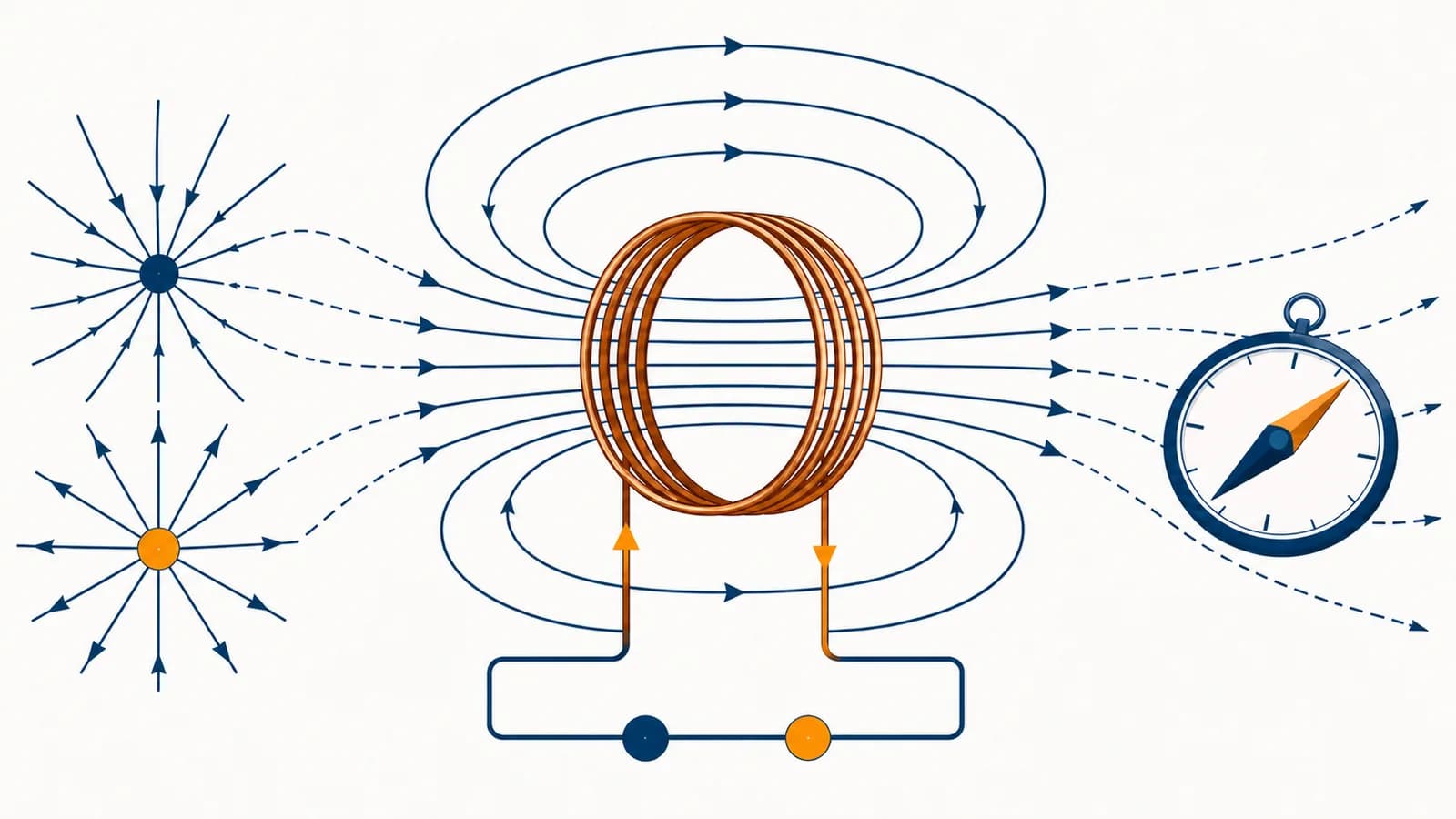
Electricity and magnetism is a branch of physics that explains how electric charges create forces, fields, currents, and magnetic effects in matter and space. Electric charge, electric current, voltage, resistance, magnets, circuits, and electromagnetic induction all belong to the same theory. The idea exists because charged matter interacts across distance, and changing electric and magnetic fields can carry energy from one place to another.
A phone charging on a desk, a compass turning north, and a train motor pulling a carriage look like separate events. They are different arrangements of electrons and electromagnetic fields. Learning the subject means tracking three things: what charge is doing, what field exists around it, and how energy moves through the system.
One interaction, many effects: stationary charge produces electrostatic effects, moving charge produces magnetic effects, and changing electric or magnetic fields can generate each other.
What electric charge actually is
Electric charge is a property of particles that determines how strongly they take part in electromagnetic interactions. Charge comes in positive and negative forms, is measured in coulombs, and is conserved: an isolated system cannot gain or lose net charge.
Protons carry positive charge, electrons carry negative charge, and neutrons have no net charge. The magnitudes of the proton and electron charges are equal. In SI units, the elementary charge is exactly , because the coulomb is defined using this fixed value.
Like charges repel and unlike charges attract. Coulomb's law gives the force between two small charged objects:
Two charges of separated by exert a force of about , using .
The inverse square in this equation matters. Double the separation and the force becomes one quarter as large. The force also acts along the line between the charges. This simple relation is accurate for point charges and for spherical charge distributions viewed from outside.
Charge moves differently through conductors and insulators
A conductor contains charge carriers that can move through the material. In a metal, some electrons are shared across the solid and respond to an electric field. An insulator holds its electrons more tightly, so charge usually stays near where it was placed. The distinction is a matter of mobility, not the presence or absence of electrons.
Materials lie on a range rather than in two perfect groups. Semiconductors can have their conductivity controlled by added atoms, light, temperature, or an electric field. That controllability is why silicon can act as a switch in a computer chip. The microscopic structure behind these behaviors belongs with how material properties arise.
Objects become charged by transferring electrons
Rubbing a balloon on hair does not create charge. Contact allows some electrons to transfer between materials, leaving one with excess electrons and the other with an equal deficit. Charging by contact transfers charge directly. Charging by induction rearranges charge through an electric field, often with a temporary connection to Earth.
Friction manufactures positive charge on one object and negative charge on the other.
Electrons already present move between surfaces. Total charge remains constant when both objects and their surroundings are counted.
How electric fields work
An electric field assigns a force per unit positive charge to every point in space. Charges create the field, and another charge placed there experiences . The field describes the local condition before a test charge arrives.
A positive source charge produces a field pointing outward. A negative source charge produces a field pointing inward. Field arrows show the direction a positive test charge would accelerate, while field strength is represented by arrow length or by the density of field lines. Field lines are a drawing convention, not physical threads.
Fields add by superposition. If several charges are present, calculate the electric field vector produced by each one and add the vectors. Equal positive charges create a zero field exactly halfway between them because their fields oppose there. An equal positive and negative pair does not cancel at the midpoint because both fields point from positive toward negative.
Electric potential measures energy per unit charge
Electric potential is potential energy per coulomb, measured in volts. A potential difference of one volt means one joule of energy changes for each coulomb of charge that moves between two points. Voltage therefore describes an energy difference, not a substance stored inside a wire.
Moving through a potential drop of transfers of energy.
Potential is a scalar, so voltages add without vector directions. Electric field is a vector. In one dimension, the field points toward decreasing potential, expressed as . A steep change in voltage over a short distance means a strong electric field.
Capacitors store separated charge and field energy
A capacitor consists of two conductors separated by an insulator. A voltage source moves electrons from one plate to the other, producing equal and opposite plate charges. The energy is stored in the electric field between the plates, not as a pile of energy inside the electrons.
Capacitance measures how much charge separation a device produces per volt: . A larger plate area increases capacitance because more charge can spread out. A smaller separation strengthens the interaction between plates and also increases capacitance. Camera flashes, touch sensors, and power supplies use this controlled storage.
How voltage, current, and resistance work together
Voltage supplies an energy difference, current measures the rate of charge flow, and resistance measures how strongly a component opposes that flow. In many components they are related by Ohm's law, , but each quantity describes something distinct.
Current is . One ampere is one coulomb passing a cross section each second. Conventional current points in the direction positive charge would move. In a metal, the mobile carriers are negative electrons, so their average drift is opposite the conventional current direction.
Electrons in a powered wire drift slowly, yet a lamp responds almost immediately when a switch closes. Closing the switch establishes an electric field around the circuit, and that field prompts electrons already present throughout the wire to move. The situation resembles pushing one end of a tube already full of beads rather than sending one bead across the whole room.
Series and parallel circuits impose different constraints
Components in series share one path, so the same current passes through each. Their voltage drops add to the supply voltage, and their resistances add: . Adding a series resistor makes the total resistance larger.
Components in parallel connect across the same two nodes, so each receives the same voltage. The branch currents add at a junction, and . Adding another parallel branch makes the total resistance smaller because it provides another route for charge flow.
A battery connected to a resistor drives . The resistor converts electrical energy at . In ten seconds, it transfers , mostly as thermal energy.
Ohm's law is a model for components whose resistance remains reasonably constant. A filament lamp is non-ohmic because heating changes its resistance. A diode passes current much more readily in one direction. Circuit analysis still uses conservation of charge and energy even when the simple proportionality does not apply.
Electric fields versus magnetic fields
Electric fields act on any electric charge, while magnetic fields exert force on moving charges and magnetic dipoles. An electric force can speed up a charge along its motion; a magnetic force on a single charge is perpendicular to its velocity.
The magnetic force on a moving point charge is . The cross product means the force is perpendicular to both the velocity and the magnetic field. If the charge moves parallel to the field, the magnetic force is zero. If it moves at right angles, the force magnitude is .
| Feature | Electric field | Magnetic field |
|---|---|---|
| Acts directly on | stationary or moving charge | moving charge and magnetic dipoles |
| Force direction | along or opposite the field | perpendicular to charge velocity and field |
| Can change a particle's speed by itself | yes | no, because the force is perpendicular to motion |
| SI field unit | newtons per coulomb, or volts per metre | tesla |
A magnetic field can bend a charged particle into a circle without changing its kinetic energy. The force changes the direction of velocity, not its magnitude. Particle accelerators and mass spectrometers use this predictable bending to guide particles or separate ions according to mass and charge.
Field direction: use the right hand rule for a positive charge. Reverse the result for a negative charge. The rule encodes a vector cross product; it does not explain the source of the force.
Electric and magnetic fields are not completely separate substances. Observers moving relative to one another can divide the same electromagnetic field into different electric and magnetic parts. Special relativity makes this connection precise, and relativity and quantum physics carry it beyond the classical model.
How magnetism works inside matter
Magnetism in matter comes mainly from electron magnetic moments associated with quantum spin and orbital motion. A material's visible magnetic behavior depends on how these moments respond to an applied field and whether neighboring moments remain aligned after it is removed.
A current also creates a magnetic field. Around a straight wire, the field forms circles centered on the wire. Curl the wire into a coil and the fields from each turn reinforce inside it, producing an electromagnet with a north and south pole. Reverse the current and the poles reverse.
Permanent magnets preserve aligned domains
In ferromagnetic materials such as iron, interactions between neighboring atoms can align many magnetic moments in regions called domains. An unmagnetized piece may contain domains pointing in different directions, giving little net field. An applied field can enlarge favorably oriented domains. In a suitable hard magnetic material, much of that alignment remains.
Electrons contribute tiny magnetic moments through quantum properties and motion.
In a ferromagnet, quantum interactions favor shared alignment within domains.
Domains aligned with an external field grow or rotate, increasing the material's total magnetization.
Defects and material structure can hinder domains from returning, creating a permanent magnet.
Heating a ferromagnet enough disrupts its ordered alignment. Strong impacts can also change domain patterns. Soft magnetic materials realign easily and suit transformer cores. Hard magnetic materials resist reversal and suit permanent magnets. The labels describe magnetic response, not how physically hard the material feels.
Magnetic poles always appear as pairs
Cutting a bar magnet does not isolate a north pole. Each piece becomes a smaller magnet with north and south poles because the aligned microscopic dipoles continue through the material. No isolated magnetic monopole has been confirmed experimentally, so magnetic field lines form closed loops rather than beginning or ending on magnetic charge.
How changing fields create electromagnetic induction
Electromagnetic induction occurs when changing magnetic flux through a conducting loop produces an electromotive force. The induced voltage drives current if the path is closed, and its direction opposes the change that produced it, as described by Faraday's and Lenz's laws.
Magnetic flux measures how much magnetic field passes through an area. For a uniform field across a flat loop, . Flux changes if the field strength changes, the loop area changes, or the loop rotates. Faraday's law combines all three possibilities.
If flux through each of turns changes by in , the average induced voltage magnitude is .
The minus sign expresses Lenz's law. An induced current creates its own magnetic field that opposes the change in flux. If the induced effect helped the original change, the system could increase its own energy without an input. Opposition is how induction remains consistent with conservation of energy.
In a generator, mechanical work rotates a coil or magnet, changing flux and producing electrical energy. In a motor, current in a magnetic field experiences forces that produce torque and mechanical motion. Real machines include many coils, shaped cores, switching electronics, and cooling systems, but the energy conversion begins with those field interactions.
Transformers trade voltage for current
A transformer uses alternating current in a primary coil to create changing magnetic flux in a core. That changing flux induces voltage in a secondary coil. For an ideal transformer, , and input power equals output power: raising voltage lowers available current by the corresponding factor.
A transformer needs changing flux, so steady direct current does not sustain transformer action. Electronic power converters first switch direct current rapidly, then use induction and other components to adjust voltage. Phone chargers use this process while also isolating the low-voltage output from the mains supply.
How electricity shows up in power grids and homes
An electric power system converts energy at generators, transmits it at high voltage, reduces the voltage near users, and distributes it through protected circuits. Its design controls current because wire heating grows with , while delivered power equals .
Suppose a line must carry . At , the current is . At , it is . For the same wire resistance, the second current produces one hundredth as much resistive heating because current is squared. This arithmetic explains high-voltage transmission.
Household devices are connected in parallel so each receives the supply voltage and can operate independently. Circuit breakers interrupt excessive current before wiring overheats. Protective earth conductors give fault current a low-resistance path, helping a breaker or residual-current device disconnect the supply. These protections serve different failure modes and should not be treated as interchangeable.
A heater used for minutes consumes . A kilowatt-hour is an energy unit, not a power rating. Electricity bills charge for energy, while the device label states the rate at which it uses that energy.
Power and energy connect this topic to calculating energy transfer and efficiency. A motor's electrical input exceeds its mechanical output because resistance, friction, magnetic losses, and electronics warm the surroundings. Efficiency accounts for where the input energy goes; it does not mean energy has vanished.
How electromagnetism shows up in motors, sensors, and communication
Electromagnetic devices control forces, energy, or information by arranging charges, currents, materials, and changing fields. Motors turn field forces into motion, sensors turn physical changes into electrical signals, and antennas exchange energy between circuit currents and traveling electromagnetic waves.
Motors use force and timed switching
A current-carrying wire in a magnetic field experiences a force. Arrange wires on a rotor and the forces can form a torque. The current direction must be switched as the rotor turns so the torque continues in the useful direction. Brushed motors do this mechanically; brushless motors use electronic switching informed by rotor position.
Sensors turn physical conditions into measurable voltages
A microphone may use sound to move a coil through a magnetic field, inducing a voltage that follows the air pressure pattern. A Hall sensor detects a voltage produced when a magnetic field deflects moving charges in a conductor. Capacitive touchscreens detect how a nearby finger changes an electric field and the effective capacitance at a grid location.
Antennas connect circuits to waves
An alternating voltage drives charges back and forth in a transmitting antenna. Their acceleration produces changing electric and magnetic fields that detach and travel outward as an electromagnetic wave. A receiving antenna experiences the reverse process: the arriving field drives charges and creates a signal voltage for the receiver to filter and decode.
Radio, microwaves, visible light, ultraviolet, X-rays, and gamma rays are all electromagnetic waves. They differ in frequency and wavelength, which changes how they are produced and how they interact with matter. In vacuum their speed is the defined SI value , with .
Medical imaging uses several distinct electromagnetic mechanisms. X-ray imaging measures how high-frequency electromagnetic radiation is absorbed across tissue. Magnetic resonance imaging uses a strong magnetic field, radio-frequency pulses, and signals from atomic nuclei. The name does not mean that MRI uses ionizing X-rays.
Five mistakes people make with electricity and magnetism
Most errors in electricity and magnetism come from treating voltage, current, charge, energy, and fields as interchangeable substances. Keeping their units and causal roles separate prevents mistakes in circuit calculations, safety judgments, force directions, and explanations of electrical devices.
1. Current gets used up by a component
Charge is conserved. In a steady series circuit, the same current enters and leaves a lamp. What changes across the lamp is electric potential energy per unit charge. The lamp transfers that energy into light and thermal motion while charge continues around the circuit.
2. A battery supplies constant current
A battery maintains a potential difference within limits; the connected circuit determines the current. A larger resistance generally produces less current at the same voltage. Real batteries also have internal resistance, chemical limits, and terminal voltage that can change under load.
3. A magnet attracts every metal
Strong everyday attraction occurs mainly with ferromagnetic materials such as iron and many steels. Copper and aluminum are metals and conduct electricity well, but an ordinary permanent magnet does not pull them strongly. Conductivity and ferromagnetism come from different features of electron behavior.
4. Voltage is dangerous but current is not, or the reverse
Electrical injury cannot be judged by naming only one quantity. Voltage helps drive current through the body, while the resulting current, path, duration, frequency, skin condition, and available source energy affect the outcome. Treat mains wiring, damaged equipment, and unknown sources as hazards rather than relying on a single slogan.
Safety boundary: classroom circuit equations are not instructions for testing household power. Never measure mains current by placing a meter directly across an outlet, because that creates a low-resistance fault.
5. A magnetic field does work on a moving point charge
The magnetic force is perpendicular to the charge's velocity, so it changes direction rather than speed and does no work on that point charge. Magnetic devices can still transfer energy because electric fields, induced voltages, moving structures, and power sources are also part of the complete system.
How static electricity differs from current electricity
Static electricity describes an imbalance of charge that remains localized until it leaks away or discharges, while current electricity describes a sustained rate of charge flow through a path. Both obey the same laws of charge, fields, voltage, and energy.
A charged doorknob shock is brief because separated charge rapidly redistributes when an air gap breaks down or contact completes a conducting path. A powered circuit continues because a battery or generator keeps doing work to maintain a potential difference. “Static” describes the charge arrangement before discharge, not a separate kind of electricity.
Lightning is a large electrostatic discharge. Charge separation inside a storm produces intense electric fields. When the field makes air sufficiently conductive along a developing path, charge moves rapidly and heats the channel. The exact path depends on changing local conditions, which is why a branching strike cannot be predicted from a simple straight-line rule.
How batteries produce voltage
A battery produces voltage through chemical reactions that separate charge and lower the system's chemical free energy. Its two electrodes favor different electron-transfer reactions, while ions move through an electrolyte and electrons move through the external circuit during discharge.
At the negative terminal of a discharging cell, an oxidation reaction releases electrons. At the positive terminal, a reduction reaction accepts them. The electrolyte carries ions internally so charge does not build up and halt the reactions. A separator prevents direct electronic contact between electrodes while allowing ionic transport.
A rechargeable cell uses an external power source to drive the chemical system toward a higher-energy state. Charging is not perfectly reversible: resistance and unwanted reactions produce heat and gradual degradation. Battery management electronics monitor voltage, current, and temperature because chemical stability has operating limits.
Energy difference available per coulomb between terminals under specified conditions.
How much charge the battery can deliver under specified conditions, commonly stated in ampere-hours.
Voltage and capacity answer different questions. Two batteries can have the same voltage but store different amounts of energy. An ideal estimate uses , though real delivered energy depends on load, temperature, age, internal resistance, and the allowed voltage range.
Can electricity travel through air or empty space?
Charge can move through air when the gas becomes ionized, but electrical energy can also cross empty space as an electromagnetic wave without matter carrying it. A spark is moving charged particles in plasma; radio and light are propagating electromagnetic fields.
Ordinary air is a good insulator because it has few free charge carriers. A strong enough electric field can accelerate an available electron until collisions free more electrons, creating an avalanche and a conductive plasma channel. Humidity, pressure, geometry, and distance affect breakdown, so no single classroom value describes every spark.
Electromagnetic waves need no material medium. Changing electric fields accompany changing magnetic fields, and the coupled disturbance carries energy and momentum through vacuum. Matter affects a wave when charges in the material respond, producing reflection, absorption, refraction, or transmission.
Electricity and magnetism form one physical theory
Electricity and magnetism are two linked aspects of electromagnetism, one of the fundamental interactions used throughout physics. Charge creates fields, fields exert forces, moving charge makes magnetic effects, and changing fields carry energy and generate one another.
Maxwell's equations collect these relationships into a compact theory. They state how charge produces electric field, how magnetic field has no observed isolated source, how changing magnetic field produces electric field, and how current plus changing electric field produces magnetic field. Their wave solutions identify light as electromagnetic radiation.
The takeaway: for any electrical or magnetic event, identify the charges and currents, map the fields they create, then track force and energy transfer. That sequence works for a rubbed balloon, a circuit board, a motor, and a radio signal.
The subject also shows how physical models join scales. Electron behavior inside a solid sets resistance, circuit rules predict device operation, and fields explain forces across space. You can place these ideas beside motion, waves, matter, and conservation in the broader set of physics explanations.
Start noticing the conversions around you. A speaker turns current into magnetic force and then motion. A charger changes voltage and stores chemical energy. A compass responds to a field you cannot see. Naming the charge, field, force, and energy path turns each device into a testable piece of physics.