A logarithm is a mathematical operation that finds the exponent needed to produce a number from a chosen base, in the context of exponential relationships. A logarithm answers the search question “what power gives this value?” In , the answer means . Log rules turn multiplication into addition, division into subtraction, and powers into multiplication. The idea exists because exponential change can span enormous ranges, while logarithms make those ranges easier to calculate, compare, graph, and explain.
If , then . These are two ways to state the same fact. The exponential form starts with a base and an exponent, then produces a value. The logarithmic form starts with the base and the value, then recovers the exponent.
A logarithm is an exponent. Whenever a logarithm looks unfamiliar, rewrite it as an exponential equation and ask which power of the base produces the input.
What a logarithm actually is
A logarithm is the inverse of exponentiation: it returns the exponent attached to a chosen base. The notation asks how many powers of are required to make , including fractional and negative powers.
Three quantities are involved. The base is the repeated multiplier, the argument is the positive number inside the logarithm, and the value is the exponent being sought. In , the base is , the argument is , and the value is because .
Example: because .
A valid real logarithm has two restrictions. Its base must be positive and cannot equal . Its argument must be positive. A positive base keeps exponential outputs positive, so no real exponent can make that base produce zero or a negative number. Base is useless because every power of remains , so it cannot represent a reversible function.
| Exponential fact | Equivalent logarithmic fact | Meaning |
|---|---|---|
| Every valid base to the zero power is one. | ||
| A negative logarithm corresponds to a reciprocal. | ||
| A fractional logarithm corresponds to a root. |
How logarithms work
Logarithms work by reversing an exponential function one output at a time. To evaluate one, identify the base, set its unknown exponent equal to the argument, and solve for that exponent using known powers, estimation, or a calculator.
Rewrite as . This exposes the exponent the problem is asking for.
Factor or rewrite the argument using the base. For , recognize that .
Since and , must lie between and .
Raise the base to your answer. A calculator gives , and .
The estimate also carries meaning. A common logarithm counts powers of ten, so its integer part tells you the scale. Positive numbers less than have negative common logarithms because they need negative powers of ten. For example, because .
The base controls how the answer moves. If , larger inputs have larger logarithms. If , larger inputs have smaller logarithms. Both cases are valid because the related exponential functions are one to one. Most school and scientific work uses bases greater than one.
Logarithms versus exponents
Exponentiation builds an output from a base and an exponent, while a logarithm recovers the exponent from a base and an output. They are inverse functions, so each operation undoes the other when their base and domain conditions are satisfied.
Given and , calculate . The unknown is the final output.
Given and , calculate . The unknown is the exponent.
This inverse relationship produces two cancellation identities:
Examples: and .
Their graphs show the same relationship. The graph of contains points such as , , and . Swapping every input and output gives , , and , which lie on . The two graphs are reflections across . A logarithmic graph has a vertical asymptote at because its input can approach zero through positive values but cannot reach zero.
This is one instance of the inverse operations studied in algebra. Subtraction undoes addition, roots undo powers in suitable domains, and logarithms undo exponentials.
How the laws of logarithms work
The logarithm laws follow from the laws of exponents. Multiplying equal base powers adds their exponents, dividing subtracts them, and raising a power to another power multiplies them, so logarithms transform those operations in exactly the same way.
Products become sums
The product rule says that the logarithm of a product equals the sum of the separate logarithms, provided both arguments are positive.
Since , .
To see why, let and . Then . Taking the base logarithm recovers the exponent .
Quotients become differences
The quotient rule says that the logarithm of a positive quotient equals the numerator's logarithm minus the denominator's logarithm.
Since , .
The subtraction comes from . This is also why a logarithm of a reciprocal changes sign: .
Powers become coefficients
The power rule says that an exponent on a positive argument can move in front of the logarithm as a multiplier.
For and , .
The rule follows because . It is useful for solving equations in which the unknown appears in an exponent. It also explains why multiplication on the original scale becomes repeated addition on a logarithmic scale.
There is no sum rule. In general, . For example, , but .
How common logarithms and natural logarithms differ
Common logarithms use base , natural logarithms use base , and binary logarithms use base . They ask the same kind of question, but each base suits a different pattern of measurement or growth.
Base fits decimal notation. Each increase of in a common logarithm means multiplication by . Base fits systems built from two states. Each increase of means doubling. The number appears naturally when a quantity's instantaneous growth rate is proportional to its current amount. In that setting, makes derivatives and growth equations especially simple.
You can convert any valid logarithm to a base available on your calculator.
Example: .
The result says that is approximately . The choice of does not alter the answer as long as the same valid base is used in the numerator and denominator. On a calculator, confirm what the keys mean. A key marked “log” normally uses base , while “ln” uses base . Software conventions can differ, so an explicit base avoids ambiguity.
How logarithmic equations are solved
A logarithmic equation is solved by isolating the logarithm, applying valid log laws where useful, converting to exponential form, and checking every proposed answer in the original equation. The final check matters because every logarithm argument must remain positive.
Solve . Convert it to , so and . The check succeeds because and .
An equation with two logarithms may first require combining them. Consider . The product rule gives . Convert to exponential form:
The algebra produces and . Only is valid. The original arguments are and , so both require . The candidate is an extraneous solution introduced by solving the transformed quadratic without carrying its domain restriction.
Exponential equations use logarithms when their terms cannot be rewritten with one convenient base. To solve , take a logarithm of both sides:
Check: is approximately .
This technique connects logarithms with powers, roots, and radical expressions. A root can isolate an unknown base, while a logarithm can isolate an unknown exponent. Choosing between them depends on where the unknown sits.
How logarithms show up in science and measurement
Logarithms appear in science when measurements cover many powers of a base or when ratios matter more than raw differences. A logarithmic scale compresses a vast numerical range and turns equal multiplication factors into equal distances on the scale.
Acidity is reported with pH
For introductory calculations, pH is the negative base logarithm of hydrogen ion concentration measured in moles per litre.
If moles per litre, then .
A change of one pH unit corresponds to a factor of ten in this concentration model. A solution with pH has ten times the hydrogen ion concentration of a solution with pH , not one unit more concentration. Precise chemistry uses activity rather than bare concentration, but the logarithmic mechanism remains.
Sound levels compare intensity ratios
A sound intensity level in decibels is ten times the common logarithm of an intensity ratio relative to a specified reference intensity.
If intensity becomes times the reference, the level is dB.
Multiplying intensity by ten adds decibels because . This formula concerns physical intensity, not a direct statement that human perception changes by the same factor. Different decibel formulas use different multipliers depending on which physical quantity is being compared.
Earthquake magnitude records ratios
Modern earthquake magnitude scales are logarithmic measures derived from recorded seismic signals, so equal steps in magnitude represent multiplicative changes in measured motion rather than equal additions.
The original local magnitude relation associated with the Richter scale used a base logarithm of a corrected wave amplitude. Modern seismology often uses moment magnitude, which is based on seismic moment and behaves differently in detail. Calling every earthquake value “the Richter scale” hides that distinction. The shared mathematical idea is that the logarithm turns a large physical range into a compact scale.
How logarithms show up in money, growth, and computing
Logarithms answer time and scale questions in systems that multiply. They find how long compound growth takes, how many repeated halvings reach a target, how many binary choices identify an item, and how orders of magnitude compare.
Compound growth hides time in an exponent
In a compound growth model, a logarithm isolates the time because time appears as an exponent on the growth factor.
An account begins with units and grows by once per year. To find when it reaches , solve . This gives years under the model.
The model assumes a fixed annual rate and no deposits, withdrawals, fees, or taxes. Real financial decisions require those details, as the guide to interest, loans, and financial calculations shows. The logarithm does not predict the rate. It answers a time question after the model and rate have been chosen.
Repeated halving also needs logarithms
Exponential decay models a quantity that loses the same fraction during each equal time interval, and a logarithm finds how many intervals are needed to cross a target.
Suppose a medicine amount is multiplied by each hour. Starting at milligrams, the model is . To find when it reaches milligrams, solve , so hours. The answer belongs to the model, which assumes the same proportional loss each hour.
Binary logarithms count repeated doubling
A binary logarithm counts how many doublings produce a quantity, which makes it useful for data structures, search procedures, and information measured through two way choices.
A balanced binary decision tree with possible endpoints needs yes or no decisions to identify one endpoint because . Equivalently, . This does not mean every search problem automatically takes exactly a logarithmic number of steps. The structure must divide the remaining possibilities into roughly equal groups.
5 mistakes people make with logarithms
Most logarithm errors come from forgetting that a logarithm is an exponent, misapplying a rule to addition, ignoring domain restrictions, mixing bases, or trusting calculator output without checking the original expression. Each error can be caught with a short exponential check.
1. Treating a logarithm as division
The notation does not mean . It asks for an exponent. For example, , while . Rewrite the statement as to recover its meaning.
2. Splitting a sum as if it were a product
The product rule applies to , not . A quick counterexample is , which is not . Parentheses and operation signs deserve attention before any rule is used.
3. Allowing zero or negative arguments
A real logarithm requires a positive argument. The expression therefore requires . An algebraic candidate outside that domain is not a solution, even if it solves a later polynomial equation.
4. Switching bases without conversion
The statements and have different answers because they ask about different repeated multipliers. When a base is omitted, use the convention established by the course, calculator, or software, and label the base in your work.
5. Rounding before the final step
Early rounding can noticeably change an answer after multiplication or exponentiation. Keep the calculator's stored value through the calculation, then round once to the precision justified by the inputs. Substitute the rounded result into the original equation to see whether it remains sensible.
Copy a decimal from the screen and assume the equation is solved.
State the base, preserve precision, check the domain, and verify by exponentiating.
What a logarithmic scale actually shows
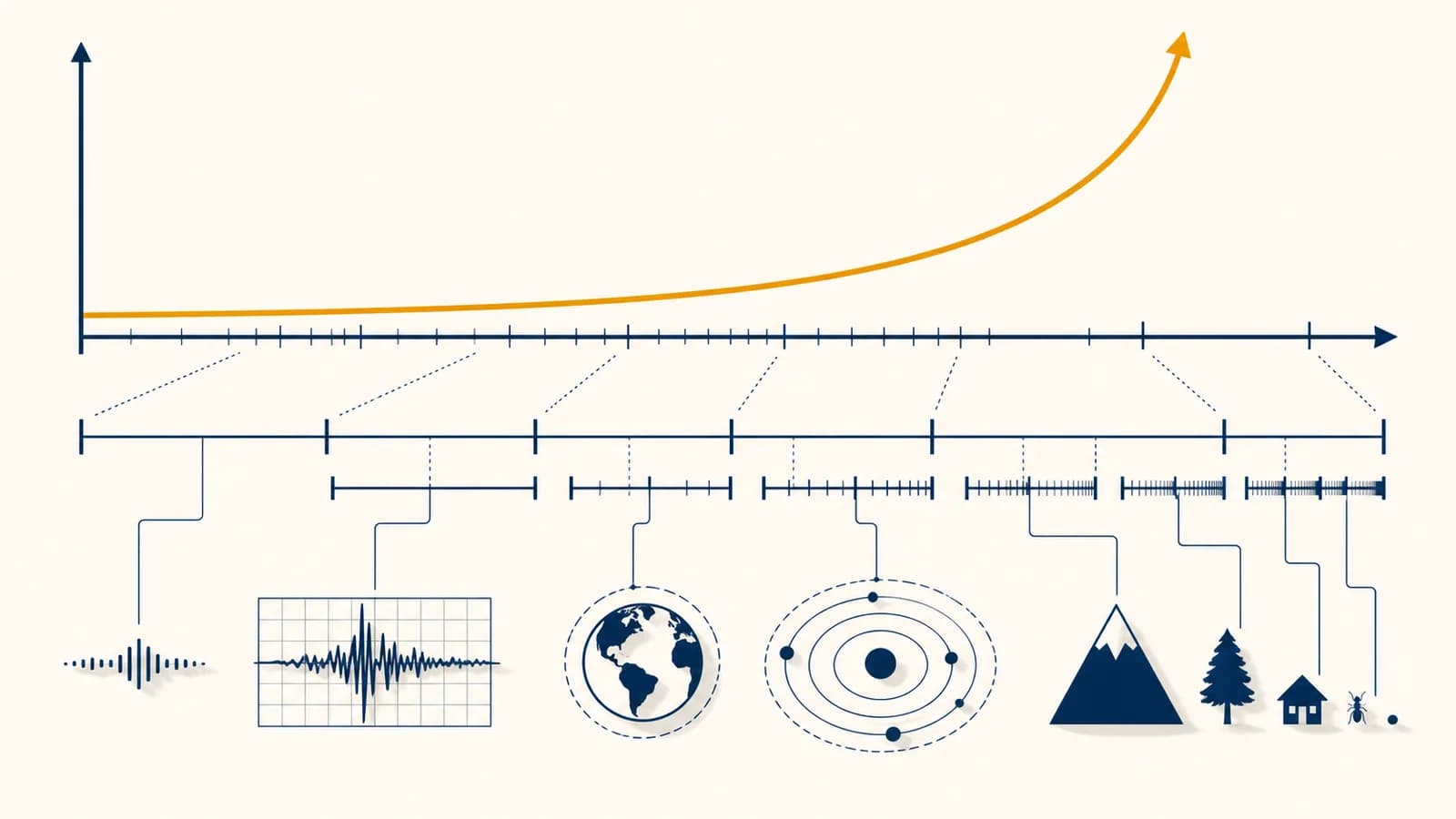
A logarithmic scale places equal ratios at equal visual distances. On a base axis, the intervals from to , to , and to have equal width. This preserves proportional comparisons that linear spacing can conceal.
This scale is useful when positive data span several orders of magnitude. On an ordinary linear axis, a value of becomes visually crushed beside . On a logarithmic axis, powers of ten are evenly spaced, so both small and large values remain visible. Zero cannot appear on a standard logarithmic axis because no real power of a positive base equals zero.
Each arrow represents multiplication by , even though the numerical differences are , , and . This changes how slopes should be read. On a graph with a logarithmic vertical axis and a linear horizontal axis, a straight line can indicate exponential change. On a graph with both axes logarithmic, a straight line can indicate a power relationship.
Charts should label logarithmic axes clearly. Without that label, equal vertical distances can be mistaken for equal numerical differences. Reading the tick marks reveals the truth: if successive marks are powers or constant ratios, the axis is logarithmic. Choosing an honest display also depends on ideas covered in data summaries, charts, and statistical reasoning.
What happens at zero and with negative numbers?
Real logarithms are undefined at zero and at negative inputs because positive real bases raised to real powers always produce positive outputs. Values can approach zero without reaching it, and their logarithms move without bound in a direction set by the base.
For a base greater than , falls toward negative infinity as positive approaches zero. This does not mean the logarithm “equals negative infinity” at zero. It means no finite lower bound stops the outputs as the input gets closer to zero.
Negative numbers can have logarithms in complex number systems, where the answer is not generally a single real value. That extension depends on complex angles and is beyond the real logarithms used in most school models. In a real equation, treat a negative log argument as a domain failure, not as a prompt to press a different calculator key.
Domain check: For in real mathematics, require . The inequality belongs to the problem from the first line, not only during the final check.
Can a logarithm have a fractional or negative answer?
A logarithm can be fractional, negative, irrational, or zero because an exponent can have any of those forms. For bases greater than one, inputs above one give positive answers, inputs between zero and one give negative answers, and input one gives zero.
A fractional result appears when a root is involved. Since , . A negative result appears when a reciprocal is involved. Since , . An irrational result is common when the argument is not an exact rational power of the base. For instance, is approximately , not a neat fraction normally used in calculation.
| Input for | Logarithm output | Reason |
|---|---|---|
| Positive | A positive exponent makes the base larger than one. | |
| Zero | . | |
| Negative | A negative exponent produces a positive reciprocal. |
Logarithms make multiplicative patterns readable
Logarithms belong to mathematics because they reveal structure: they reverse exponential functions, convert products into sums, expose hidden exponents, and place ratios on readable scales. The best way to understand one is to translate it, calculate it, and check it.
When you next see a pH value, a decibel level, a compound growth time, or a logarithmic chart, identify the base and ask what ratio one unit represents. Then rewrite one logarithm as an exponential statement. That simple move connects the notation to the repeated multiplication underneath it.
The takeaway: A logarithm tells you the exponent required to reach a positive value from a chosen base. Treat it as an inverse power, respect its domain, and use its laws only where multiplication, division, or powers justify them.
That habit links logarithms to functions, equations, graphs, modelling, and proof across the wider collection of mathematics explanations. Pick a real quantity that changes by a constant factor, write its exponential model, then use a logarithm to solve for the step you cannot see directly.