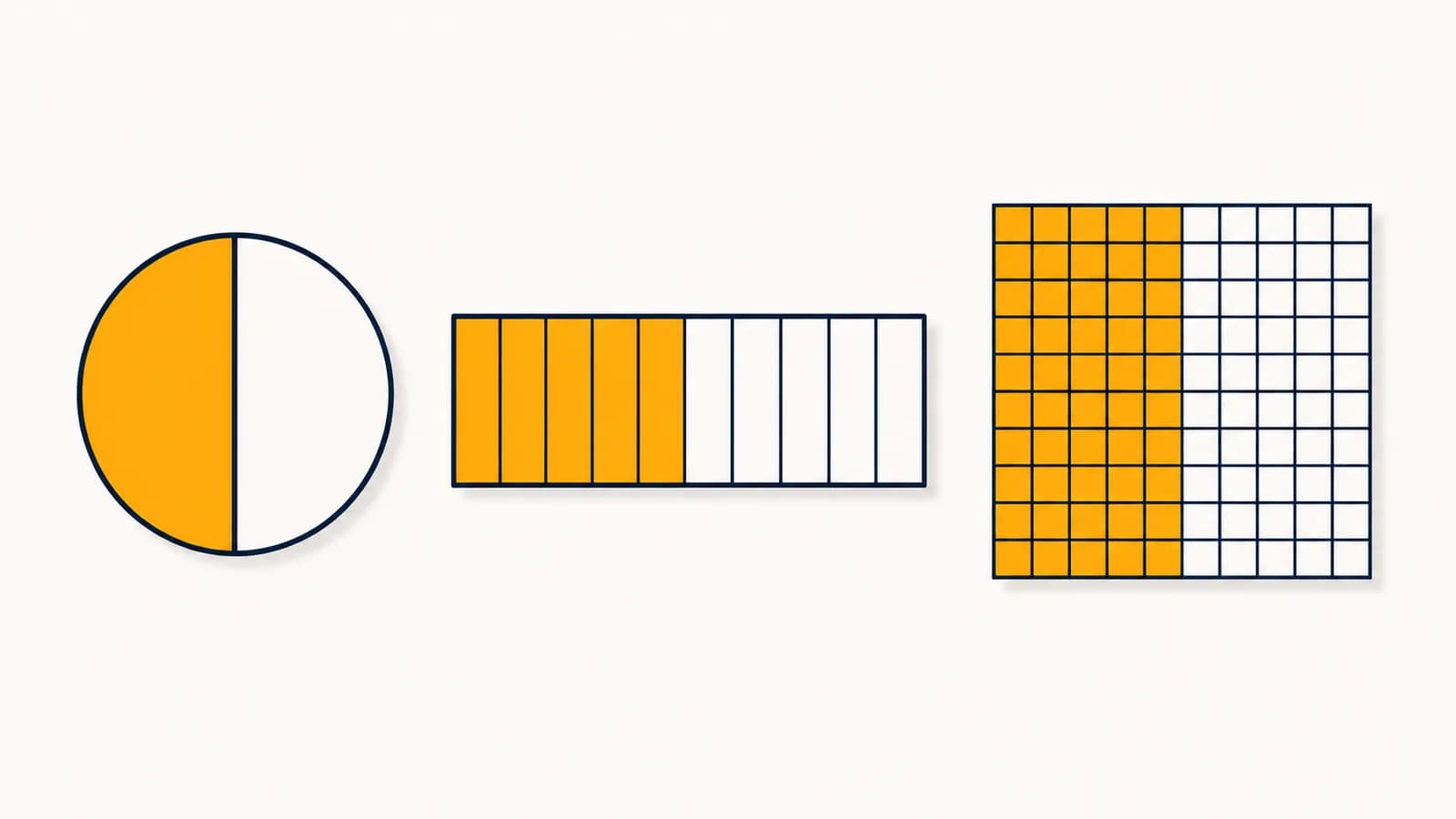
Fractions and decimals are number forms that represent parts of a whole, in the context of arithmetic, measurement, comparison, and calculation. A fraction uses a numerator and denominator, while a decimal uses place value to express tenths, hundredths, and smaller parts. Converting fractions to decimals, comparing them, and adding, subtracting, multiplying, or dividing them are different ways to answer the same practical question: how much is there when the amount is not a whole number? These forms exist because whole numbers alone cannot describe half a metre, three quarters of a tank, or a price of 2.75.
Both forms locate values on the same number line. The amount and the decimal occupy exactly the same point. The notation changes, but the quantity does not. Once that distinction is clear, most rules stop looking arbitrary. They follow from how equal parts, ratios, and base ten place value work.
One quantity, several names: . A fraction, decimal, and percentage can describe the same amount.
What a fraction actually is
A fraction is a number that expresses one quantity divided by another. Its numerator states how many equal parts are being counted, and its nonzero denominator states how many such parts make one whole. The fraction can also represent a ratio or a division operation.
In , the denominator 8 defines the size of each part. One whole has been separated into eight equal parts. The numerator 3 counts three of them. Equality of the parts matters. Three pieces of a cake do not necessarily make three eighths if the pieces have different sizes.
The fraction bar means division, so also means . This meaning handles cases that do not look like a cut object. If three litres of paint are shared equally among eight containers, each receives of a litre. If a car travels 180 kilometres on 12 litres, the ratio gives 15 kilometres per litre.
A proper fraction, such as , has a value below 1. An improper fraction, such as , has a value of at least 1. There is nothing mathematically improper about it. The name only describes its form. In fact, improper fractions are often easier to calculate with than mixed numbers.
How decimal place value works
A decimal is a base ten notation in which each position to the right of the decimal point is one tenth of the position before it. Digits therefore record a sum of tenths, hundredths, thousandths, and successively smaller powers of ten.
In 4.372, the 4 represents four ones, the 3 represents three tenths, the 7 represents seven hundredths, and the 2 represents two thousandths. Written as a sum, the number is . A zero can hold an empty place, which is why 4.07 is not the same as 4.7. The first contains zero tenths and seven hundredths. The second contains seven tenths.
Each move one place to the right divides the place value by 10.
Adding zeros at the far right of a finite decimal does not change its value. The forms 0.6, 0.60, and 0.600 all mean six tenths. The extra zeros can still carry information in a measurement. A laboratory report of 0.600 grams may signal finer measurement resolution than 0.6 grams, even though both notations name the same mathematical value.
Decimals fit measuring systems and calculators because both commonly organize quantities in powers of ten. Money supplies a familiar example: one dollar divides into one hundred cents, so 7 dollars and 35 cents is written as 7.35 dollars. The notation works because the second decimal place counts hundredths of a dollar.
Fractions versus decimals
Fractions and decimals can name the same numbers, but they preserve different information. Fractions show an exact division or ratio directly. Decimals make place value, ordering, and calculator entry convenient. The best form depends on the calculation and on what must remain visible.
states the exact ratio of two parts to three. It keeps the division visible and never needs rounding.
displays the value through base ten places. A finite screen must round or truncate it.
Some fractions become terminating decimals. A denominator of 2, 5, 8, 20, or 25 can be scaled to a power of ten, so familiar examples end neatly: and . Other fractions repeat forever. Dividing 2 by 3 produces , where the digit 6 repeats without an end.
Exactness is the main reason to retain a fraction during a calculation. Replacing with 0.67 before multiplying by 300 gives 201, while the exact product is 200. The early rounding created the difference. A decimal is not inherently approximate, since 0.5 is exact. Approximation enters when an infinite decimal is cut off or when a measured value has limited precision.
To compare fractions, one may use a common denominator, cross products, or decimal conversion. For and , a common denominator of 24 gives and . Therefore is larger. The decimal forms, 0.625 and approximately 0.583, confirm the order.
How conversion between fractions and decimals works
To convert a fraction to a decimal, divide the numerator by the denominator. To convert a terminating decimal to a fraction, write its digits over the matching power of ten and simplify. Both procedures work because a fraction bar denotes division and decimals encode powers of ten.
For 0.375, the last digit is in the thousandths place, so use 1000 as the denominator.
Write . The decimal digits become the numerator.
Divide numerator and denominator by 125 to obtain .
Long division exposes the reverse direction. For , calculate 3 divided by 8. Since 8 does not fit into 3 as a whole number, place a decimal point and consider 30 tenths. This gives 3 tenths with a remainder of 6 tenths. Continue with 60 hundredths, then 40 thousandths, until the remainder becomes zero. The quotient is 0.375.
A useful shortcut is to make the denominator a power of ten. Multiply by to get . Multiplying by changes the written terms but not the value, because .
Conversion is also a way to check work. If a diagram appears to show but a calculation produces 0.8, something is wrong: is greater than 1, while 0.8 is less than 1. Estimating the expected size catches the reciprocal error before any detailed recalculation.
How equivalent fractions and simplification work
Equivalent fractions are different numerator and denominator pairs that represent the same number. Multiplying or dividing both terms by the same nonzero number preserves the value because it multiplies the original fraction by 1 or reverses that multiplication.
For example, . The second fraction divides each original quarter into two smaller pieces, so the whole now contains eight pieces and the selected amount contains six. The pieces have changed size, but the selected quantity has not.
With , , and , the rule gives .
Simplifying reverses this scaling. Find a common factor of the numerator and denominator, then divide both by it. The fraction has a greatest common factor of 6, so . A fraction is in simplest form when numerator and denominator share no positive whole number factor except 1.
Simplest form makes structure easier to see. A recipe using of a cup becomes easier to compare with of a cup after reduction. But an unsimplified form can preserve useful context. A score of reports 18 successful items out of 24 attempted, while hides the number of items.
How arithmetic with fractions works
Fraction arithmetic follows the meaning of equal parts and division. Addition and subtraction require equal sized parts, so denominators must match. Multiplication takes a fraction of a fraction. Division asks how many groups of the divisor fit into the dividend.
Addition and subtraction require a common unit
A denominator names the unit being counted. Adding and directly as would mix thirds and quarters as if they were the same size. Convert both to twelfths: and . Then .
The least common denominator keeps numbers manageable, but any common denominator gives the same result after simplification. This rule is an extension of ordinary unit reasoning. One cannot add 3 metres to 4 feet and call the result 7 metres. First express both measurements in one unit.
Multiplication finds a part of a part
To multiply fractions, multiply the numerators and multiply the denominators. If of a garden is planted and of the planted area contains beans, the bean area is of the garden.
Cross cancellation before multiplication is valid because factors may be divided from a numerator and a denominator without changing the total ratio. In the garden example, the factor 3 cancels, leaving . This reduces arithmetic without changing the reasoning.
Division counts groups and uses a reciprocal
Dividing by asks how many eighths fit into three quarters. Since , the answer is 6. The standard method gives the same result: .
Multiplying by the reciprocal works because division seeks a missing factor. If , multiplying both sides by 8 isolates . More generally, dividing by is multiplying by , provided . The skills behind these calculations extend the operations in whole number arithmetic and operation order.
How arithmetic with decimals works
Decimal arithmetic uses the same operations as whole number arithmetic while preserving place value. Addition and subtraction align equal places. Multiplication first treats digits as integers, then restores scale. Division shifts both numbers equally until the divisor is a whole number.
Add and subtract by aligning places
To calculate , write 12.40 above 0.37 so ones, tenths, and hundredths align. Then add each place to get 12.77. Aligning the rightmost digits instead would put tenths above hundredths and change the quantities being added.
Multiply by tracking the scale
For , first calculate . The factor 2.4 is 24 divided by 10, and 0.3 is 3 divided by 10. Their product is therefore 72 divided by 100, or 0.72. Counting two decimal places across the factors is a shortcut for tracking those two divisions by 10.
Divide by making the divisor whole
For , multiply both numbers by 100 to obtain , which equals 30. Scaling both dividend and divisor by the same nonzero number does not change their ratio. Moving a decimal point in only one number would change the answer.
Estimate before accepting a decimal answer. Since 0.15 fits into 4.5 many times, an answer smaller than 4.5 cannot be correct for this division.
Calculator entry does not replace this place value check. A mistyped decimal point can produce a syntactically valid answer with the wrong scale. Before calculating , round mentally to . The exact answer should be near 100, not near 10 or 1000.
How fractions and decimals show up in real decisions
Fractions and decimals appear whenever a person measures, allocates, prices, compares, or estimates a nonwhole amount. The notation chosen often reflects the setting: trades use familiar fractional units, while money, instruments, spreadsheets, and digital displays commonly use decimals.
Money uses decimals, but decisions use ratios
A shop price of 48 dollars reduced by one quarter requires both forms. One quarter of 48 is , so the sale price is 36 dollars. The decimal calculation is . Tax rates, interest rates, discounts, and profit margins are ratios even when displayed as percentages or decimals. Calculations for interest, discounts, and loans show how those ratios accumulate across time.
A group shares a 126 dollar bill. One person pays one third because they ordered for two people, and four others split the rest equally. One third is 42 dollars. The remaining 84 dollars divided by four is 21 dollars each. The fractions encode a fair allocation rule before decimals express the payments.
Measurement depends on units and tolerated error
A carpenter might mark half an inch because the tool and convention use fractional inches. A machinist may record 12.70 millimetres because a decimal fits metric units and communicates a measurement position. Neither form is more scientific. The useful form matches the unit, instrument, and required precision.
Recipes also expose scaling. A batch requiring cup of oats must be multiplied by to make one and a half batches. Convert the mixed number to , then calculate cups. The units remain cups throughout.
Probability and data are proportions
A probability is a number from 0 to 1. If a fair six sided die has two outcomes greater than 4, the probability is . The fraction displays favorable outcomes over possible outcomes. The decimal makes comparison with other probabilities quick. Methods for counting outcomes and probability develop this connection further.
Data tables frequently store rates as decimals even when reports show percentages. A spreadsheet may hold 0.18 and format it as 18%. This prevents the percent sign from becoming part of the stored quantity. Confusing 18 with 0.18 causes a factor of one hundred error, so it matters whether a cell stores a decimal ratio or a displayed percentage.
5 mistakes people make with fractions and decimals
Most errors with fractions and decimals come from losing track of the unit, the scale, or the operation's meaning. A short estimate and a check against an equivalent form can expose these mistakes before they move into a measurement, payment, or later calculation.
1. Adding denominators
The false rule treats thirds and quarters as equal units. They are not. Rename both as twelfths, then add: . The result must also exceed each positive addend, while does not.
2. Judging a fraction by one term
A larger denominator does not by itself mean a larger fraction. With the same numerator, it means smaller pieces, so . With different numerators, compare whole values: , even though 8 is larger than 6.
3. Misaligning decimal places
The sum of 2.5 and 0.06 is 2.56, not 3.1. Writing 2.50 above 0.06 makes the place values visible. Trailing zeros do not alter the value, but they help align tenths with tenths and hundredths with hundredths.
4. Moving a decimal point in only one division term
Changing into multiplies the dividend by 10 and changes the quotient. Scale both terms equally: . The ratio stays fixed only when the same factor affects both numbers.
5. Rounding during an intermediate step
Approximating as 0.33 and then multiplying by 300 gives 99 instead of 100. Keep exact fractions or extra decimal places through intermediate work. Round once, at the end, to the precision the result needs.
This check is compact but powerful. The unit identifies what each number counts. The estimate gives an expected range. The calculation supplies the precise result. If a grocery total, dosage, or length falls outside the expected range, stop and inspect the scale before using it.
How repeating decimals work
A repeating decimal is a decimal whose digits enter a pattern that continues forever. Every fraction of two integers has a decimal expansion that terminates or eventually repeats, because long division has only finitely many possible nonzero remainders for a fixed denominator.
Consider . Division produces 0.3 with a remainder, then the same remainder returns at every step. The same calculation repeats, giving . The dots are not an invitation to stop at a convenient place. They state that the pattern has no final digit.
A repeating decimal can be converted exactly to a fraction with algebra. Let . Multiplying by 100 shifts one full repeating block: . Subtract the first equation from the second to cancel the repeating tail. Then , so .
The familiar equality follows from the same logic. If , then . Subtraction gives , so . There is no positive gap between the two forms. They are two representations of one number.
How rounding and precision work
Rounding replaces a number with a nearby value at a chosen place, while precision describes how finely a value is stated or measured. Rounding controls manageable detail, but it introduces an error whose possible size depends on the rounding place.
To round 8.376 to the nearest hundredth, inspect the thousandths digit. It is 6, so increase the hundredths digit from 7 to 8. The result is 8.38. This does not claim that the original value equals 8.38 exactly. It claims 8.38 is the nearest number at hundredth resolution.
A value rounded to the nearest hundredth differs from the original by at most 0.005. For example, all values from 8.375 up to but not including 8.385 round to 8.38 under the usual rule. Context decides whether hundredths are sufficient. Currency often uses hundredths of a unit, while a rough head count cannot meaningfully include decimal people.
8.376 becomes 8.38 at the nearest hundredth. The process chooses a nearby stated value.
8.376 becomes 8.37 at two decimal places. The process cuts off later digits without choosing the nearest value.
Repeated rounding can accumulate error. Suppose three exact lengths are 1.46 metres each. Rounding each to 1.5 metres before adding gives 4.5 metres. Adding first gives 4.38 metres, which rounds to 4.4 metres at the same one decimal place. Keep unrounded values during the calculation whenever they are available.
How mixed numbers and percentages connect
Mixed numbers and percentages are alternate forms built from fractions and decimals. A mixed number combines a whole number with a proper fraction. A percentage expresses a ratio per hundred. Conversion makes them available to the same arithmetic rules as other number forms.
To convert to an improper fraction, count fifths. Two wholes contain ten fifths, and three more make thirteen fifths, so . Reverse the process by division: 13 divided by 5 gives 2 with a remainder of 3.
To convert a decimal to a percentage, multiply by 100 and attach the percent symbol. Thus . To convert back, divide by 100. The word percent means per hundred, so . A value may exceed 100%: an increase from 40 to 50 is 25% because the increase of 10 is one quarter of the original 40.
Percentage change always needs a reference value. A fall of 10 from 50 is . A rise of 10 from 40 is . Equal absolute changes can have different percentage sizes because their starting quantities differ.
Percentage points are not percent change. If a rate rises from 20% to 25%, it rises by 5 percentage points, which is a 25% increase relative to the original rate.
Mixed numbers suit spoken measurements, and percentages suit comparison against a hundred. Improper fractions and decimals usually suit calculation. Moving deliberately among the forms lets each one do the job it expresses most clearly.
Fractions and decimals make ratios computable
Fractions and decimals extend arithmetic beyond whole objects to measured, shared, and compared quantities. Their rules come from two structures: equal parts in fractions and powers of ten in decimals. Converting between the forms reveals that both describe the same number system.
The practical habit is simple: identify the whole, name the unit, choose a useful form, and estimate before calculating. Notice the next nonwhole quantity you meet, perhaps a price, recipe, screen reading, or chance. Ask what counts as one whole and which notation makes the relationship easiest to check.
The takeaway: A fraction records division and a decimal records base ten place value. Keep exact values as long as possible, match units before combining amounts, and use conversion to check that different forms name the same quantity.
These ideas support algebra, probability, statistics, geometry, and every calculation that uses a rate. See how number relationships connect across mathematics when you are ready to place this skill beside the wider subject.