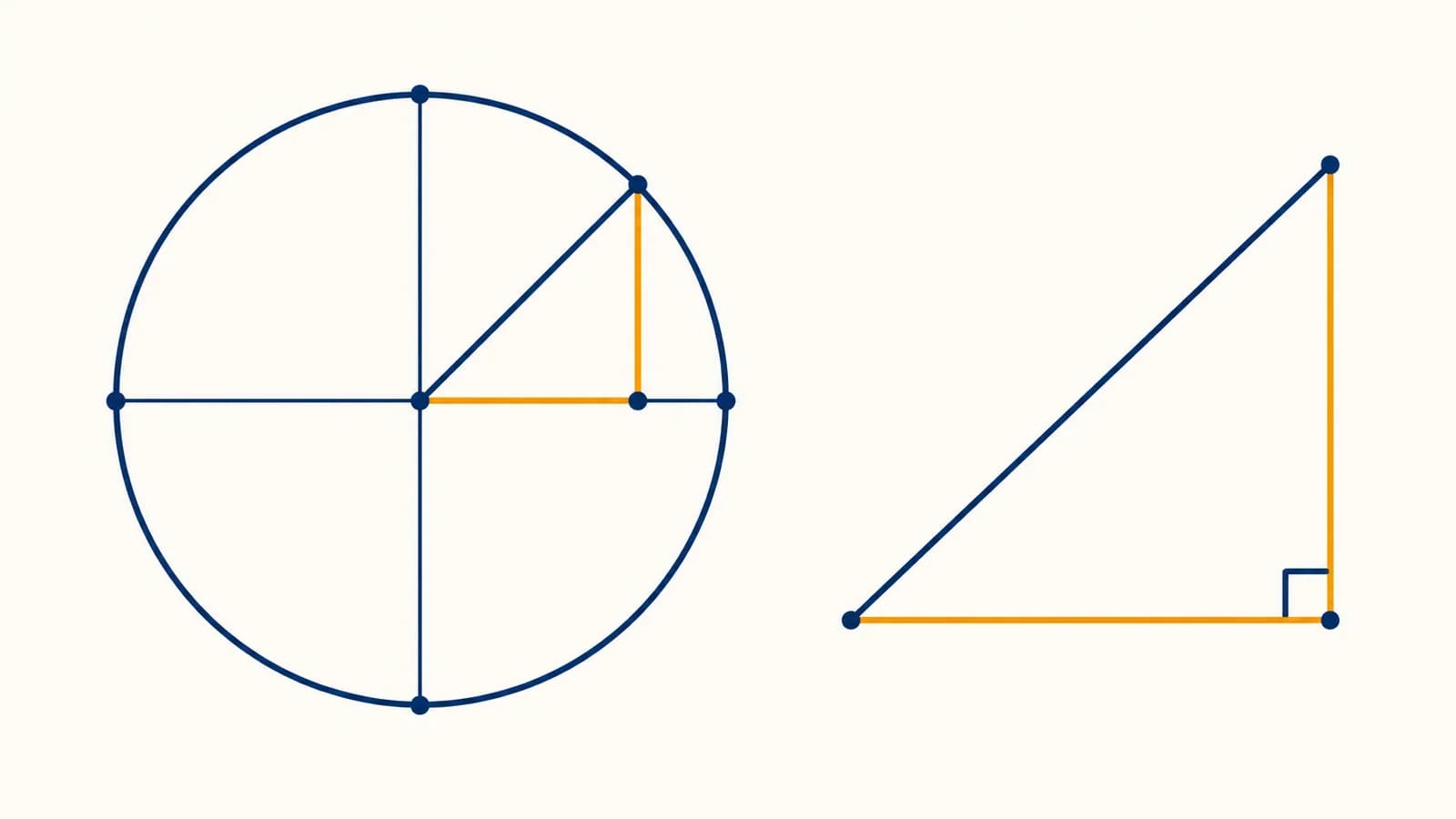
Basic trigonometry is a branch of mathematics that relates angles to side lengths and coordinates, in the context of triangles and rotation. The main trigonometric ratios, sine, cosine, and tangent, let you calculate a missing side or angle in a right triangle. They also describe repeating motion around a circle. Trigonometry exists because many distances cannot be measured directly, while an angle and one accessible length often can. Surveyors use it across rivers, builders use it on roofs, and software uses it to place moving objects on a screen.
What basic trigonometry actually is
Basic trigonometry is the study of fixed relationships between the angles and side lengths of right triangles. It turns the shape of a triangle into ratios, so one measured angle and one known side can determine lengths that are difficult or impossible to measure directly.
A right triangle has one angle of . The other two angles must add to , because all three interior angles of any triangle add to . Relative to one of those smaller angles, the three sides have specific names:
- The hypotenuse is opposite the right angle. It is always the longest side.
- The opposite side lies across from the angle being used.
- The adjacent side touches that angle but is not the hypotenuse.
The labels opposite and adjacent depend on which acute angle you choose. The physical triangle does not change, but your viewpoint does. A side that is opposite one acute angle is adjacent to the other. The hypotenuse keeps its name.
Start by marking the right angle and the chosen angle. Those two marks determine which side is the hypotenuse, which is opposite, and which is adjacent.
Trigonometry connects geometry with calculation. If rearranging formulas is unfamiliar, the methods in using letters and equations to represent unknowns supply the exact algebra used to isolate a missing side.
How sine, cosine, and tangent work
Sine, cosine, and tangent compare pairs of sides in a right triangle. For a chosen angle , sine is opposite divided by hypotenuse, cosine is adjacent divided by hypotenuse, and tangent is opposite divided by adjacent.
A common memory aid is SOH CAH TOA. It compresses the three definitions, but it does not choose the correct ratio for you. That choice comes from identifying the known side and the unknown side.
For a triangle with sides 3, 4, and 5, using the angle opposite the side of length 3 gives , , and .
These ratios depend only on the angle, not on the size of the triangle. Imagine two right triangles that both contain a angle, with one triangle enlarged to twice the dimensions of the other. Both the opposite and hypotenuse double, so their quotient stays unchanged. Every right triangle with the same acute angle is similar, meaning its corresponding sides remain in the same proportions.
The calculator values are decimal versions of those fixed proportions. For example, . In any right triangle with a angle, the side opposite that angle is half the hypotenuse. The decimal is not an arbitrary calculator output. It describes a shape.
How solving right triangles works
Solving a right triangle means finding an unknown side or angle from the measurements already given. Label the sides, choose the ratio containing the known and unknown quantities, substitute carefully, then use algebra or an inverse trigonometric function to isolate the answer.
How to find a missing side
To find a missing side, label the triangle from the chosen angle, select the ratio containing both the known and unknown sides, substitute the values, then solve the equation. A final estimate should agree with the triangle's visible proportions and longest side.
Use the acute angle given in the problem, not the right angle.
Label the hypotenuse first, then decide which remaining side is opposite and which is adjacent.
Ignore the unused side. Select sine, cosine, or tangent according to the known and unknown pair.
Keep the full calculator value until the end, then round once and attach the correct unit.
Suppose a ladder long leans against a vertical wall and makes an angle of with level ground. How high does it reach? The ladder is the hypotenuse, and the height is opposite the angle, so sine uses exactly the two relevant sides.
The result is shorter than the ladder, as a leg of a right triangle must be.
Now suppose the same ladder angle is known, but the question asks how far the foot sits from the wall. That horizontal distance is adjacent to the chosen angle. Cosine gives . One physical setup can produce different equations because the requested side changes.
Many errors disappear if you estimate before calculating. An angle of is steep, so the vertical height should be most of the ladder length and the horizontal distance should be much smaller. The computed results fit that picture.
How to find an unknown angle
To find an unknown angle, form the appropriate side ratio and apply the matching inverse trigonometric function. The buttons , , and reverse sine, cosine, and tangent when the calculator uses the correct angle unit.
Suppose a ramp rises over a horizontal run of . The rise is opposite the incline angle and the run is adjacent, so tangent is the direct ratio.
The calculator must be in degree mode to report this result in degrees.
The superscript on an inverse trigonometric function does not mean reciprocal here. asks, “Which angle has tangent ?” By contrast, the reciprocal of tangent is , also called cotangent. The notation can be confusing, so use the calculator's inverse function key with care.
A sensible check uses shape. Since is small beside , the ramp should make a small acute angle with the ground. A calculator result near would signal that the ratio was inverted or that the complementary angle was found.
Degrees versus radians
Degrees and radians are two units for the same angle. Degrees divide a full turn into 360 parts, while radians measure an angle by comparing arc length with radius. Right triangle exercises often use degrees; calculus and circular motion usually use radians.
A full turn is , a half turn is , and a right angle is . Degrees are convenient for bearings, construction drawings, and everyday descriptions.
A full turn is radians, a half turn is radians, and a right angle is radians. Radians connect angle directly to distance around a circle.
If a circle has radius and an arc on its edge has length , the angle subtending that arc is radians. An arc equal in length to the radius subtends exactly one radian. Because the circumference is , one full turn contains radians.
For example, radians.
The mode indicator on a calculator matters. If you enter in degree mode, the result is . In radian mode, the calculator treats 30 as 30 radians and returns a different value. The mathematics has not changed; the unit attached to the input has.
Right triangle trigonometry versus the Pythagorean theorem
Trigonometric ratios connect an angle with side lengths, while the Pythagorean theorem connects the three side lengths of a right triangle. Use trigonometry when an angle is known or requested. Use Pythagoras when two sides are known and the third is requested.
For legs and and hypotenuse , . It contains no acute angle.
A relation such as includes one acute angle and a pair of sides. It can find either a side or the angle.
Suppose a right triangle has legs and . Pythagoras gives . To find the angle opposite the side, trigonometry then gives . The methods can work in sequence because they answer different questions.
Coordinate geometry uses the same relationship. A horizontal change and a vertical change form the legs of a right triangle. Their straight line distance comes from Pythagoras, while their direction comes from tangent. This is one reason trigonometry appears naturally beside graphs of constant rate and straight lines.
How trigonometry extends from triangles to circles
The unit circle extends sine and cosine beyond acute triangle angles. A point rotating around a circle of radius one has coordinates , so cosine gives horizontal position and sine gives vertical position for any angle around a full turn.
Draw a radius from the circle's centre to a point on its edge, then drop a vertical line to the horizontal axis. The radius is the hypotenuse of a right triangle. Since its length is one, the adjacent side has length and the opposite side has length . Those lengths are also the point's horizontal and vertical coordinates.
Negative values now have a geometric meaning. On the left half of the circle, the horizontal coordinate is negative, so cosine is negative. On the lower half, the vertical coordinate is negative, so sine is negative. A triangle side length itself is not negative; the sign records direction in a coordinate system.
As the point turns at a constant rate, its height rises, falls, crosses the centre line, and repeats. A graph of that height against time is a sine wave. This connects the triangle ratios to sound vibration, alternating electrical signals, daylight cycles, and any process that is well approximated by smooth repetition.
Tangent also has a circular interpretation because . It is undefined when cosine is zero, including , because division by zero has no value. In a right triangle, this matches the fact that a line at has no finite horizontal run.
How trigonometry shows up in practical measurement and technology
Trigonometry appears wherever people convert distance and direction into usable measurements. Surveyors calculate inaccessible heights, builders set slopes, navigators resolve travel into components, graphics software rotates objects, and signal tools describe repeating change through the same relationships between angles and coordinates.
How trigonometry shows up in surveying and construction
Surveyors and builders use trigonometry to turn measured angles and accessible distances into heights, slopes, offsets, and horizontal positions. The method is especially useful when the target is unsafe, elevated, blocked by water, or otherwise unsuitable for direct measurement.
A person stands from a tree on level ground. An instrument above the ground measures an elevation angle of to the top. Tangent finds the height above the instrument, and the instrument height is added afterward.
The calculation is above eye level. Adding gives a tree height of about . This answer assumes level ground, a vertical tree, an accurate horizontal distance, and a clear sight line to the top. The formula is exact for the triangle described, but the real measurement is only as good as those assumptions.
A surveyor can use a similar process to locate a point across a river. Measure a baseline along the accessible bank, record the viewing angles to the target from both ends, then solve the resulting triangle. More advanced work uses the sine rule or coordinate methods, but the underlying strategy remains the same: create a measurable triangle around an inaccessible length.
Construction drawings describe roof pitch, stair angle, drainage fall, and diagonal bracing. A carpenter checking whether a rectangular frame is square may compare its diagonals or use a 3, 4, 5 triangle. A roof designer can convert a horizontal run and rise into a rafter length using Pythagoras, then use tangent to calculate the roof angle.
Trigonometry does not correct a poor model. Sloping ground, a tilted target, or a distance measured along the slope instead of horizontally changes the triangle and can make a neat calculation wrong.
The output should match the precision of the inputs. If a distance was measured only to the nearest metre, reporting a height to six decimal places creates false precision. Keep extra digits during the calculation, then round the final value to a sensible level.
How trigonometry shows up in navigation, graphics, and signals
Navigation, computer graphics, and signal analysis use sine and cosine to split a magnitude into perpendicular components or rebuild a direction from those components. The same calculation can separate motion into east and north parts, place a screen object, or describe oscillation over time.
Suppose a boat travels at north of east. Its eastward displacement is adjacent to the angle, and its northward displacement is opposite:
The components recombine because , apart from rounding.
For compass bearings, the reference direction and the direction in which angles increase must be stated. Bearings are commonly measured clockwise from north, while coordinate angles in mathematics are commonly measured anticlockwise from the positive horizontal axis. A formula copied without translating that convention may swap sine and cosine or reverse a sign.
In a game or animation, an object moving with speed at angle can receive horizontal velocity and vertical velocity . Each frame updates the object's coordinates using those components. Rotating a shape uses the same functions on every vertex, with signs arranged to preserve distance and direction.
Signals provide a less visible use. A microphone turns air pressure changes into an electrical signal. A steady pure tone has a repeating waveform that can be represented by a sine function with an amplitude, frequency, and phase. Real sound is more complicated, but combinations of sine and cosine waves let software examine its frequency content, filter noise, and compress recordings.
In physics, forces and velocities are often resolved into components before equations are applied. The trigonometry is basic, but the choice of axes is part of the model. Axes aligned with a slope can make one component vanish and simplify the rest of the work.
Five mistakes people make with basic trigonometry
Most basic trigonometry errors come from mislabelling the triangle, choosing the wrong ratio, using the wrong calculator mode, reversing an inverse operation, or trusting an implausible result. A diagram and a brief estimate catch many of these mistakes before they spread.
1. Opposite and adjacent are treated as permanent names
Opposite and adjacent are defined relative to the chosen acute angle. Circle that angle first. The side across from it is opposite, while the nonhypotenuse side touching it is adjacent. If the reference angle changes, those two labels exchange places.
2. The longest visible side is assumed to be the hypotenuse
The hypotenuse is identified by position, not by how a sketch looks. It is always opposite the angle. Diagrams are often not drawn to scale, so visual length is unreliable.
3. A ratio is chosen from the angle alone
No angle automatically means sine, cosine, or tangent. The known and required sides decide. If opposite and adjacent are involved, use tangent. If adjacent and hypotenuse are involved, use cosine. Cross out the unused side to make the choice clearer.
4. The calculator uses the wrong angle unit
Check for DEG or RAD before entering a trigonometric expression. A triangle question that labels angles with a degree symbol requires degree mode. A problem expressing angles with usually requires radian mode.
5. The answer is accepted without a size check
A hypotenuse must exceed either leg. An acute angle must lie between and . As an angle rises toward , its opposite side becomes large compared with its adjacent side. Use these facts to test the result.
Type numbers into a memorised button sequence, then copy every decimal shown.
Label the sides, write the ratio as an equation, solve it, attach units, and compare the answer with the diagram.
The arithmetic inside these calculations is usually short. Confidence with multiplication, division, roots, and rounding still matters, and methods for accurate everyday calculation can strengthen that foundation.
What exact trigonometric values are
Exact trigonometric values are ratios written as fractions or roots instead of rounded decimals. The common angles , , , , and have values that follow from simple geometric constructions.
Cut an equilateral triangle of side length 2 in half through its top vertex. Each half is a right triangle with hypotenuse 2, short side 1, and other leg by Pythagoras. Its acute angles are and . Therefore , , and .
For , use an isosceles right triangle with both legs equal to 1. Pythagoras makes the hypotenuse . It follows that , and .
| Angle | |||
|---|---|---|---|
| undefined |
Exact form preserves information. The decimal is an approximation, while identifies the value precisely. Use an exact value through symbolic work unless the question requests a decimal measurement.
How do you know which ratio to use?
Choose the ratio by naming the two sides that matter: the given side and the required side. Opposite with hypotenuse means sine, adjacent with hypotenuse means cosine, and opposite with adjacent means tangent. The unused third side should not appear.
A compact decision process is more dependable than guessing from a diagram. Mark , , and beside the sides. Circle the two labels involved in the question. The resulting pair selects the formula.
Example: A cable is the hypotenuse, the ground distance is adjacent, and the cable angle is known. The requested vertical height is opposite. Since opposite and hypotenuse are involved, use sine.
If the problem gives two sides and asks for an angle, the same selection rule applies, followed by an inverse function. If it gives one side and one angle and asks for another side, use the ordinary function and rearrange. The information chooses the ratio; the requested quantity chooses whether an inverse is needed.
Can trigonometry work without a right triangle?
Trigonometry can work with nonright triangles by drawing an altitude to create right triangles or by using the sine rule, cosine rule, and area formulas. Basic right triangle ratios remain underneath these methods, but extra information is needed to determine a general triangle.
Dropping a perpendicular from a vertex can split an oblique triangle into two right triangles. Each smaller triangle can then be solved using sine, cosine, tangent, or Pythagoras. This construction is especially useful for deriving formulas and understanding why the wider rules work.
The sine rule relates each side to the sine of its opposite angle. The cosine rule extends Pythagoras by adding an angle term, and becomes Pythagoras when that angle is . These methods sit beyond the most basic case, but they are not separate tricks. They generalise the same relations between lengths and angles.
A triangle is determined only when the given facts constrain its shape sufficiently. Three angles fix the shape but not the size, because similar triangles of many sizes share those angles. At least one length is needed to establish scale.
Trigonometry turns shape into measurable mathematics
Trigonometry makes angles, lengths, coordinates, and rotation part of one system. A labelled triangle leads to a ratio, the ratio leads to an equation, and the equation produces a value that can be checked against the physical shape.
The habit to practise is simple: draw the situation, mark the right angle and reference angle, label the sides, then choose a ratio. Do not begin with a calculator. Begin with the geometry that tells the calculator what to do.
Once sine and cosine are seen as coordinates on a circle, the subject opens into vectors, waves, complex numbers, calculus, and mathematical models of repeating change. You can place those next steps beside the wider collection of mathematics explanations and applications.
The takeaway: Every basic trigonometry problem asks you to connect a shape with a ratio. Find the relevant angle and sides, write the relationship before entering numbers, and test whether the answer fits the diagram and the real situation.