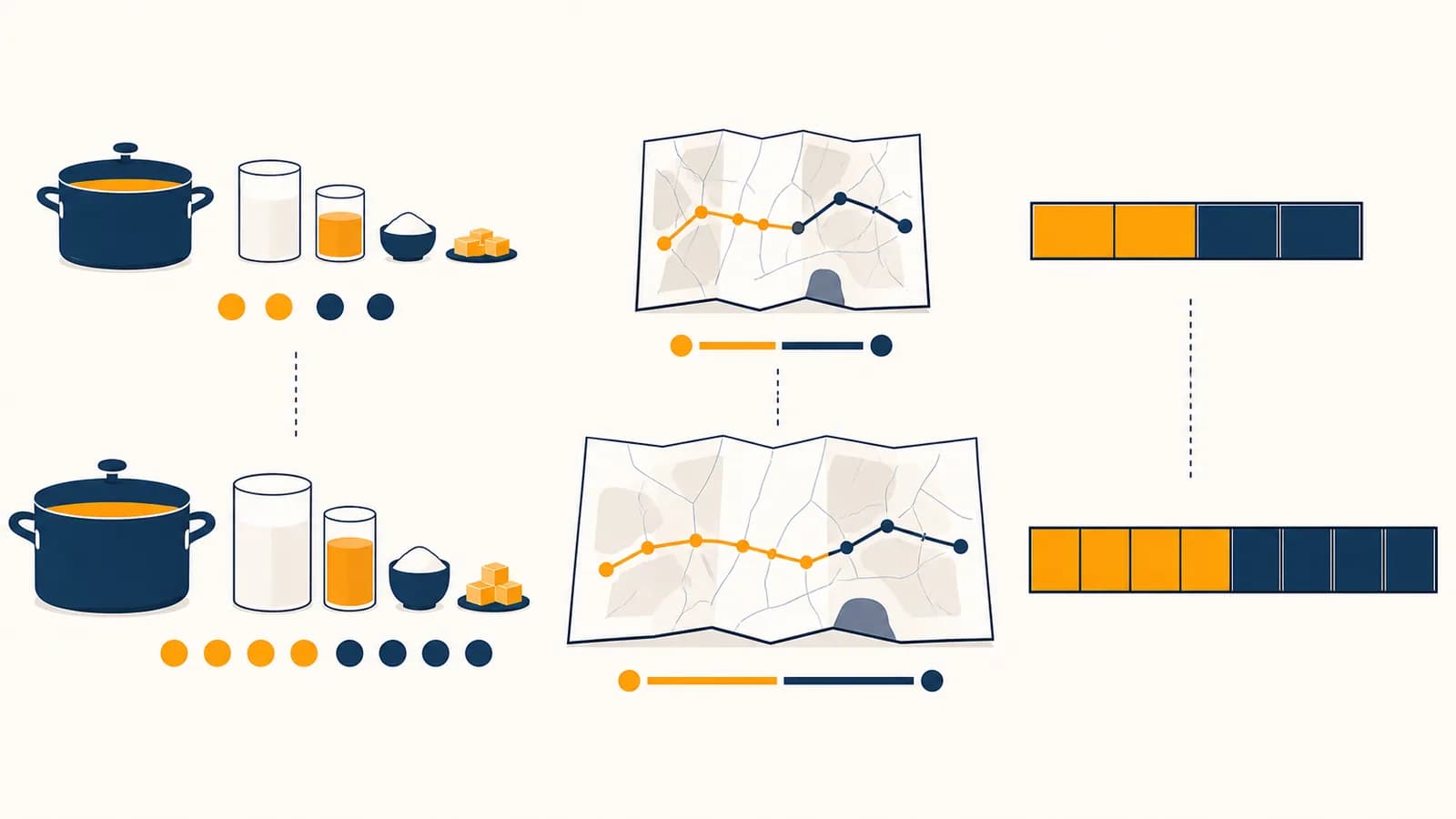
Ratios and proportions are mathematical relationships that compare quantities and express equal relative scale, in the context of arithmetic, algebra, measurement, and practical calculation. A ratio answers questions such as “how many per one?” or “how much of one quantity for another?” A proportion states that two ratios are equal. Ratios can be written with a colon, as a fraction, or with the word “to,” while proportions are equations. The idea exists because recipes, maps, prices, mixtures, speeds, scale drawings, and many other situations must stay consistent when their absolute size changes.
What a ratio actually is
A ratio is an ordered comparison of two quantities by division. The ratio means , provided . Its order, units, and stated reference group determine exactly what the comparison means.
Suppose a fruit bowl contains 6 apples and 4 oranges. The ratio of apples to oranges is , which simplifies to . For every 3 apples, there are 2 oranges. Reversing the order gives the orange to apple ratio, . These ratios describe the same bowl from different directions, but they do not answer the same question.
A part to part ratio compares two separate groups, such as apples to oranges. A part to whole ratio compares one group with the total. The bowl contains 10 pieces of fruit, so the apple to total ratio is . Confusing the other part with the whole is one of the fastest ways to get a plausible but wrong answer.
Ratios may compare quantities with the same unit or different units. The ratio of 12 centimetres to 8 centimetres simplifies to because the centimetre units cancel. A speed of 150 kilometres in 3 hours becomes 50 kilometres per hour. Here the units do not cancel, and the resulting rate keeps both parts of the comparison.
Order is part of the meaning. A ratio of 2 teachers to 25 students is not interchangeable with 25 students to 2 teachers, even though both statements use the same quantities.
A ratio can include more than two terms. A paint mixture described as might mean 2 parts red, 3 parts blue, and 1 part white. The mixture contains 6 equal parts in total. A 12 litre batch therefore needs 4 litres red, 6 litres blue, and 2 litres white because each original part has been multiplied by 2.
How equivalent ratios work
Equivalent ratios express the same relative comparison with different numbers. Multiplying or dividing every term by the same nonzero number preserves the ratio because the underlying quotient does not change.
For example, multiplying both terms of by 4 gives . Both quotients equal .
The multiplier is a scale factor. If a recipe uses flour and water in a ratio, doubling the recipe changes the amounts to . The quantities grow, but their relationship stays fixed. Multiplying only the flour would change the recipe rather than scale it.
Simplifying a ratio runs the same process backward. Divide all terms by a common factor, preferably their greatest common factor. For , the greatest common factor is 6, so . This simplest form makes comparisons easier, but the unsimplified ratio may still carry useful context. A score of 18 correct answers out of 30 tells you the actual test length; does not.
For 18 correct answers and 12 incorrect answers, correct to incorrect is .
Convert before simplifying if the units match in kind. For 2 metres to 50 centimetres, use , not .
Dividing by 6 gives .
The simplified ratio says there were 3 correct answers for every 2 incorrect answers.
Decimal and fractional terms are allowed, though clearing them often makes the comparison easier to read. The ratio becomes after multiplying both terms by 10, then after dividing by 5. No approximation is involved.
What a proportion actually is
A proportion is an equation asserting that two ratios are equal. In , both sides must represent the same comparison in the same order, and the denominators and cannot be zero.
If 3 notebooks cost 12 dollars at a constant price, then 5 notebooks cost dollars according to the proportion . The left side compares notebooks with dollars, so the right side must do the same. Writing silently changes the order and creates the wrong equation.
is one comparison. It may describe 3 notebooks for every 4 dollars, 3 red tiles for every 4 blue tiles, or another stated relationship.
is an equation between two ratios. It makes a claim that can be checked as true or false.
A proportion is true only if its ratios have the same value. The statement is true because simplifies to . The statement is false. A proportion with an unknown asks which value makes the equation true.
The language matters. “Three out of every eight” identifies the ratio . “Three is to eight as six is to sixteen” states the proportion . Reading the quantities before calculating helps distinguish a comparison from an equality claim.
How solving a proportion works
To solve a proportion, preserve the matching quantities and find the scale factor, a unit rate, or a cross product. Each method expresses the same multiplicative structure, so the clearest method depends on the numbers and context.
Return to the notebook example: 3 notebooks cost 12 dollars, and 5 notebooks cost dollars. The scale factor from 3 to 5 is . Apply it to the cost: . The answer is 20 dollars.
A unit rate reaches the same result by finding the value for one unit. Twelve dollars divided by 3 notebooks is 4 dollars per notebook. Five notebooks at that price cost dollars. Unit rates are especially useful when you want to compare several offers.
For , cross multiplication gives , so .
Cross multiplication works because multiplying both sides of by clears both denominators. It is not a separate law that lets numbers jump diagonally. It is ordinary multiplication applied to an equation. This explanation also shows why zero denominators are forbidden.
Estimation should come before acceptance. Five notebooks must cost more than three notebooks if the price per notebook is positive and constant, so an answer below 12 dollars would signal a setup or arithmetic error. Exact calculation and a size check support each other.
A printer produces 84 labels in 6 minutes at a steady rate. The unit rate is labels per minute. In 15 minutes it produces labels. The model assumes the machine runs continuously at the same rate.
The final sentence in that scenario is part of the mathematics. A proportion is a model, and a model depends on conditions. Warmup time, paper jams, bulk discounts, fixed fees, and capacity limits can break a constant ratio. Solving the equation correctly does not prove that proportionality was the right assumption.
Ratios versus fractions, rates, and percentages
Ratios, fractions, rates, and percentages all use division, but they frame the quotient differently. A ratio compares quantities, a fraction often names part of one whole, a rate compares different units, and a percentage fixes the denominator at 100.
In a class with 12 students wearing glasses and 18 not wearing glasses, the glasses to no glasses ratio is . The fraction wearing glasses is , because the denominator is the entire class. The same count produces different expressions because the reference group changes.
The page on how fractions and decimals represent division develops the number forms behind these calculations. A ratio can be evaluated as a fraction, but its wording may still compare two parts rather than a part and a whole.
A rate compares quantities with different units. Driving 180 kilometres in 3 hours gives the rate kilometres per hour. A unit rate has a denominator of one unit, even when the written form leaves that 1 implicit. Price per kilogram, beats per minute, and litres per second are rates.
A percentage is a part to whole ratio expressed per 100. In the class example, , so 40 percent of the students wear glasses. The guide to converting and calculating percentages extends this connection to percentage change and reverse percentages.
The bars show a whole divided into complementary parts. They do not directly display the part to part ratio, though that ratio can be recovered from 40 to 60 and simplified. Always identify what each number is being compared with before choosing a form.
How proportional relationships show up in graphs and equations
A proportional relationship has the equation , where is the constant of proportionality. Its graph is a straight line through the origin, and every nonzero input gives the same ratio .
Suppose a tap fills containers at 4 litres per minute. Time is , volume is , and the equation is . After 3 minutes the volume is 12 litres; after 7.5 minutes it is 30 litres. Each pair gives the same quotient: .
| Time in minutes, | Volume in litres, | Ratio |
|---|---|---|
| 1 | 4 | 4 litres per minute |
| 3 | 12 | 4 litres per minute |
| 7.5 | 30 | 4 litres per minute |
The origin matters. At zero minutes, the tap has added zero litres. A straight line that does not pass through the origin can represent a constant rate of change without representing a proportional relationship. A taxi fare with a 5 dollar starting charge and 2 dollars per kilometre follows . Its graph is straight, but doubling the distance does not double the total fare.
. The ratio stays at 4, the graph passes through , and doubling doubles .
. The slope stays at 2, but changes because the fixed starting amount affects smaller inputs more strongly.
This distinction connects proportions with how linear functions connect equations and graphs. All proportional relationships are linear, but linear relationships with a nonzero intercept are not proportional.
To find from a table, divide any nonzero output by its matching input. To find it from a graph, use the rise from the origin divided by the run. To find it from an equation already written as , read the coefficient of . Agreement among these views confirms the model.
How ratios show up in recipes, maps, mixtures, and money
Ratios control real situations whenever relative composition, scale, or unit value must remain fixed. Recipes preserve ingredient balance, maps preserve relative distance, mixtures preserve concentration, and price comparisons reduce packages to a shared unit.
A recipe keeps ingredient relationships fixed
A recipe that serves 4 people uses 300 grams of rice. For 10 people, the serving scale factor is . Multiplying the rice by 2.5 gives 750 grams. Every scalable ingredient should receive the same factor.
Real kitchens add constraints. An egg cannot always be divided conveniently, a pan has limited volume, and cooking time may not scale in direct proportion to ingredient mass. The ratio calculation gives the target amounts; practical judgment decides whether the whole process scales cleanly.
A map turns drawn distance into actual distance
A scale of 1 centimetre to 5 kilometres means each centimetre on the map represents 5 kilometres on the ground. A route measuring 7.2 centimetres represents kilometres. The conversion follows the map scale, not the physical size of the screen or paper after resizing.
A printed scale bar can remain useful after proportional resizing because the bar changes size with the map. A written statement such as “1 centimetre represents 5 kilometres” becomes false if the image is enlarged without updating the statement.
A mixture depends on parts, not container size
A cleaning solution mixed as 1 part concentrate to 9 parts water has 10 parts total. For 2 litres of finished solution, each part is litre. The mixture needs 0.2 litre concentrate and 1.8 litres water.
The concentrate to water ratio is , while the concentrate to total ratio is . Those are not interchangeable. Safety instructions may specify one form, so the labels attached to the numbers matter as much as the arithmetic.
A unit price makes unlike packages comparable
A 750 gram package costing 4.50 dollars has a unit price of dollar per gram, or 6 dollars per kilogram. A 1.2 kilogram package costing 6.60 dollars has a unit price of dollars per kilogram. On price alone, the larger package is cheaper per kilogram.
Unit price is a ratio, not a complete buying decision. Waste, storage, quality, and the amount actually needed still matter. The calculation answers one precise question: how much money is charged for the same amount of product?
4 mistakes people make with proportions
Most proportion errors come from mismatched order, incompatible units, additive thinking, or an unjustified constant rate. A reliable check names both quantities, aligns their units, tests the multiplicative pattern, and asks whether the situation can really scale.
1. Reversing one ratio but not the other
If 4 metres of fabric cost 28 dollars, the setup for 7 metres is or . Both are valid because each equation keeps the order consistent. The mixed setup compares metres per dollar on one side with dollars per metre on the other.
2. Comparing measurements before converting units
The ratio of 2 metres to 50 centimetres is not . Convert 2 metres to 200 centimetres, giving . Alternatively, convert 50 centimetres to 0.5 metre, giving . Compatible units reveal the real relative size.
3. Adding the same amount instead of multiplying
The ratios and are not equivalent, even though 2 was added to both terms. Their quotients are and . Equivalent ratios come from a shared multiplier or divisor, such as .
Equal differences do not make equal ratios. Proportional reasoning is multiplicative. If one quantity doubles, its paired quantity must double as well for the ratio to stay fixed.
4. Assuming every two quantity problem is proportional
A worker who earns 18 dollars per hour with no fixed payment has proportional gross pay, . Add a one time 40 dollar equipment allowance and the relationship becomes . The hourly change stays constant, but the total pay to hours ratio does not.
Look for phrases such as “at a constant rate,” “for every,” and “same mixture,” but do not treat them as automatic proof. Check a table for constant quotients, an equation for the form , or a graph for a straight line through the origin.
How do you find a missing value in a ratio table?
Find the multiplier connecting one known entry to another, then apply that same multiplier to its paired value. If the multiplier is awkward, divide to find the value for one unit and build the missing pair from there.
Suppose 5 tickets cost 35 dollars, and a table asks for the cost of 8 tickets. Dividing by 5 gives 1 ticket for 7 dollars. Multiplying by 8 gives 8 tickets for 56 dollars. The full chain is visible:
A table can also be filled by combining rows. If 3 boxes hold 24 markers and 2 boxes hold 16 markers, then 5 boxes hold markers, provided box size is constant. This works because proportional relationships preserve multiplication and addition of matching bundles.
Ratio tables are useful because they keep labels visible. They also expose inconsistent data. If 2 items cost 6 dollars and 5 items cost 20 dollars, the unit prices are 3 dollars and 4 dollars. One constant proportion cannot describe both rows.
How do you divide an amount in a given ratio?
Add the ratio terms to count the total number of equal shares, divide the amount by that total, then multiply one share by each term. The resulting parts add to the original amount and preserve the requested ratio.
To divide 420 dollars in the ratio , first count shares. Each share is dollars. The parts are dollars and dollars. They total 420 dollars, and simplifies to .
With , , and , the parts are 180 and 240.
For a three term ratio, add all three terms. Dividing 72 kilograms in the ratio creates 9 shares of 8 kilograms each. The parts are 16, 24, and 32 kilograms. Their sum is 72 kilograms.
Do not divide the total by one term and then improvise the rest. The terms describe shares of a common unit. Finding that common share first keeps every part tied to the same scale factor.
How can you tell if a relationship is proportional?
A relationship is proportional if every valid pair has the same output to input ratio and zero input corresponds to zero output. In a table check quotients, in an equation look for , and on a graph check for a straight line through the origin.
Consider the pairs , , and . Their output to input ratios are , , and . The constant is , so the equation is .
Now consider , , and . Each increase of 3 in adds 9 to , so the points lie on a straight line with slope 3. Yet the quotients , , and differ. The equation is , so the relationship is linear but not proportional.
A tank already contains 10 litres before a pump starts adding 3 litres per minute. Added water is proportional to time, . Total water is not proportional to time, , because the tank does not contain zero litres at time zero.
The variables you choose can change the answer. In the tank example, “water added” and “total water” describe related but different quantities. Clear labels prevent a correct calculation from answering the wrong question.
Ratios make multiplicative structure visible
Ratios connect arithmetic, algebra, geometry, measurement, and data by describing how quantities change together. The lasting skill is to identify the comparison, keep its order and units clear, then test whether one multiplier truly governs the situation.
The basic arithmetic is often short. The reasoning lies in choosing the correct reference group, deciding whether the relationship is constant, and interpreting the quotient with its units. Those habits carry into scale factors in similar figures, slope in coordinate geometry, concentration in science, probability odds, exchange rates, and rates of change.
You can place this topic within the wider set of mathematics explanations and applications, where the same multiplicative thinking reappears in equations, functions, geometry, and statistics. The symbols change, but the question stays recognizable: what remains fixed while the quantities change?
Try the idea on an ordinary label or receipt. Find two quantities, write their ratio in a stated order, attach the units, and calculate the unit rate. Then ask what would have to remain constant for your result to predict a larger or smaller case.
The takeaway: A ratio is a division based comparison, a proportion is an equality between ratios, and proportional reasoning works only when the same scale factor applies to every matching quantity.