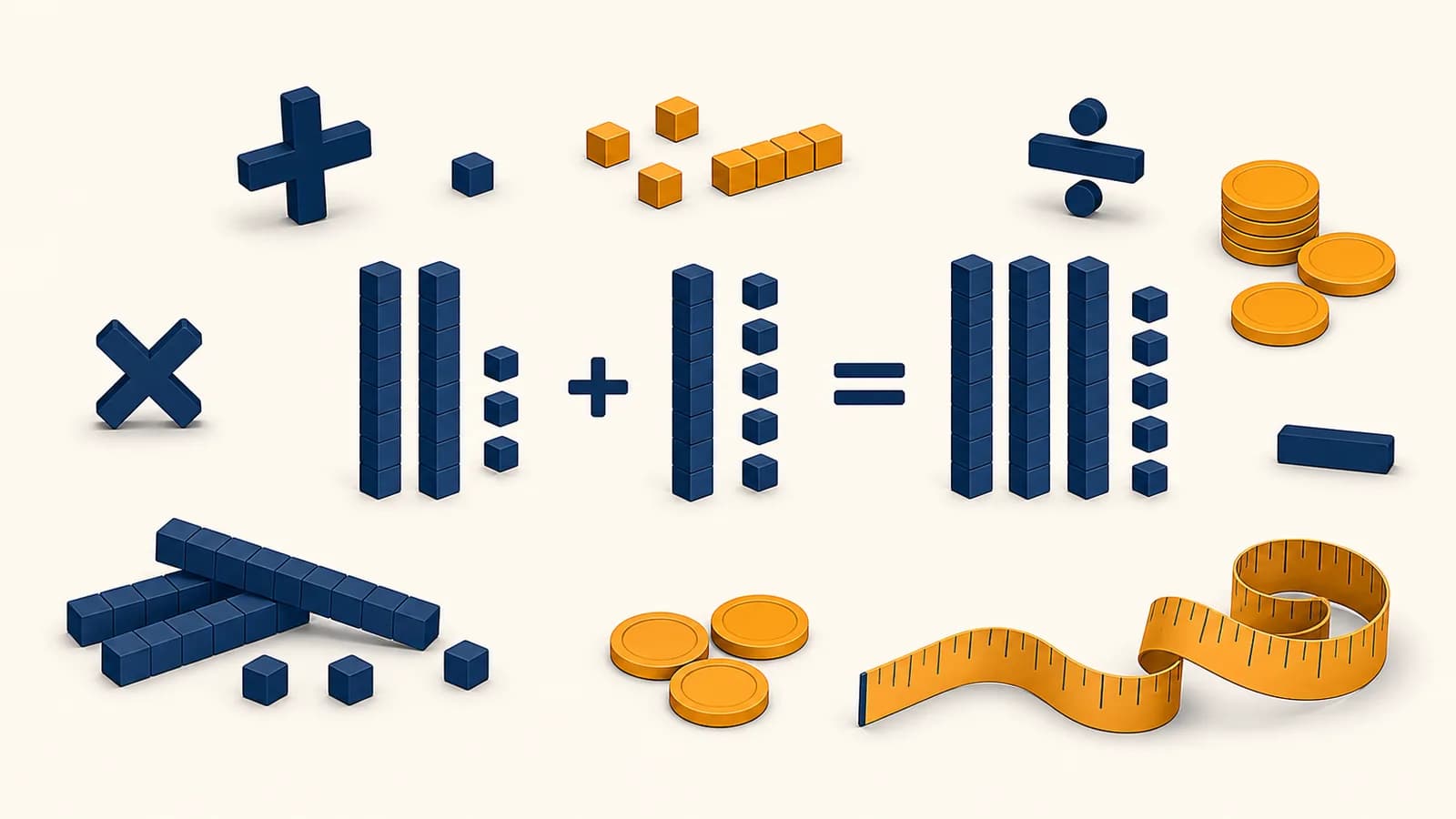
Basic arithmetic is a branch of mathematics that combines and compares quantities using addition, subtraction, multiplication, and division, in the context of counting, measuring, and everyday calculation. These four basic arithmetic operations answer familiar search questions such as how to add, subtract, multiply, divide, use negative numbers, and follow the order of operations. Arithmetic exists because people need a consistent way to track how quantities change, split a total fairly, compare amounts, and check that records agree.
A grocery receipt, a medication label, a bank balance, and a carpenter's tape all ask the same underlying questions. What amount is present? What changed? How many equal groups fit? Which calculation should happen first? Arithmetic turns those questions into operations whose results another person can reproduce and check.
What basic arithmetic actually is
Basic arithmetic is the study of numbers, place value, operation symbols, and the rules that make numerical calculations consistent. It works with whole numbers, negative numbers, fractions, and decimals, although the four operations keep the same meanings across those forms.
A number can describe a count, a measurement, a position, or a label. The 12 in “12 bolts” is a count. The 12 in “12 centimetres” is a measurement. The 12 on a bus route is usually a label, so adding two route numbers would not describe anything useful. Before calculating, identify what the numbers represent.
Place value gives a written digit its size. In 4,572, the 4 means four thousands, the 5 means five hundreds, the 7 means seven tens, and the 2 means two ones. Moving one place left multiplies a digit's value by 10. Moving one place right divides its value by 10. The same structure continues past the decimal point: tenths, hundredths, and thousandths.
The symbols tell you which relationship to apply, but units tell you what the result means. Adding 3 metres and 5 metres gives 8 metres. Multiplying 3 metres by 5 metres gives 15 square metres if the lengths are perpendicular sides of a rectangle. The digits alone do not carry that distinction.
Units are part of the arithmetic. Write them beside intermediate results. A correct number with the wrong unit can still be a wrong answer.
How the four arithmetic operations work
The four arithmetic operations describe distinct changes: addition combines quantities, subtraction removes or compares them, multiplication scales them, and division shares them or counts equal groups. Their written methods use place value, and inverse operations provide a direct way to check results.
Addition and subtraction combine, remove, and compare quantities
Addition produces a total from two or more quantities, while subtraction finds a remainder, a signed change, or the difference between quantities.
Consider . Ones combine with ones: , so write 5 ones and regroup 10 ones as 1 ten. Tens then give tens, so write 2 tens and regroup 10 tens as 1 hundred. Hundreds give . The total is 825.
Put ones under ones, tens under tens, and decimal points under decimal points.
Start at the smallest place value so any regrouping moves into the next column.
Exchange 10 units in one place for 1 unit in the place immediately to its left.
For an addition result, subtract one addend from the total and look for the other addend.
Subtraction uses the same place system. For , the ones column cannot take 8 from 2. The tens column contains zero tens, so regroup 1 hundred as 10 tens, then regroup 1 of those tens as 10 ones. The written places now represent 4 hundreds, 9 tens, and 12 ones. Calculate , , and . The difference is 224.
Subtraction has more than one interpretation. If a tank holds 90 litres and 34 litres leave, finds the remainder. If one shelf is 90 centimetres long and another is 34 centimetres long, the same calculation finds how much longer the first shelf is. On a number line, subtraction can also find the distance from one position to another, provided direction is handled carefully.
Since , the check is .
Multiplication and division scale and share quantities
Multiplication scales one quantity by another, and division reverses that scaling by finding either the size of each equal share or the number of equal groups. Place value and the distributive property explain the standard written methods for both operations.
Multiplication is often introduced as repeated addition. Four bags with 6 apples each contain apples. Scaling is the broader idea. Multiplying a 2.5 metre length by 3 makes it 7.5 metres even though 2.5 is not a count of separate objects.
The written method for breaks 14 into . First, . Then, . Add the partial products to get 322. This works because multiplication distributes over addition.
For : .
Division answers two related questions. If 24 apples are shared equally among 4 people, asks for the size of each share, which is 6. If bags hold 4 apples each, asks how many bags are needed, which is also 6. One interpretation shares; the other measures groups.
Long division makes repeated place value decisions. For , ask how many groups of 4 fit into 9 hundreds. Two groups fit, using 8 hundreds, and 1 hundred remains. Regroup that remainder with the 3 tens to make 13 tens. Three groups fit, using 12 tens, and 1 ten remains. Regroup with 6 ones to make 16 ones. Four groups fit. The quotient is 234.
A remainder is information, not an error. If 29 people travel in cars that each hold 4 passengers, gives 7 remainder 1. Seven full cars are not enough, so the situation requires 8 cars. If 29 biscuits are packed four per bag, the same remainder may mean 7 full bags and 1 loose biscuit. Context decides how to report it.
How negative numbers change the operations
Negative numbers represent values below a chosen zero, and arithmetic with them tracks both magnitude and direction. Addition combines signed changes, subtraction adds the opposite, and multiplication or division uses the signs to determine the direction of the result.
A negative number is not automatically a debt or a loss. It may describe a temperature below zero, an elevation below sea level, or movement in a chosen reverse direction. The minus sign has two jobs: in it marks a negative number, while in it names the operation of subtraction.
On a number line, adding a positive number moves right and adding a negative number moves left. Starting at 5 and adding lands at . Subtracting a number means adding its opposite, so becomes . Removing a negative change has the same numerical effect as adding a positive change.
“Two negatives make a positive” is applied to every expression containing two minus signs.
Two negative factors have a positive product. In addition, equals , not 7.
The sign rule for multiplication follows from keeping the distributive property consistent. Since and 0 can be written as , then plus must equal zero. Therefore . A similar argument makes the product of two negative factors positive.
Absolute value measures distance from zero without direction. Both and 12 have an absolute value of 12. This matters when the question asks for the size of a difference rather than its direction. A balance moving from 20 to 13 changes by , but the magnitude of the change is 7.
How the order of operations works
The order of operations is a shared convention for reading an expression with several operations: evaluate grouping symbols first, then exponents, then multiplication and division from left to right, followed by addition and subtraction from left to right.
The convention prevents one string of symbols from producing several answers. For , multiplication happens before addition, so the result is . Parentheses can request a different structure: .
Multiplication and division have equal priority. Work left to right. The same is true for addition and subtraction. The mnemonic PEMDAS does not make multiplication outrank division.
For , work left to right: , then . Dividing by as if the expression were changes its grouping and gives the wrong result. A fraction bar acts as a grouping symbol, so everything in its numerator and denominator should be evaluated before the final division.
A calculator follows entered structure, but different calculator designs show it differently. A basic four function calculator may execute operations as they are entered. A scientific calculator usually respects conventional precedence. Parentheses make the intended order explicit and reduce input errors.
Arithmetic versus algebra
Arithmetic calculates with known numbers, while algebra represents unknown or variable quantities with symbols and studies the relationships between them. The operations do not change; algebra makes their structure visible so one rule can cover many numerical cases.
In arithmetic, is a completed calculation. In algebra, is a condition, and reversing the addition gives . The same inverse relationship used to check arithmetic now solves an equation.
A taxi travels 45 kilometres, then 18 kilometres. What total distance did it travel?
If the two distances are and , the total is . Any suitable pair can replace the letters.
Arithmetic also supplies the numerical evidence used to understand later topics. Repeated calculations reveal patterns. A table of input and output values can expose constant change, which leads to how linear functions model steady rates. Algebra then explains why the pattern continues beyond the entries already calculated.
Estimation belongs to both subjects. If an equation produces 6,042 when all the given quantities are near 20, an order of magnitude check may expose an incorrect operation or misplaced decimal point. Symbolic work still needs numerical sense.
How arithmetic shows up in money and work
Arithmetic in money and work records quantities, rates, totals, differences, and checks. Receipts, wages, stock counts, invoices, construction measurements, and laboratory preparations all depend on matching an operation to the physical or financial meaning of the numbers.
A cafe starts with 18 cartons of milk, receives 12, and uses 21. Its closing count is cartons. Counting the actual cartons then checks the record.
That cafe calculation is an inventory reconciliation. If the shelf count is 8 rather than 9, the arithmetic has not explained the cause, but it has exposed a one carton discrepancy. A delivery may have been recorded incorrectly, a carton may have spoiled, or the physical count may be wrong. Arithmetic creates the check that prompts investigation.
Money calculations demand attention to decimal place value. Suppose three items cost £4.75, £2.40, and £6.85. Their total is £14.00 because . Paying with £20 gives £6.00 change. The subtraction can check the change, and adding £14.00 and £6.00 checks the original payment.
A payslip uses multiplication before addition or subtraction. If someone works 7 hours at £12 per hour, gross pay for that shift is £84 because . If a separate allowance of £9 is added, the total becomes £93. Deductions are then subtracted according to the actual payslip. Percent deductions require an additional idea developed in calculating rates, ratios, and proportions.
Trades use arithmetic with measurements. A wall 4.2 metres wide needs skirting board, but a 0.9 metre doorway needs none. The required run is 3.3 metres because . This is the amount before allowing for the job's cutting plan. If boards come in fixed lengths, division determines how many boards are needed, and any remainder may force the count to round upward.
For the cafe: cartons.
Laboratory arithmetic follows the same logic but may use much smaller units. A technician who needs four trays with 24 sample positions calculates positions. The arithmetic is elementary; the discipline lies in tracking labels, units, and which count belongs to which batch.
How estimation and checking catch errors
Estimation replaces exact values with nearby convenient values to predict the rough size of an answer, while checking uses inverse operations, a second method, or the original context to test whether an exact result is plausible and internally consistent.
Suppose a basket contains items priced at £19.80, £31.25, and £8.70. Rounding to £20, £31, and £9 predicts a total near £60. The exact sum is £59.75. An answer of £597.50 would fail the estimate immediately, even if it came from a calculator.
Round the inputs enough to make a mental calculation easy, but keep their scale.
Use a written method or calculator, keeping decimal points and units visible.
Check addition with subtraction, or multiplication with division.
Ask whether a remainder, negative sign, or fractional unit makes sense in the situation.
Different estimates answer different needs. Rounding every price upward gives a safe upper estimate for checking whether cash is sufficient. Rounding to the nearest convenient value gives a closer prediction. Truncating decimals, which simply drops later digits, is not the same as rounding and creates a consistent downward bias for positive numbers.
Inverse checks are strong but not infallible. If the same wrong number is copied into both calculations, the check may agree. An independent method is better for important work. Add a column from bottom to top after first adding it top to bottom, or calculate a multiplication once by distribution and once with a calculator. A calculator can confirm keystrokes; an estimate can test whether the keystrokes described the right calculation.
Arithmetic also supports data checks. A set of category counts should add to the stated total. A set of percentages describing all mutually exclusive categories should total 100%, apart from a small stated rounding difference. Statistical interpretation then asks what those totals reveal and what they leave uncertain.
5 mistakes people make with basic arithmetic
Most arithmetic errors come from losing place value, changing the intended grouping, confusing a sign with an operation, dropping units, or reporting a remainder without interpreting it. Each mistake can be caught by writing one extra line or performing an independent check.
1. Misaligning decimal places
Decimal columns must be aligned by place value, not by the last visible digit. For , write to get 4.15. Aligning the 7 with the 5 would mix tenths and hundredths.
2. Treating the minus sign as decoration
A negative sign changes the number's position relative to zero. The difference between and 2 is 8, because moving from to 2 covers eight units. Ignoring the sign would incorrectly produce a difference of 4.
3. Applying precedence as a letter chant
The order of operations has paired levels. Multiplication and division share one level, while addition and subtraction share another. Within a shared level, work left to right unless grouping symbols specify a different order.
4. Rounding during every intermediate step
Repeated rounding can accumulate error. Keep the available digits through intermediate calculations, then round the final answer to a precision justified by the original measurements or the reporting requirement. An estimate is separate from that exact calculation.
5. Giving a remainder without reading the situation
A quotient of 7 remainder 1 can mean 8 vehicles, 7 full packages plus one loose item, or 7 complete time periods with some time left. The operation finds the structure; the noun and the decision determine the reported answer.
Fast diagnostic: If an answer looks wrong, check the sign, decimal position, operation order, and unit before repeating the entire calculation.
What zero actually is
Zero represents no quantity at a position, serves as the dividing point between positive and negative numbers, leaves a number unchanged under addition, makes any product zero, and cannot be used as a divisor in ordinary arithmetic.
As a placeholder, zero preserves place value. The numbers 52 and 502 are different because the zero in 502 records that there are no tens. In decimals, 0.5 and 0.50 name the same value, but the extra zero may communicate measured precision in a scientific setting.
Adding zero changes nothing, so zero is called the additive identity. Multiplying by one changes nothing, so one is the multiplicative identity. Multiplying by zero gives zero because zero equal groups contain no objects, and any number of groups with zero objects also contains none.
For : , , and .
Division by zero is undefined because it cannot satisfy the inverse relationship with multiplication. If were some number , then would have to equal 8. Yet every number multiplied by zero equals zero. No ordinary number can meet the requirement.
How fractions, decimals, and percentages work
Fractions, decimals, and percentages are different notations for quantities that may lie between whole numbers, and the four arithmetic operations still apply to them. Correct calculation depends on preserving place value or rewriting quantities in a compatible form.
A fraction records division. The fraction means , which equals 0.75. A percentage uses a denominator of 100, so 75% means and also equals 0.75. These are three names for the same point on the number line.
To add fractions, use a common denominator because the pieces must have the same size. One third plus one sixth becomes two sixths plus one sixth, which is three sixths or one half. Multiplying fractions does not require common denominators because it scales one fraction by the other.
Decimals use the base ten place system, so written addition and subtraction align decimal points. Multiplying by 10 moves every digit's value one place to the left relative to the decimal point. The decimal point itself need not be imagined as moving. A fuller treatment appears in how fractions and decimals represent the same quantities.
Converting notation should serve the task. Fractions can preserve exact values, decimals fit money and metric measurement, and percentages make comparisons against a common base of 100 easy to read. None is inherently more accurate unless rounding has changed the value.
How mental arithmetic, written methods, and calculators work together
Mental arithmetic suits short calculations and estimates, written methods expose place value and preserve an audit trail, and calculators handle long or repetitive computations. Good numerical work chooses the method that is fast enough, transparent enough, and easy to check.
Mental strategies often rearrange a calculation without changing it. For , add 2 to 198 to make 200, subtract that 2 from 37 to make 35, then calculate . Compensation works because the total change is zero.
A written method is useful when several digits, decimal places, or intermediate values must remain visible. It also lets another person locate an error. For work involving money, measurements, or safety limits, a clear record may matter as much as speed.
The displayed result is accepted without checking the entered operation, units, or scale.
An estimate predicts the range, the expression is entered with clear grouping, and the output is read in context.
Calculators are especially useful for repeated multiplication, long division, and expressions with many terms. They do not decide which values belong in the calculation. Entering the wrong tax rate, length, or sign can produce a perfectly calculated answer to the wrong problem.
A practical routine is to estimate mentally, calculate with the appropriate tool, then check by reversal or context. The three actions do different jobs. Estimation tests scale, calculation finds the requested value, and checking tests consistency.
Basic arithmetic is the working language of mathematics
Basic arithmetic supplies the operations, place value, signs, and checking habits used throughout mathematics. Algebra reorganises them, geometry applies them to shape and measure, and statistics applies them to data, but every later calculation still depends on their meanings.
The useful skill is not performing a column method at maximum speed. It is recognising what an operation says about a quantity. Addition combines, subtraction compares or removes, multiplication scales, and division shares or measures groups. Place value keeps the written quantities aligned; operation order keeps expressions unambiguous.
Notice arithmetic in the next receipt, timetable, recipe, or measurement you use. Name the quantities and units, predict the result's rough size, calculate it, then reverse the operation. That small routine connects basic calculation to the wider structure of school mathematics and makes errors easier to see before they affect a decision.
The takeaway: Arithmetic is a system for tracking quantities and their changes. A reliable answer includes the right operation, correct place value, a sensible unit, and a check against the situation.