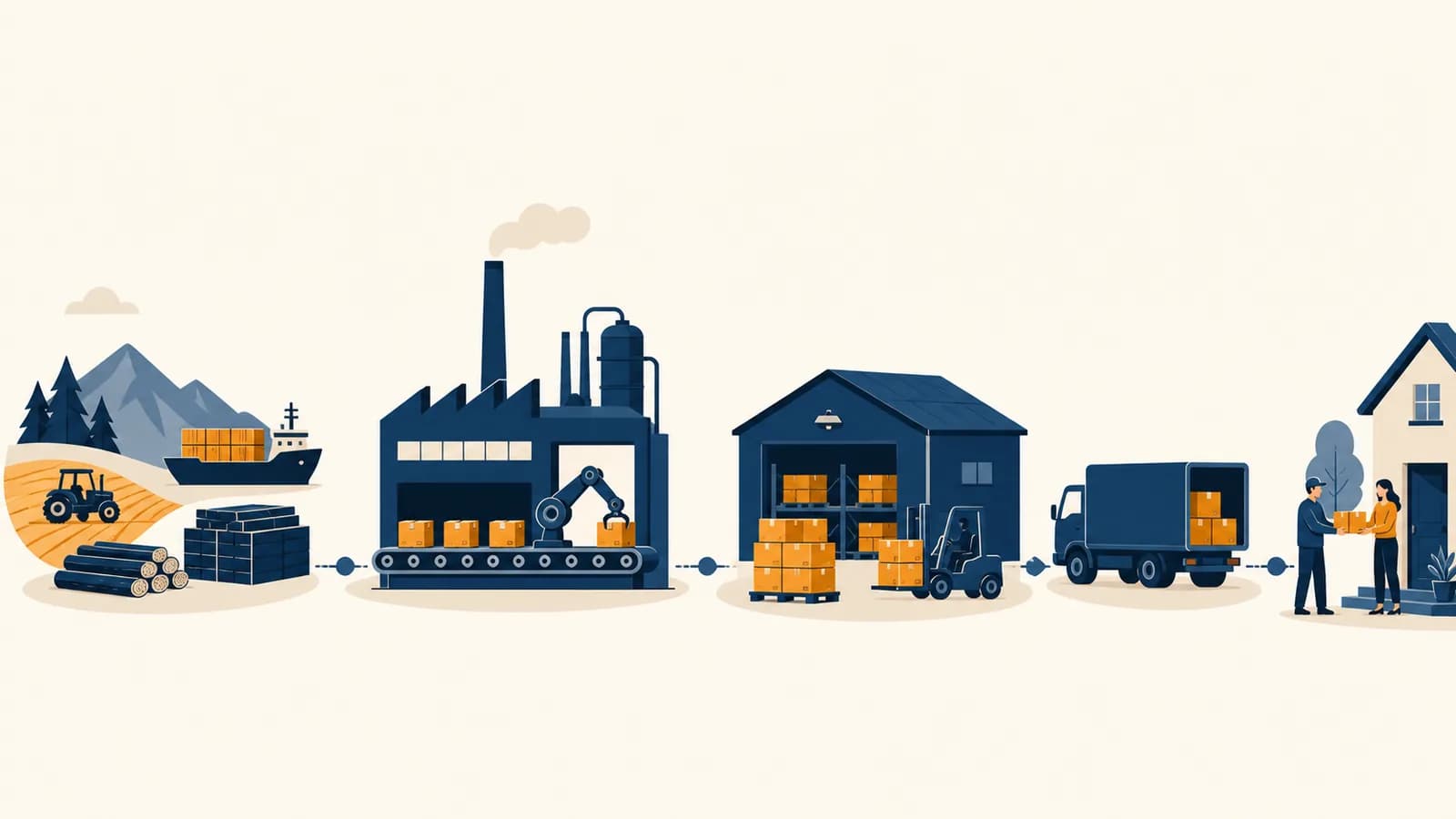
Supply chain management is a business discipline that coordinates the flow of materials, information and money from suppliers to customers, in the context of producing and delivering goods and services. A supply chain management definition therefore includes procurement, operations, logistics, inventory management and demand forecasting. The idea exists because no business can sell a product reliably unless the right inputs reach the right place, in the right condition, when they are needed. Good management links those decisions instead of letting each department optimize its own small piece.
Consider a jar of pasta sauce. Tomatoes must be grown and processed, glass must be formed, labels must be printed, recipes must meet food rules, and finished jars must reach shops before shoppers want them. A delay in one modest item, such as metal lids, can stop the sale of the whole product. Supply chain management treats those connections as one operating system.
What a supply chain actually is
A supply chain is the connected network of organizations, people, facilities and activities that creates and delivers a product or service. It carries physical goods toward customers, while orders, forecasts, payments and performance data move in both directions.
The word chain is convenient but slightly misleading. Most products do not pass through one straight sequence. They move through a network. A phone maker may buy screens from one supplier, chips from another and packaging from a third. Each supplier has suppliers of its own. Warehouses, ports, software providers, banks, repair centres and recycling firms may all take part.
Three flows keep that network working. Materials include ingredients, parts, packaging and returned products. Information includes purchase orders, stock records, shipment notices and sales forecasts. Money includes customer payments, supplier invoices, credit and taxes. If the information flow is late or wrong, the physical flow soon suffers. A warehouse system that says 500 units are available when only 50 exist can promise stock that cannot be shipped.
The network also has upstream and downstream sides. Upstream activity looks toward sources, such as farms, mines and component makers. Downstream activity looks toward distribution, retailers, customers, returns and disposal. A business may sit in the middle of several supply chains at once. A bakery buys flour upstream, sells loaves downstream and also supplies sandwiches to offices through a separate route.
A supply chain is wider than one company. A manager can control internal orders and stock directly, but supplier capacity, port congestion, customer demand and weather require coordination rather than command.
How supply chain management works
Supply chain management works by translating expected customer demand into linked decisions about sourcing, capacity, production, inventory and delivery. Managers compare the plan with actual events, correct gaps and share updated information with every party whose work depends on it.
Use past sales, confirmed orders, promotions, seasonality and market knowledge to estimate what customers will request by product, place and time.
Check whether suppliers, workers, machines, storage space and transport can meet that demand. Identify the constraint before it stops the whole plan.
Select suppliers, agree specifications, prices and lead times, then issue purchase orders. Supplier quality matters because defects move downstream.
Schedule production, assembly, picking or service work. Record what was consumed and what finished output became available.
Allocate inventory, pack orders, select routes and carriers, and provide customers with accurate delivery information.
Inspect returns, arrange refunds, repair or recover products, and feed causes of failure into the next forecast and sourcing decision.
This cycle is continuous. A plan made on Monday may be wrong by Wednesday because a large order arrives, a machine fails or a supplier misses a shipment. Control therefore depends on feedback. Managers compare planned demand with actual sales, promised dates with actual arrivals, and recorded stock with counted stock. They investigate meaningful differences rather than blindly preserving the old plan.
Coordination prevents a familiar business problem: local success that harms the total result. Purchasing may get a lower unit price by ordering a full truck, while the warehouse pays for months of storage and risks obsolete stock. Production may maximize machine use by making huge batches, while customers wait for a different product. The best decision minimizes the relevant total cost while meeting the required service.
This is one reason supply decisions belong within the wider study of Business. They connect finance, marketing, operations, people and strategy through choices that can be measured in cash, time and customer outcomes.
Demand planning turns uncertain sales into operating decisions
Demand planning is the process of estimating future customer requirements at a useful level of detail. It does not remove uncertainty. It gives purchasing, production and distribution a shared starting point, along with assumptions that can be revised when evidence changes.
A monthly total is rarely enough. A retailer needs demand by item and location. A factory needs it by product family and production period. A restaurant needs it by ingredient and day. Planners begin with historical patterns, then adjust for known causes such as holidays, price changes, promotions, new competitors and product launches.
A shop sold 100 reusable bottles last week. It expects an advertised promotion to add 30 sales, but a planned two-day closure to remove 20. Its working forecast is 110 bottles. The arithmetic is visible: . Each adjustment can later be checked against what happened.
Forecast error is the gap between forecast and actual demand. If the shop forecasts 110 bottles and sells 125, the absolute error is 15. One common percentage measure divides that error by actual demand.
For 125 actual sales and a forecast of 110: .
A forecast should be judged over repeated periods, not by one lucky result. It should also be compared with a simple baseline. If an elaborate model cannot beat using last week's sales, the extra complexity has not earned its cost. Forecasts for individual products are often less stable than forecasts for a broad category because customers can switch between similar items.
Demand can also become distorted as information moves upstream. A small rise in checkout sales may cause a retailer to order extra stock, a wholesaler to add its own safety margin and a manufacturer to schedule a much larger batch. Suppliers then see a dramatic order spike even though final customer demand changed only slightly. This amplification is called the bullwhip effect. Shared sales data, smaller order batches and stable ordering rules can reduce it.
Inventory trades availability against tied-up cash
Inventory is the stock of materials, work in progress and finished goods held for future use or sale. It protects operations against timing and demand uncertainty, but it also consumes cash, space and attention while creating risks of damage or obsolescence.
Cycle stock covers normal demand between replenishments. Safety stock is an extra buffer for uncertainty. Pipeline stock is already moving between locations. Seasonal stock is built before a predictable peak. These categories matter because the remedy for each is different. Faster transport can reduce pipeline stock, while a better demand forecast may reduce the safety buffer.
The reorder point tells a buyer when to place the next order. In a simple case, it equals expected demand during the supplier's lead time plus safety stock.
If lead-time demand is 120 units and safety stock is 30 units, reorder when the inventory position reaches 150 units.
The inventory position normally includes stock on hand plus stock already ordered, minus quantities promised to customers. That distinction prevents duplicate ordering. A shelf may contain only 40 units, but another 200 may already be due tomorrow.
More stock usually improves the chance of immediate availability, but only up to a point. Excess food spoils. Fashion dates. Electronics can be replaced by newer versions. Stored material needs insurance, handling and space. Managers therefore choose a service target and calculate the buffer that fits demand variation, lead-time variation and the cost of a shortage. The correct level is a decision, not a universal percentage.
Supply chain management versus logistics
Logistics manages the movement and storage of goods and related information, while supply chain management coordinates the wider network that plans demand, buys inputs, manages production, designs partnerships and handles returns. Logistics is therefore a major part of supply chain management.
Which carrier and route will move 20 pallets from the factory to the distribution centre by Friday, and where will those pallets be stored on arrival?
Should the business make the product at this factory, how much should it make, which suppliers can support it, and what inventory and delivery promise fit the business strategy?
Procurement is another related term. Procurement identifies requirements, evaluates suppliers, negotiates terms, places orders and manages contracts. Operations transforms inputs into outputs. Logistics moves and stores those outputs. Supply chain management links all three to customer demand and financial goals.
| Decision | Typical focus | Example measure |
|---|---|---|
| Procurement | Supplier, specification, price and contract | Supplier defect rate |
| Operations | Capacity, schedule, quality and process | Output per machine hour |
| Logistics | Transport, storage and order fulfilment | Orders delivered on time |
| Supply chain management | End-to-end trade-offs across the network | Total cost to serve |
The boundaries can vary by organization. A small business may give one person all these duties. A large business may have separate teams for category sourcing, production planning, warehousing, transport and returns. The names matter less than whether the decisions use shared facts and support the same customer promise.
How supply chain management shows up in a supermarket
A supermarket supply chain matches thousands of products with local demand while respecting shelf life, storage conditions and limited shelf space. Checkout data triggers replenishment, distribution centres combine flows from suppliers, and workers rotate stock so older goods sell first.
Take milk. The store records each sale through its checkout system. Current stock, expected sales and the next delivery time determine the replenishment request. A distribution centre combines requests from many stores, prepares mixed loads and sends vehicles on scheduled routes. The store checks the delivery, moves milk into refrigeration and fills the shelf. Unsold stock approaching its date may be marked down.
Products need different policies. Tinned food can tolerate a longer cycle and larger batch. Fresh berries need fast handling and accurate temperature control. Ice cream needs an unbroken cold chain. A promotion needs extra stock before the advertisement begins, not after customers have found an empty display.
The business also decides its service promise. Carrying every possible product would use too much cash and space. Carrying too little would lose sales and trust. Assortment, price and availability therefore connect supply decisions with how businesses position products for chosen customers. A discount store and a specialist food shop can make different supply choices because they promise different experiences.
A recorded sale is not the same as full demand. If the shelf is empty, a customer may leave or buy a substitute, and the checkout system never records the missed request. Planners must examine stockouts as well as sales.
How production planning connects orders to factory work
Production planning converts demand into a timed schedule for people, materials and machines. It calculates what must be made, identifies the required components, checks available capacity and sequences jobs so finished products are ready without creating unnecessary queues or stock.
Suppose a desk maker plans 60 desks. Each desk requires one top and four legs. The gross requirement is therefore 60 tops and 240 legs. If 20 tops and 100 legs are already available, the net requirement before allowances is 40 tops and 140 legs. The calculation is simple, but it becomes extensive when a product has hundreds of components and several assembly levels.
For desk tops with no scheduled receipt: tops to obtain.
A bill of materials lists the parts and quantities in one finished unit. Planners multiply it by the production schedule, subtract usable stock and account for incoming orders. They then offset purchase and work orders by lead time. If a component takes ten working days to arrive, the order must be released before the day it is needed.
Capacity creates a second constraint. A factory may have every part but too few machine hours. The slowest or most heavily loaded stage can limit the output of the whole process. Making more work than that stage can handle simply creates a queue. Managers can add a shift, move work to another machine, subcontract it, redesign the process or change the promised date. Each option changes cost and risk.
A workshop can cut 80 panels a day but can paint only 50. Scheduling 80 completed cabinets creates unfinished stock before painting. Unless painting capacity changes, the sustainable output is no more than 50 cabinets a day. Extra cutting looks productive but does not increase sales-ready output.
Quality belongs inside the flow rather than at the end. A faulty component can consume labour, block capacity and cause returns long after it passes inspection. Clear specifications, supplier process checks and traceable batch records help find the source. Measuring useful output and managing time supports these choices, but speed without quality can increase total cost.
How risk and resilience change supply decisions
Supply chain risk is the possibility that an event will disrupt supply, demand, quality, cost or compliance. Resilience is the ability to prepare for disruption, keep essential flows operating and recover. Managers build it by understanding dependencies and choosing proportionate safeguards.
Risks differ in cause and effect. A storm can close a route. A cyberattack can hide inventory records. A supplier can fail financially. Demand can collapse or surge. A design fault can force a recall. The useful question is not simply, “What could go wrong?” It is, “Which failure would stop the customer promise, how quickly would we notice, and what practical response exists?”
| Exposure | Early evidence | Possible response |
|---|---|---|
| Single source for a unique part | Late deliveries or declining supplier capacity | Qualify a second source or redesign the part |
| One transport route | Weather warnings or repeated congestion | Prearrange an alternative route or mode |
| Unreliable stock data | Frequent count differences | Correct transactions and increase cycle counts |
| Very long replenishment time | Forecast changes before orders arrive | Shorten the lead time or position a measured buffer |
Resilience has a price. Buying from two suppliers may cost more than awarding all volume to the cheapest one. Holding a buffer uses cash. Backup capacity may sit idle. Managers compare that cost with the loss and recovery time associated with a failure. A hospital can justify stronger safeguards for medicine than an office can for printer paper because the consequences differ.
Mapping beyond direct suppliers often exposes hidden concentration. Two apparently independent suppliers may rely on the same sub-supplier, port or software service. A complete map records sites, materials, lead times, capacity limits and substitutes. Contracts and ethical duties also shape the response, which links risk work to business compliance and legal responsibilities.
Five mistakes people make with supply chain management
Most supply chain mistakes come from optimizing one measure while ignoring its effects elsewhere. Low purchase prices, full machines or tiny inventories can look efficient alone, yet damage cash flow and customer service once delays, defects and uncertainty enter the system.
1. Treating the forecast as a promise
A forecast is a reasoned estimate, not a fact. Building the entire operation around one number hides uncertainty. Better plans use ranges or scenarios, record assumptions and define what action follows if demand moves above or below the working estimate.
2. Choosing suppliers on unit price alone
A low price can be erased by defects, slow response, high freight charges or orders that must be placed in large batches. Buyers should compare total cost and test the supplier's ability to meet the required specification and lead time.
3. Adding inventory without finding the cause
Extra stock can cover unstable deliveries, inaccurate records or poor scheduling, but it can also hide them. Before increasing a buffer, identify the variation it is meant to absorb. Fixing false stock records may improve availability without buying another unit.
4. Measuring departments instead of customer flow
A warehouse can minimize handling cost by delaying work until a large batch accumulates. The customer then waits longer. Measures should include end-to-end outcomes such as order cycle time, complete delivery and total cost to serve, alongside local operating measures.
5. Keeping bad news inside one organization
A supplier that hides a delay leaves the buyer no time to reschedule. A retailer that withholds promotion plans creates an avoidable demand spike. Useful collaboration shares exceptions early, defines who must act and protects sensitive information through clear agreements.
How software helps without making the decisions
Supply chain software stores transactions, connects plans and highlights exceptions, but it cannot make poor data or unclear priorities disappear. Its value comes from giving people a consistent view of demand, orders, stock, capacity, shipments and supplier performance.
Barcode scans can confirm a movement. Enterprise systems can connect a customer order to inventory and purchasing. Planning tools can test scenarios. Transport systems can group deliveries and select routes. Sensors can record location or temperature. Each tool answers a specific operating question, and each depends on accurate identifiers, units and timestamps.
It can detect that recorded stock has crossed a reorder point, compare carrier routes or show that planned demand exceeds stated capacity.
They must judge whether the data is trustworthy, which customer gets scarce stock, and what cost or risk the business will accept.
Automation should include controls for unusual cases. If a damaged pallet is moved physically but not recorded, the system still believes it exists. If two products use different units but share a confused code, an automatic order can multiply the mistake. Regular counts, clear ownership and exception review make digital speed useful.
How sustainability enters the supply chain
Sustainable supply chain management considers environmental and social effects alongside service, cost and risk. It examines materials, energy, transport, labour conditions, waste, repair and disposal across the network, including effects outside the company that sells the final product.
The mechanism begins with traceability. A claim about recycled material or responsible labour requires evidence about where inputs came from and how suppliers handled them. The business can then set specifications, assess suppliers, improve packaging, reduce avoidable movement and design products for longer use or easier recovery.
Trade-offs need honest measurement. A lighter package may cut transport weight but protect the product less well. More damaged goods can erase the material saving. A slower transport mode may use less energy per unit moved but require a larger inventory buffer. Managers should define the boundary of the comparison and check the entire effect rather than promoting one attractive number.
Packaging example: A firm tests a smaller box on 1,000 shipments. It records material used, damage, empty space and handling time. The decision comes from the combined results, not the percentage reduction in cardboard alone.
Returns create a reverse supply chain. Products move back for inspection, refund, repair, reuse, parts recovery, recycling or safe disposal. A clear disposition rule prevents good items from becoming waste and unsafe items from returning to sale. Broader study of corporate responsibility in business decisions helps explain why effects on workers and communities belong in the analysis.
What supply chain jobs actually involve
Supply chain jobs turn customer needs and operating evidence into daily decisions. Planners balance demand with supply, buyers manage suppliers, warehouse teams control stock, logistics teams move goods, analysts test data, and managers resolve trade-offs across those roles.
A demand planner may investigate why actual sales differ from the forecast. A buyer may compare quotations and chase a late component. A production planner may resequence factory work after a machine failure. A warehouse supervisor may redesign a picking route. A logistics coordinator may book a carrier and handle a customs document. An analyst may find that one product creates most urgent shipments.
The work rewards specific habits: checking units, asking where data came from, making assumptions visible, listening to people who operate the process and explaining decisions clearly. Spreadsheet skill helps, but arithmetic is only part of the job. A correct calculation based on the wrong product code is still wrong.
Choose one ordinary product at home. List its likely materials, packaging, production steps, storage needs and route to you. Then identify one item whose absence would stop delivery. That item may reveal more about the supply chain than the most expensive component.
Supply chain choices shape business performance
Supply chain management turns a business promise into repeatable action. It links what customers want with what suppliers and operations can provide, then balances availability, cash, speed, quality, risk and wider effects through evidence rather than isolated departmental targets.
A strong product cannot create value while its parts are unavailable, its records are wrong or its delivery promise is impossible. Equally, the fastest possible delivery is wasteful if customers do not value it enough to cover the cost. Supply chain decisions reveal how a business competes because they decide which promises receive resources.
Watch the next time a shelf is empty, a parcel arrives early or a repair part takes weeks. Look for the demand signal, the constraint, the inventory decision and the information that connected them. Those visible outcomes are the results of choices made across a network.
The takeaway: Manage the flow, not one isolated activity. Define the customer promise, map the dependencies, measure the full effect of each choice and revise the plan when reality changes.