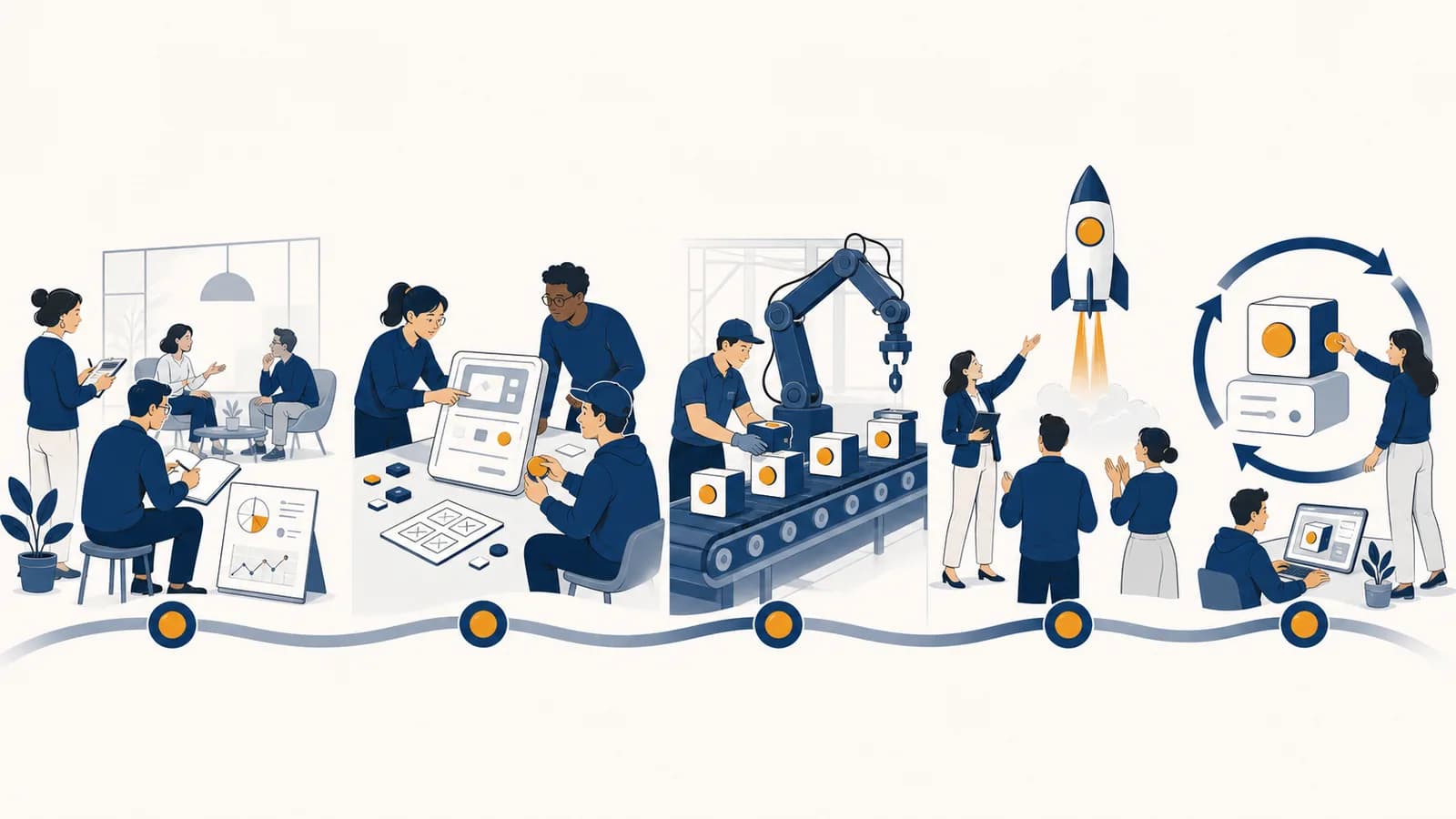
Innovation and product development is a business process that turns new or improved ideas into useful offerings that organizations can create and support, in the context of commercial activity. The innovation process explains how ideas become useful; the product development process explains how teams research, design, test, launch, and improve an offering. Businesses use it to reduce uncertainty before committing major time and money. A reusable water bottle, a banking app, and a safer factory tool may look unrelated, but each succeeds only when customer needs, technical choices, costs, and business goals fit together.
What innovation and product development actually are?
Innovation is the successful use of a new or improved idea, while product development is the organized work of turning that idea into an offering people can use and the business can sustain. One describes useful change; the other describes how teams build it.
An invention becomes an innovation only when it creates value in practice. A new valve design may be inventive, but it becomes an innovation when a manufacturer uses it to prevent leaks, reduce maintenance, or serve a customer in a better way. The change does not have to be a world first. A local bakery that introduces online preordering may be innovating for its customers and its own operation even though online ordering already exists elsewhere.
A product is an offering created to solve a problem or satisfy a want. It can be a physical good, a digital service, or a combination. A smart thermostat combines hardware, software, installation, data, and customer support. Product development must therefore manage more than the object in the box. It must also shape the full experience of buying, using, maintaining, and eventually replacing the product.
A possible answer to a problem, such as a lunch container that shows whether food has stayed cold.
A working solution that creates value, such as a reliable indicator that customers use and a manufacturer can produce at an acceptable cost.
This topic sits across the whole of business decisions and operations. Strategy determines which problems deserve attention. Finance sets investment limits. Marketing explains the value to a chosen market. Operations makes delivery repeatable. Product development connects those decisions around one offering.
How the product development process works?
The product development process moves from a defined customer problem through research, concept selection, design, testing, launch, and improvement. Each stage replaces an assumption with evidence, so the business can stop weak ideas early and invest more in stronger ones.
Describe the user, the situation, the difficulty, and the outcome they need. “Students need lunch” is vague. “Students with a twenty minute break need a filling meal they can collect in under two minutes” can guide design.
Observe behavior, interview potential users, examine alternatives, and measure the current process. The aim is to discover what people do, not to collect polite approval for an idea already chosen.
Create several possible solutions. Compare them against customer value, technical feasibility, cost, strategic fit, safety, and legal requirements. A selection score supports judgment but does not replace it.
Create the cheapest version that can answer the next important question. A paper screen can test an app flow. A foam model can test a handle shape. Neither needs to look finished.
Set a prediction, run the test, record the result, and change the design. Teams repeat this loop because one test rarely removes every important uncertainty.
Finalize production, quality checks, pricing, distribution, staff training, instructions, support, and promotion. A launch is a coordinated operating event, not simply the day an advertisement appears.
Compare actual adoption, use, defects, returns, costs, and customer feedback with the plan. Improve, reposition, expand, or withdraw the product according to the evidence.
The stages are ordered, but the work is not a one way march. A test may reveal that the team misunderstood the problem. A supplier may show that a chosen material cannot be sourced consistently. The team then returns to an earlier decision with better information. This controlled repetition is iteration.
Different organizations name the stages differently. A small startup may run them in days, while an aircraft component maker may spend years on testing and approval. The logic remains constant: identify uncertainty, obtain credible evidence, and limit irreversible commitments until the evidence supports them. Planning methods covered in how businesses set strategy and build plans help connect these product choices to the organization’s wider aims.
Innovation versus invention
Invention creates something technically new; innovation puts a new or improved idea to useful work. An invention can remain in a workshop or patent file, while an innovation must change what customers, workers, or organizations can actually do.
The distinction matters because technical novelty does not guarantee demand. A team may invent a complex lid that opens four ways. If customers find it confusing and it raises manufacturing costs, it has not created useful value. Another team may use an existing hinge in a simpler package that reduces spills. That second change can be an innovation without containing a new scientific discovery.
| Term | Main question | Evidence of success |
|---|---|---|
| Invention | Can this new thing be made to work? | A functioning device, method, or technical result |
| Innovation | Does this change create useful value? | Better outcomes for users or the organization |
| Product development | How can the solution become a dependable offering? | A tested product that can be delivered and supported |
Innovation can affect more than products. Process innovation changes how work is done, such as using computer vision to spot damaged packaging. Business model innovation changes how value is delivered and paid for, such as charging for access instead of ownership. Incremental innovation improves an existing offer. More radical innovation changes the technology, the market behavior, or both. The scale of change affects risk, but small improvements can still produce large results when repeated across many sales or operations.
Novelty is not the finish line. A product creates business value only if someone benefits from it and the organization can deliver that benefit consistently.
How customer research works in product development?
Customer research turns guesses about users into evidence about their goals, behavior, constraints, and alternatives. Teams use interviews, observation, prototypes, usage data, and market tests to decide which problem to solve and which product features deserve investment.
Good research begins with behavior. Asking “Would you buy a better lunch box?” invites a pleasant but weak answer. Asking “Show me how you packed lunch this morning” reveals the containers used, the time available, the food that leaked, and the compromises already made. Past actions usually provide firmer evidence than predictions about an imaginary future.
A canteen manager thinks students want more menu choices. Observation shows that many students leave the queue because payment is slow. A shorter queue may create more value than another sandwich. The problem changes from “limited variety” to “unreliable service within a short break.”
Researchers look for a job to be done, meaning the progress a person is trying to make in a particular situation. A commuter does not necessarily want a travel app with more maps. The commuter may want confidence that a late train will not cause a missed appointment. That need suggests live disruption alerts, realistic transfer times, and a clear alternative route.
Segmentation prevents the word “customer” from hiding meaningful differences. First time users may need guidance. Frequent users may value speed. Buyers may care about budget, while end users care about comfort. In business markets, the person approving payment may be different from the operator and the person responsible for safety. A team should identify each role and the decision each role influences.
Research does not let customers design the product by vote. Customers are experts in their own problems and circumstances. Designers and engineers are responsible for combining those facts into a workable solution. Evidence narrows uncertainty; judgment still chooses among competing possibilities.
How prototypes and product experiments work?
A prototype is a simplified representation built to test a specific assumption, and an experiment is a planned comparison between a prediction and an observed result. Together, they help teams learn before paying for a finished design, full production, or broad launch.
The right prototype depends on the question. A sketch can test whether labels make sense. A clickable screen can test whether users complete a booking. A three dimensional print can test whether a part fits. A small production batch can expose assembly defects. Building more detail than the question requires consumes time and can make the team reluctant to change direction.
Show friends a polished image and ask if they like it. Approval is easy, the sample is biased, and no real behavior is required.
Give target users a realistic task, define what success looks like, watch without coaching, and record completion, errors, questions, and abandonment.
A useful experiment states its logic before results appear. Suppose a team is testing a preorder button for the canteen. Its hypothesis could be: “If students can choose and pay before morning registration, then at least 24 of the next 40 invited students will complete an order without staff help.” The threshold is a management choice for this example, not a universal standard. If 27 complete the order, the observed completion proportion is:
The result exceeds the team’s chosen threshold of 60%, but the team should still inspect where the other 13 users stopped.
A result does not automatically prove why it occurred. Students may complete the order because of a temporary discount, staff encouragement, or unusually long queues that week. The team should record test conditions and repeat important tests with a more representative group. It should also seek evidence that could disprove the idea. Testing only with enthusiastic supporters hides failure modes.
Digital teams often compare two versions, called an A/B test, when they have enough suitable traffic and can isolate one meaningful difference. Physical product teams may run drop tests, wear tests, temperature tests, or assembly trials. In either case, the test must represent the real risk. A beautiful package mockup cannot establish that the seal will survive transport.
How product economics works?
Product economics explains how price, sales volume, variable cost, fixed cost, and product lifetime combine to create profit or loss. A promising product must generate enough contribution from each sale to cover its development and operating commitments over time.
Fixed costs do not change directly with the number of units sold within a relevant period. Design work, tooling, and an annual software license can behave this way. Variable costs rise with each unit, such as ingredients, packaging, payment fees, or delivery. Classification depends on the situation. Factory rent may be fixed until production outgrows the building, at which point expansion creates a new fixed cost.
If a refillable bottle sells for $24 and its variable cost is $9, each sale contributes $15 toward fixed costs and then profit.
Assume the bottle requires $12,000 of design, testing, and setup costs. Ignoring tax, financing, product returns, and later fixed costs, the simple break even quantity is 800 bottles:
At 800 sales, total contribution equals the stated fixed cost. This is a worked model, not a forecast of actual demand.
The arithmetic is simple; the assumptions are difficult. Will customers accept $24? Does the $9 include damaged units, packaging, and payment fees? Can the business sell 800 bottles before tastes change? A sensitivity check changes one assumption at a time. If variable cost rises to $12, contribution falls to $12, and break even quantity rises to 1,000 bottles. That visible change tells the team which assumptions deserve stronger evidence.
A business should also consider opportunity cost. Engineers assigned to the bottle cannot work on another project during the same hours. Cash used for tooling cannot pay for a different expansion. Budgeting, cash flow, and financial control provide the wider methods for judging those tradeoffs. A product can show an accounting profit eventually and still create a cash shortage if suppliers must be paid long before customers pay.
Break even is not proof of demand. The formula calculates the sales quantity needed under stated assumptions. Customer research and market tests must show whether that quantity is realistic.
How product development shows up in real settings?
Product development appears wherever an organization changes an offering for a defined user, including factories, hospitals, banks, farms, shops, public services, and software teams. The setting changes the evidence and controls required, but the problem, test, decision cycle remains recognizable.
A food producer manages taste, safety, and repeatability
A food producer developing a lower salt soup cannot change one ingredient in isolation. Salt affects taste and may affect processing or preservation, depending on the recipe and production method. The team creates trial recipes, checks them against applicable food safety controls, tests production equipment, designs accurate labeling, and evaluates whether target customers accept the result. A kitchen sample that tastes good is only an early prototype. The factory must reproduce it consistently.
A software team manages behavior after launch
A banking app team may want to reduce abandoned transfers. Researchers examine where users stop, interview people who encountered difficulty, and test revised instructions or screen order. The team must also protect account security, accessibility, privacy, and transaction accuracy. A quicker flow that makes the payment recipient unclear is a bad trade. After release, the team monitors errors and support cases because software use produces new evidence continuously.
A manufacturer manages a chain of physical commitments
A furniture maker introducing a flat pack desk tests stability, assembly time, packaging, transport damage, and the clarity of instructions. A small change to a fastener can alter tooling, supplier orders, assembly steps, package size, and spare part support. Physical products create inventory risk because materials and finished units may be purchased before demand is known.
These views can conflict. Extra packaging may reduce breakage but create more waste. A customization option may attract buyers but slow production. A security check may protect users but add friction. Product work is therefore a series of explicit tradeoffs, with evidence used to choose which cost is acceptable and which is not.
5 mistakes people make with product development
Most product development failures are not caused by a lack of ideas. They come from solving an unverified problem, treating opinions as evidence, adding features without cost discipline, delaying difficult tests, or launching without preparing the operating system around the product.
1. Starting with a favorite solution
A founder decides to build an app and then searches for a problem the app might solve. This reverses the evidence. Start with a specific user and situation, then compare several possible solutions, including a service or process change that may not require new technology.
2. Confusing stated interest with buying behavior
People often say an idea sounds useful because the claim costs nothing. A stronger test asks for effort, time, data, a deposit, or a real purchase under fair conditions. The size of the commitment should match the stage of development, and customers should never be misled about what exists.
3. Adding features without counting their full cost
A feature creates design work, test cases, instructions, support questions, maintenance, and possible failure. Its cost continues after launch. Teams should ask which user outcome improves, how they will detect that improvement, and what simpler option could produce it. Product positioning methods in marketing and brand positioning decisions also help define which benefits belong in the offer and which distract from it.
4. Testing the easy parts first
A team polishes colors while an uncertain battery design threatens the entire product. Tests should attack the assumption that could cause the largest loss or force the biggest redesign. Technical safety, legal permission, a scarce supplier, and willingness to pay often deserve attention before surface detail.
5. Treating launch as the end
Launch changes the kind of evidence available. Real customers use the product in conditions the team did not fully predict. Returns expose defects. Support requests expose confusing instructions. Competitors respond. A responsible team assigns owners for monitoring, corrections, communication, spare parts, updates, and eventual withdrawal.
How intellectual property works in product development?
Intellectual property gives legal protection to certain creations, signs, designs, and confidential knowledge. Product teams use it to control copying or preserve an advantage, but each form covers different subject matter, has limits, and requires deliberate management.
Patents may protect qualifying inventions for a limited period in jurisdictions where protection is granted. Trademarks identify the commercial source of goods or services. Copyright generally protects original expression, such as software code, illustrations, and written instructions, rather than the underlying idea. Registered design rights or design patents, depending on the legal system, can protect aspects of appearance. Trade secret protection depends on information remaining secret and on reasonable steps to preserve that secrecy.
Protection is not automatic in the same way for every right, and laws differ by country. Public disclosure before filing can damage patent options in some places. A team planning a serious launch should obtain qualified legal advice for the relevant market rather than treating a web summary as a filing strategy.
Ownership must be clear. Contracts with employees, freelancers, universities, and suppliers should state who owns relevant designs, code, research, and improvements.
Intellectual property is one business tool, not a substitute for customer value. A patent does not prove that a product is safe, useful, affordable, or profitable. Some advantages come instead from manufacturing skill, trusted distribution, proprietary data gathered lawfully, service quality, or the speed at which a team learns.
Physical products versus digital products
Physical and digital products follow the same evidence based development logic, but their cost, change, distribution, and failure patterns differ. Physical products commit money to materials and inventory; digital products can change quickly but create continuing security, reliability, and maintenance obligations.
| Development issue | Physical product | Digital product |
|---|---|---|
| Cost of another unit | Usually requires more material, assembly, storage, and transport | Copying may cost little, while hosting, support, and payment costs still grow |
| Changing the product | May require new tooling, stock replacement, or a recall | Can be updated quickly, but an update can introduce errors for many users at once |
| Quality evidence | Fit, strength, wear, temperature, assembly, and transport | Accuracy, speed, accessibility, security, compatibility, and uptime |
| End of life | Repair, spare parts, recycling, and waste | Data export, account closure, support ending, and software compatibility |
Many products are mixed systems. A fitness watch is physical, but much of its value depends on software, data processing, charging, and a phone app. A team cannot evaluate the watch by testing the case alone. It must examine the entire service, including what happens if syncing fails or software support ends.
Services also use product development methods. A clinic may prototype a new appointment process with printed signs and a temporary desk before changing its booking system. A delivery company may trial a route process in one area before changing every depot. The “product” can be a repeatable service experience even when customers take no object home.
How responsible and sustainable product development works?
Responsible product development considers safety, fairness, privacy, accessibility, labor, environmental effects, and end of life while choices can still change. It examines who receives the benefits, who carries the risks, and what evidence supports claims made about the product.
Many impacts are determined early. Choosing a glued battery can make repair difficult. Selecting a rare material can create supply and sourcing concerns. Collecting personal data “in case it becomes useful” increases privacy and security exposure. A team should reduce unnecessary harm through the design itself, then add controls, warnings, and monitoring where risk remains.
Life cycle thinking follows effects beyond the factory gate. A durable product may use more material at first but last longer. A lightweight package may cut transport load but be harder to recycle. There is no honest universal answer without boundaries and data. Teams should state what they measured, which stages they included, and which tradeoffs remain.
Accessibility is also a design input. Color alone should not carry essential information for users who cannot distinguish it. A touch interface may exclude a person wearing gloves or someone with limited dexterity. Captions help people who are deaf or hard of hearing and also help anyone in a noisy room. Designing with varied users often reveals product weaknesses that affect a wider group.
Responsibility includes stopping conditions. A team should decide in advance which safety result prevents launch, which defect triggers investigation, and who can pause sales. Clear authority matters because commercial pressure becomes strongest after money and reputation have already been committed.
Innovation and product development connect the whole business
Innovation and product development turn business knowledge into a tested offer: strategy chooses the problem, research explains the user, operations builds the solution, finance tests sustainability, marketing communicates value, and leadership accepts responsibility for the resulting effects.
The central skill is disciplined learning. Write down what must be true for a product to succeed. Separate facts from assumptions. Rank assumptions by the damage they could cause, then design the smallest fair test that can change a decision. A product team is making progress when uncertainty falls, not when documents and features simply accumulate.
Choose an object or service you used today. Name the job you expected it to do, one frustration, one proposed change, and the riskiest assumption behind that change. Then describe a test that could be completed without building the finished product.
Notice the tradeoffs around ordinary products. A grocery package balances protection, shelf display, transport, information, cost, opening, and disposal. A school platform balances access, privacy, teacher control, student effort, reliability, and support. Each visible feature is connected to less visible operating choices.
That agreement is never permanent. Customer behavior changes, suppliers change, equipment wears, laws develop, and competitors respond. The business must keep measuring the product’s performance and its effects, then decide what to improve, maintain, or retire.
The takeaway: Treat every product idea as a set of testable assumptions. Define the user’s problem, test the largest risks early, show the economics, prepare delivery and support, and keep learning after launch.