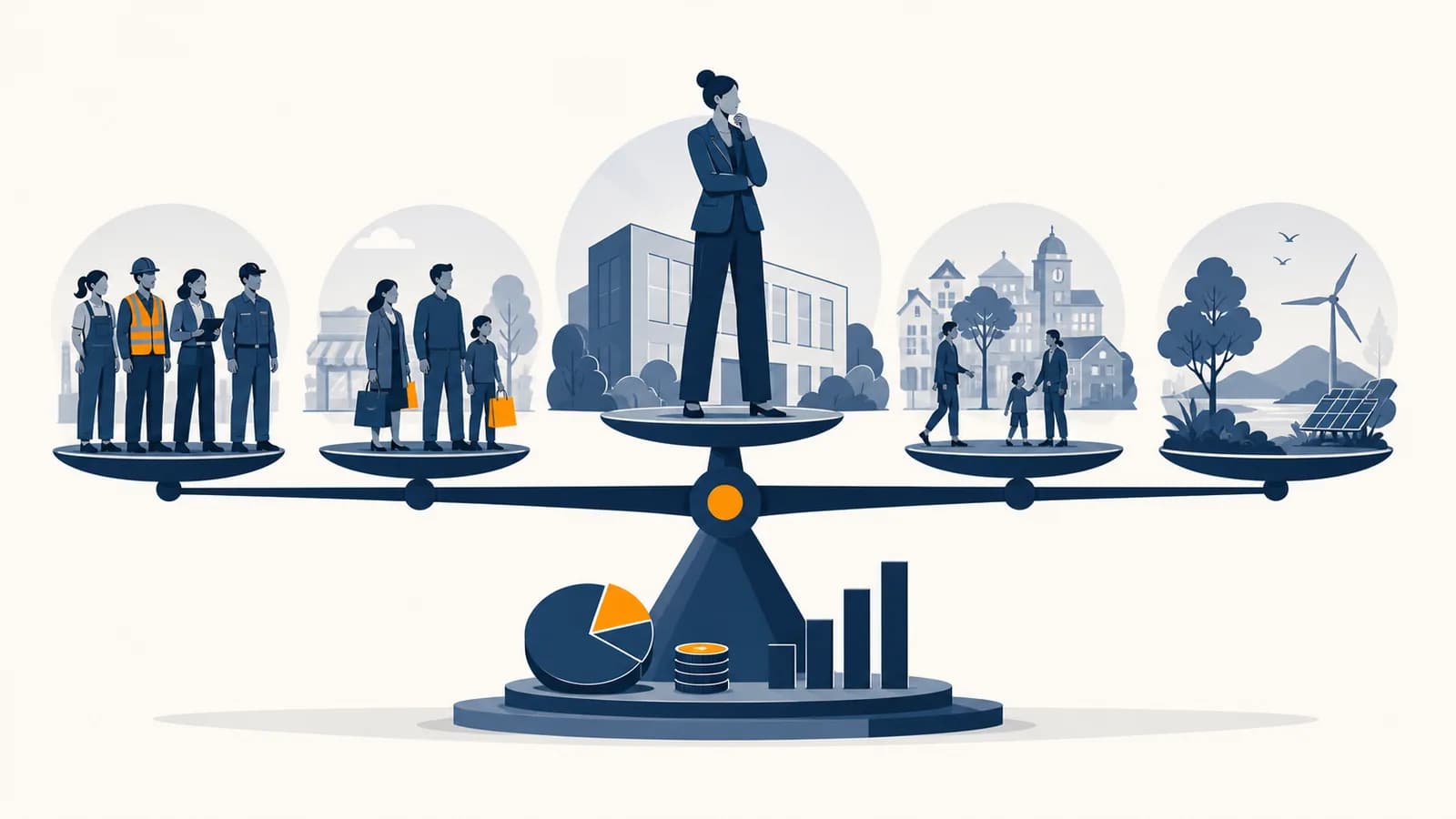
Corporate social responsibility (CSR) is a business management approach that makes a company account for its effects on people and the environment, in the context of commercial decision-making. Put simply, the meaning of corporate social responsibility is that a business accepts duties beyond obeying the law and earning a profit. Common CSR examples include safer working conditions, lower pollution, responsible sourcing, honest product claims, and investment in local communities. The idea exists because a company can pass costs to workers, customers, taxpayers, or ecosystems unless managers identify those effects and take responsibility for them.
CSR changes decisions. A donation may be generous, but it does not make a harmful product, an unsafe factory, or a misleading advertisement responsible.
A useful test is to ask what the business does when responsibility costs money or slows a launch. If the answer changes purchasing, product design, pay, targets, or executive oversight, CSR is part of management. If nothing changes except the publicity, it is probably a campaign rather than a responsibility system.
What CSR actually is
CSR is a company's deliberate responsibility for the social, environmental, and economic effects of its decisions, including effects that the law does not fully control. It connects duties to stakeholders with policies, budgets, operating controls, measurement, and public accountability.
A stakeholder is any person or group that affects the business or is affected by it. Shareholders are stakeholders because they provide capital and bear financial risk. Employees, customers, suppliers, local residents, regulators, and future generations can also have a stake, even when they do not own shares.
CSR therefore asks managers to look beyond the price paid at the checkout. A cheap shirt may also carry unpaid overtime, dangerous factory conditions, polluted water, and disposal costs. Those effects are often called externalities when the people causing them do not bear their full cost. Responsible management tries to prevent the harm, reduce it, repair it, or compensate those affected.
CSR commonly covers four connected areas:
- Work: fair recruitment, safe conditions, reasonable hours, training, equal treatment, and channels for reporting abuse.
- Markets: product safety, honest advertising, fair contracts, privacy, accessible service, and responsible selling.
- Environment: energy, emissions, water, materials, waste, land, and the effects of products after sale.
- Community and conduct: tax behavior, bribery controls, local disruption, community investment, and respect for human rights.
These responsibilities fit within the wider study of Business because every promise must eventually appear in an operating choice. A company has to decide who owns the task, what standard applies, what it will cost, and what evidence proves the result.
How CSR works
CSR works by turning broad duties into a repeating management cycle: identify significant effects, consult affected groups, set priorities, assign controls and resources, measure results, report honestly, and correct failures. The cycle matters because good intentions alone cannot control daily operations.
Consider a bakery chain that buys cocoa. A vague promise to source responsibly is difficult to manage. A working system names the risk, such as child labor or unsafe pesticide use, maps the farms and traders involved, sets supplier requirements, checks evidence, gives suppliers time and support to improve, and defines what happens if serious abuse continues.
List what the company changes through its sites, products, employment, purchasing, finance, and disposal. Include people with little bargaining power, not only groups that can complain loudly.
Compare the scale, likelihood, and reversibility of each impact. Severe harm to a small group can deserve priority over a minor issue affecting many people.
State the behavior required, the boundary covered, the deadline, and the measure. “Use less water” is weak. “Cut water used per finished unit and publish the calculation method” can be tested.
Assign an owner, fund equipment or training, alter contracts, and add checks. This is where responsibility becomes part of purchasing, production, staffing, and product design.
Collect evidence, compare it with the starting point, investigate misses, and publish enough detail for others to judge the claim. Set a new action when the first one fails.
This cycle is a form of turning a goal into a workable business plan. Responsibility competes for people, equipment, management attention, and cash, so it must be built into ordinary planning instead of being left with a communications team.
CSR versus ESG
CSR is the company's approach to its responsibilities and effects, while ESG is a way of organizing environmental, social, and governance information for assessment and decision-making. They overlap heavily, but one describes management commitments and the other often supplies evaluation categories.
Starts with the business's duties to people and the environment. It asks what the company should do, how its conduct should change, and how it should answer to affected stakeholders.
Groups evidence under environmental, social, and governance headings. Investors, lenders, boards, customers, and rating organizations may use that evidence to compare risks, practices, or performance.
The same activity can belong to both. If a warehouse replaces dangerous equipment, the decision may express a CSR commitment to worker safety. Injury records, inspection results, and board oversight of safety can also become social and governance evidence in an ESG assessment.
CSR is also different from philanthropy. Philanthropy transfers money, goods, or time to a cause. It can be part of CSR, but it does not repair harmful conduct elsewhere. A delivery company that funds a park while pushing drivers to break safety rules has made a donation without solving its main responsibility problem.
Nor is CSR the same as legal compliance. Compliance means meeting enforceable duties. CSR can require anticipating harm before rules catch up, applying a higher standard across countries with different laws, or listening to affected people whose interests are lawful to ignore but costly to damage.
How CSR shows up in supply chains
CSR appears in supply chains through product specifications, supplier selection, contract terms, training, traceability, inspections, worker complaints, purchasing schedules, and corrective action. The buyer must examine how its own price and deadline decisions influence conditions far beyond its offices.
A company may outsource production, but it does not automatically outsource responsibility. If a buyer demands a low price and then changes an order at the last minute, the supplier may respond with excessive overtime, rushed safety checks, or unauthorized subcontracting. Auditing the supplier without changing the buyer's behavior can miss the cause.
A school orders branded hoodies for an event. One bidder is cheaper but cannot identify the factory. Another names the factory, explains its worker complaint process, and offers a realistic delivery date. The purchasing decision now includes traceability and labor risk, not only unit price.
Responsible sourcing usually follows a ladder of responses. First, prevent a predictable harm by changing the design, deadline, or supplier. Next, reduce risks that cannot yet be removed. Then remedy harm by restoring pay, treating injury, cleaning pollution, or compensating loss. Ending a contract can be necessary for severe or repeated abuse, but a sudden exit can also remove workers' income and hide the problem at another factory.
Traceability is the ability to connect a finished item to the places, organizations, and materials involved in making it. It is harder for commodities that are mixed during trading, such as metals or crops. A claim about “responsible materials” is only as good as the chain of records, checks, and physical controls supporting it.
How businesses measure CSR
Businesses measure CSR by defining an impact, choosing a clear boundary and unit, recording a baseline, tracking both actions and outcomes, and checking data quality. A useful measure reveals change in the underlying condition, not simply the amount of activity performed.
Inputs are resources such as money and staff time. Outputs are immediate activities or products, such as training sessions delivered. Outcomes are changes in conditions, such as fewer injuries or more reliable access to work. Counting attendance does not prove that behavior or safety improved.
| Claim | Weak measure | More useful measure |
|---|---|---|
| We support worker safety | Number of safety posters | Hazards corrected, injury pattern, worker reports, and investigation quality |
| We reduce waste | Recycling bins purchased | Total waste by type, waste per unit, and final destination |
| We buy responsibly | Suppliers sent a code | High risk suppliers assessed, problems remedied, and repeat failures |
| We serve the community | Volunteer hours | The specific condition changed and evidence from the people affected |
Absolute and intensity measures answer different questions. Absolute waste tells managers the total burden. Waste per item shows efficiency. If a factory improves efficiency while doubling production, waste per item can fall even as total waste rises.
If waste falls from 1,000 kg for 5,000 units to 900 kg for 6,000 units, intensity falls from 0.20 kg to 0.15 kg per unit, while absolute waste falls by 100 kg.
Boundaries matter just as much as arithmetic. Does a carbon measure cover company vehicles only, purchased electricity too, or the production and use of everything sold? Does a labor figure include agency workers and supplier workers? Managers can produce a flattering trend by changing what is included, so reports should explain the boundary and keep it consistent.
The 25 percent result comes directly from the visible calculation: . Good reporting preserves the source records, states assumptions, corrects errors, and distinguishes estimates from measurements. Independent assurance can test the process and samples of evidence, though assurance does not turn a poorly chosen measure into a meaningful one.
How CSR affects profit, cost, and risk
CSR can change profit by affecting revenue, operating cost, investment, financing, staff retention, disruption, fines, and reputation. Its financial effect is neither automatically positive nor automatically negative; managers must trace each action through cash flows, time horizons, and risk exposure.
Some actions save money quickly. Reducing wasted material lowers both purchasing and disposal costs. Other actions require spending now for uncertain future benefits. Safer machinery, supplier training, product redesign, and pollution controls may need capital before they reduce accidents, interruptions, complaints, or legal exposure.
A simple business case uses incremental cash flows, meaning the amounts that change because the project goes ahead.
A reuse project that saves $18,000 in materials, saves $4,000 in disposal, and costs $7,000 to operate has an annual net benefit of $15,000 before tax and financing effects.
If equipment for that project costs $45,000, a simple payback calculation is years. Payback is easy to understand, but it ignores cash flows after the cutoff, the timing of money within the period, and benefits that are difficult to price. Managers still need judgment.
This is why CSR belongs beside budgeting and financial control. A target without money is unlikely to survive, while a spreadsheet that excludes injury, disruption, cleanup, and trust can make a harmful option look cheaper than it is.
There can also be tradeoffs among stakeholders. Closing a polluting plant may improve local air but remove jobs. Keeping it open without change transfers the cost to residents. A responsible decision states the conflict, examines alternatives, funds a fair transition where possible, and avoids pretending that every group wins.
How CSR shows up in jobs and daily decisions
CSR appears in ordinary work whenever someone writes a specification, selects a supplier, approves an advertisement, schedules a shift, handles customer data, designs packaging, investigates a complaint, or signs a budget. Responsibility is distributed across roles, not confined to one department.
A product designer chooses materials, repairability, accessibility, and safety margins. A buyer checks origins, prices, lead times, and contract terms. A human resources manager examines pay, promotion, working hours, and grievance systems. An accountant tests spending and records liabilities. A lawyer interprets duties. An operations manager controls actual conditions. A communications team describes results without overstating them.
You manage a café and discover that disposable cup use is high. Buying cups labeled “green” is not enough. You check what the label means, measure current use, test reusable options, consider washing energy and water, train staff, give customers a practical return route, and count both reuse and losses.
Customers meet CSR through labels, product durability, repair policies, accessibility, privacy choices, complaint handling, and disposal instructions. Employees meet it through payslips, schedules, safety procedures, hiring, monitoring, and the freedom to report misconduct. Residents meet it through traffic, noise, land use, jobs, tax-funded services, and the business's response when something goes wrong.
A person evaluating a claim can ask five practical questions:
- What exact impact is the company claiming to change?
- Which products, sites, workers, suppliers, and dates are included?
- What starting point and measure are used?
- What evidence shows an outcome rather than an activity?
- What problem, limitation, or missed target is disclosed?
These questions do not require specialist knowledge. They require attention to nouns, boundaries, and evidence. “Better for communities” is difficult to test. “Paid all small suppliers within the contract period and published late payment cases” is narrower and checkable.
Four mistakes people make with CSR
The most common CSR mistakes are treating charity as proof of responsible conduct, chasing easy numbers, ignoring conflicts in the business model, and reporting success without a boundary or baseline. Each error separates a public claim from the operation that creates the impact.
1. Treating donations as a substitute for responsible operations
A donation can help a community, but it does not cancel harm. The first duty is to control the company's own products, employment, purchasing, pollution, and conduct. Community giving should be assessed on its own results, not used as a moral credit against unrelated damage.
2. Measuring what is easy instead of what changes
Training hours, policies issued, and trees planted are easy to count. The harder questions concern safer behavior, living trees, restored habitats, fairer outcomes, and lasting improvements. Activity measures still help managers control delivery, but they should connect to an outcome and a credible explanation of cause.
3. Ignoring incentives that recreate the problem
A supplier code can require reasonable working hours while purchasing staff receive bonuses for speed and low prices. A bank can promise responsible selling while rewarding staff only for the number of products sold. Managers must examine targets, pay, deadlines, and authority because behavior follows the operating system.
4. Publishing a claim with no boundary
“Zero waste” could mean no waste at one office goes to landfill, while factories and suppliers remain outside the count. “Ethically sourced” could cover one material in one product. A credible claim states what is included, what is excluded, how the measure was made, and what remains unresolved.
Watch the denominator. A falling rate can hide a rising total. Always compare both the absolute impact and the amount per employee, product, sale, or other unit.
Oversight reduces these errors when managers can challenge optimistic claims and affected people can report evidence safely. That connection leads directly to how boards control risk and corporate conduct, especially when responsibility failures could threaten people, cash flow, or the company's permission to operate.
What greenwashing actually is
Greenwashing is communication that makes an environmental benefit appear broader, stronger, better supported, or more relevant than it really is. It can use false statements, but it also works through vague wording, missing context, selective evidence, and impressive images.
A package covered in leaves may still provide no factual environmental information. A technically true claim can also mislead if it highlights a tiny improvement while hiding the main impact. For example, reducing a box by 5 grams is measurable, but presenting that change as proof that the whole product is “planet safe” jumps far beyond the evidence.
“Our delivery is greener.” The comparison, boundary, date, and measure are missing.
“We cut fuel used per delivered parcel from 0.12 litres to 0.10 litres on our city route between the stated reporting periods.” Records can test the figures and the company can disclose total fuel too.
Social washing follows the same pattern for people and communities. A company may celebrate diversity in advertising while concealing unequal promotion outcomes, or announce a worker hotline that nobody can use safely. The cure is specificity, complete boundaries, evidence, and open reporting of limitations.
Can small businesses practice CSR?
Small businesses can practice CSR without a specialist team or a long report. They can identify their largest effects, meet affected people, choose a few material controls, keep simple records, and explain results accurately. Scale changes the system, not the responsibility.
A repair shop might focus on safe storage of chemicals, honest estimates, responsible disposal, accessible hiring, and treatment of apprentices. A restaurant might focus on food safety, scheduling, tips, energy, waste, allergens, and supplier terms. A software studio might focus on privacy, accessibility, contract labor, energy use, and harmful uses of its product.
The word material helps set priorities. An issue is material when it is significant enough to affect stakeholder decisions, business decisions, or both. A two-person firm does not need to copy a multinational's reporting structure. It does need to pay attention to the harms it can actually cause or prevent.
Is CSR voluntary?
CSR often includes voluntary commitments, but the activities it covers may also be governed by labor, consumer, environmental, privacy, competition, tax, and company law. The exact legal boundary depends on the location, industry, company size, and the claim being made.
Calling CSR voluntary can therefore mislead. Paying the legal minimum is compliance, while choosing a safer material before it is required may be voluntary. Once a company puts a promise into a contract, employment policy, product claim, or public filing, that promise may create consequences beyond goodwill. Laws also change, so a business must check the rules that apply to its actual operations.
Voluntary action can move faster than law and can cover gaps between jurisdictions. It can also be weak if leaders can abandon it without explanation. Clear governance improves durability by assigning board or executive responsibility, joining targets to budgets, protecting internal challenge, and reporting missed goals as well as successes.
CSR makes business decisions answerable
CSR makes a business answerable for how it earns money, not only for what it does with profit afterward. It connects stakeholder effects to strategy, operations, finance, evidence, and correction, which makes it part of business judgment rather than an optional public image exercise.
The strongest sign of serious CSR is a visible chain between an impact and a decision. A worker concern changes a shift system. Waste data changes a product specification. A community complaint changes delivery hours. A missed target changes a budget or a manager's instructions. Evidence travels upward, and authority travels back down.
Notice the next corporate claim you meet on a package, job advertisement, annual report, or social post. Name the affected stakeholder, find the operational change, check the boundary, and look for an outcome. If any link is missing, you have found the exact question the business still needs to answer.
The takeaway: CSR is credible when a company identifies its real effects, changes the decisions causing them, measures the result, and accepts scrutiny when the result falls short.