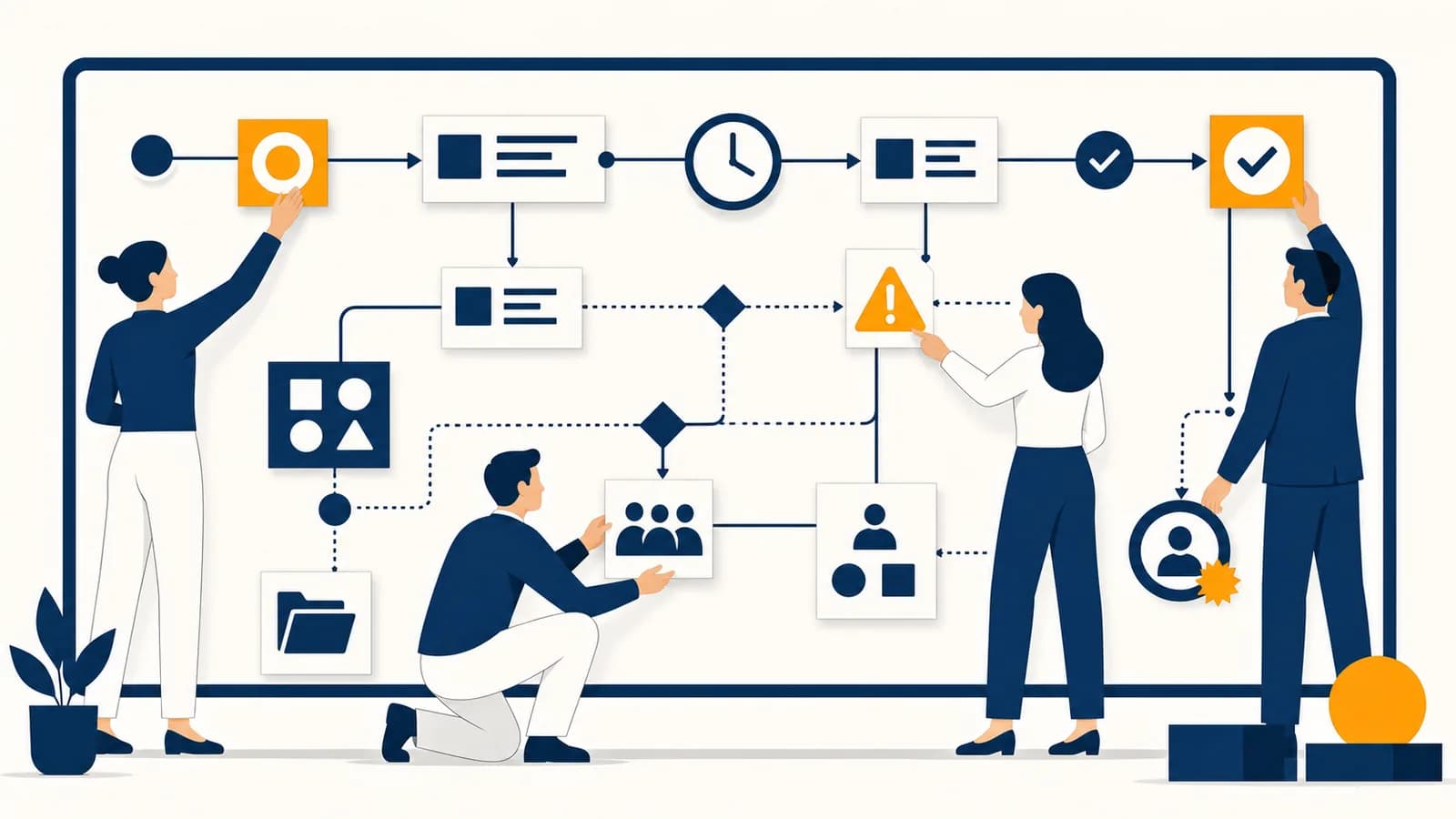
Project management is a business discipline that organizes people, time, money, information, and work to deliver a defined result within agreed constraints. It explains how to plan a project, set its scope, build a schedule, assign tasks, manage a budget, control risks, and complete execution. The idea exists because valuable work often requires many connected actions, while responsibility, resources, and deadlines are limited.
What project management actually is
Project management is the deliberate control of temporary work that has a specific outcome, a beginning, and an end. It turns a goal into coordinated decisions about scope, tasks, owners, timing, cost, quality, risk, communication, and acceptance.
A project creates a change. Opening a shop, launching an app, moving an office, filming a documentary, and organizing a school festival are projects because each aims at a distinct result. The work may repeat in parts, but the whole effort is temporary and produces something new or changed.
The word management does not mean making a colorful plan and asking everyone for updates. It means maintaining a usable connection between what was promised and what is happening. A project manager helps people see dependencies, makes decisions visible, brings unresolved issues to the right owner, and checks that completed work meets its acceptance conditions.
“Design screens, write code, test the app” names work but says little about sequence, ownership, completion, or the result that must be accepted.
Each deliverable has an owner, a due condition, dependencies, a quality test, and a decision path if the plan stops matching reality.
Projects sit inside Business as a field of study because execution connects strategy to actual use of labor and capital. A company may choose the right product and still fail to release it. Another may have limited resources but coordinate them well enough to finish first.
A project has a result, constraints, and stakeholders
Every project can be described through three connected ideas. The result is the accepted change or deliverable. The constraints limit how the result can be made. The stakeholders are people who affect the work, pay for it, perform it, approve it, use it, or live with its effects.
Suppose a school wants an online system for booking science equipment. The result is not “do some coding.” It is a working booking system that teachers accept. Constraints include the available weeks, student developer time, school privacy rules, and the devices already in use. Stakeholders include teachers, students, laboratory staff, school leaders, and whoever maintains the system after launch.
A deliverable is accepted output. “Worked on the database” describes effort. “A database that stores each booking, blocks conflicts, and passes the agreed tests” describes a deliverable.
How a project moves from an idea to an accepted result
A project moves through connected decisions: define the need, authorize an outcome, plan the work, execute the plan, monitor evidence, control changes, obtain acceptance, and close responsibilities. Feedback can send work backward when evidence disproves an assumption.
The first decision is about value. A sponsor, the person or group authorizing the project, states the problem and decides what success would justify spending resources. A project charter or similar short document records the purpose, broad scope, main authority, important constraints, and named project lead. Its value comes from agreement, not from its format.
Planning decomposes the outcome into deliverables and tasks. Execution produces those deliverables. Monitoring compares observed results with the baseline, which is the approved version of the scope, schedule, and budget used for comparison. Control means deciding how to respond to a difference. It can include correcting work, changing resources, changing the plan through approval, or stopping an effort that no longer makes sense.
Closure is more than announcing that the deadline arrived. The customer or sponsor accepts the result against stated criteria. Accounts and contracts are closed. Remaining support work moves to an operating owner. Records and lessons are stored where the next team can use them. A project that launches a service but leaves nobody responsible for access, maintenance, or customer questions is not cleanly finished.
A community group plans a one-day food fair. “A successful event” is too vague to manage. The team defines booked space, approved food sellers, working payment points, published visitor information, a safety plan, and a cleanup handover. Each output can now be owned, checked, and accepted.
Feedback changes the path without removing control
Real projects do not travel through the stages once in a perfect straight line. A prototype may reveal that a requested feature confuses users. A permit review may impose a new condition. Monitoring feeds evidence into planning, and authorized decisions update the baseline. The discipline lies in making those changes explicit.
Iteration is controlled repetition used to learn. Rework is repeating work because a requirement, handoff, or quality check failed. The actions may look similar, but their causes differ. A team that expects a prototype to teach it something has planned an iteration. A team that rebuilds a finished component because nobody checked its dimensions has incurred avoidable rework.
How scope, time, cost, and quality work together
Scope defines the promised result, time defines when work and milestones occur, cost measures the resources consumed, and quality defines acceptable performance. Changing one can alter the others, so a responsible decision states the tradeoff instead of hiding it.
Scope includes the products, services, or changes the project will deliver, plus the work needed to make them. A scope statement also names exclusions. If a website project includes account creation but excludes online payment, the exclusion prevents an unstated assumption from becoming a late demand.
Time is represented by task durations, sequence, milestones, and a completion target. Cost covers money and other scarce resources consumed by the work. Quality is fitness against defined requirements. High quality does not always mean luxurious. A temporary event sign can be inexpensive and still meet its requirements for legibility, weather resistance, and safe installation.
If 80 staff hours cost $25 per hour and materials cost $1,400, planned cost is .
A budget is not only a total. It rests on assumptions about quantities and prices. When actual cost differs, the team needs to ask which assumption changed. Ten more hours and an unchanged hourly rate tell a different story from the original hours billed at a higher rate.
Tradeoffs should be stated as options. If a launch date cannot move, the sponsor might remove a lower value feature, approve more skilled help, or accept a smaller testing window with clearly recorded risk. Each choice changes the business case. Simply demanding the original scope sooner does not make the work disappear.
Acceptance criteria make quality testable
Acceptance criteria are observable conditions that a deliverable must meet before an authorized person accepts it. “Easy to use” is an aspiration. “A first-time user can submit the form using only the labeled controls, and every required field gives a clear error when empty” provides conditions that can be tested.
Good criteria prevent two costly arguments. The producer cannot claim that unfinished work is done merely because much effort was spent. The customer cannot reject completed work because of a preference that was never stated. Criteria will not remove every disagreement, but they give the disagreement evidence.
Project management versus ongoing operations
Project management controls temporary work that creates a defined change, while operations management controls continuing work that repeatedly delivers a product or service. A project often ends by handing its result to the people who will operate it.
| Question | Project | Operation |
|---|---|---|
| What is the aim? | Create a specific change | Produce a continuing result |
| How long does it last? | Until defined closure | While the service is needed |
| What is managed? | Deliverables, dependencies, uncertainty, acceptance | Capacity, consistency, demand, quality, recurring cost |
| What is a typical example? | Install a new ordering system | Process customer orders each day |
The distinction changes how managers think. A project team asks what must be created and how to reach completion. An operations team asks how to keep output safe, consistent, timely, and economical. The methods overlap, but the time horizon and definition of success differ.
The handover links them. If a project installs new warehouse equipment, operating staff need instructions, spare parts, access permissions, maintenance schedules, and a clear owner. Project completion without operational readiness shifts unfinished work into someone else’s queue.
A continuing service may also contain projects. A hospital runs patient services as operations, but replacing its appointment system is a project. After release, booking appointments becomes operational work again. Readers interested in capacity, bottlenecks, and recurring workflow can connect this distinction to methods for improving operations and processes.
How a schedule turns work into a dependency network
A project schedule connects tasks by order, duration, ownership, and dependency, then identifies when deliverables can realistically finish. Its main job is to expose which delay affects later work, not to make every calendar box look occupied.
Begin with a work breakdown structure, a hierarchy that divides the total scope into manageable deliverables and smaller work packages. Then identify activities needed to produce each package. A useful task is small enough to estimate and assign, but large enough that tracking it has value.
Describe accepted outputs, such as an approved menu, a tested payment setup, or trained event staff.
List the work required to create each output, with enough detail to estimate and assign it.
Record which activities need another output, decision, or resource before they can begin or finish.
Separate the labor required from elapsed calendar time, then account for availability and waiting.
Give each task one accountable owner and use milestones to mark significant zero-duration events, such as permit approval.
A dependency is a logical relationship between activities. You cannot print a final poster before its wording is approved. Approval is therefore a predecessor to printing. Some tasks can run in parallel, such as booking musicians while designing signs, if they do not compete for the same unavailable person or information.
The critical path is the longest dependent path through the schedule. It determines the earliest possible project finish under the current durations and logic. A task on that path has no scheduling flexibility at that moment. Delay it without recovery, and the project finish moves.
Research takes 2 days, approval takes 1 day, and printing takes 3 days in sequence, so the path lasts days.
Effort is not duration. A task needing 16 hours of focused work could take two days for one available person, four half-days for someone split across jobs, or longer if it includes waiting for review. Adding people does not always divide duration evenly because new people need coordination, access, and context.
How estimates work when the future is uncertain
An estimate is a reasoned forecast based on defined scope, assumptions, evidence, and uncertainty. It becomes more useful when it gives a range or confidence level and is revised as the team learns, rather than presented as a guarantee.
Teams estimate with several kinds of evidence. Analogous estimation starts from a similar past task and adjusts for differences. Bottom-up estimation estimates smaller pieces and adds them. Parametric estimation uses a measurable rate, such as hours per interview, multiplied by quantity. Expert judgment can help when experience is relevant and assumptions are made visible.
Imagine a team must edit 12 short videos. Its observed rate on a comparable format is 90 minutes per video. A parametric starting estimate is hours. If three videos need original animation, the old rate may not apply to those items. The team should estimate that work separately instead of hiding the difference inside the average.
Precision is not certainty. An estimate of 37.5 hours may look scientific, but it is weak if the scope is unclear or the rate came from unrelated work. State assumptions before adding decimal places.
Contingency is time or money reserved for identified uncertainty within the project. It is not a secret pile used to protect a manager from difficult conversations. A risk register should connect meaningful risks to causes, possible effects, probability judgments, response owners, and triggers. Broader work on how organizations manage risk and oversight explains how these project choices fit company accountability.
Three-point estimates express a range
A three-point estimate records an optimistic value, a most likely value, and a pessimistic value. The values do not predict every possible outcome. They force the estimator to consider variation and explain what conditions would produce each case.
For 4 optimistic days, 6 most likely days, and 11 pessimistic days, the simple average is days.
The arithmetic does not eliminate judgment. The team must still explain why 11 days is plausible. Perhaps an external reviewer is sometimes unavailable. That cause suggests an action, such as booking the review date early. An unexplained number does not.
How execution stays controlled while work changes
Controlled execution means assigning clear ownership, comparing progress with evidence, resolving impediments, checking quality, and approving material changes through a known decision process. It protects the outcome while allowing the plan to respond to new information.
Execution happens where people create outputs: writing copy, negotiating with a supplier, testing equipment, interviewing users, or training staff. The project manager may perform some of that work, but the role is mainly integrative. Someone must see that the supplier needs approved dimensions before manufacturing, that finance must approve payment, and that the installer needs building access.
Status should describe evidence, not mood. “Almost done” is difficult to test. “The draft contains all six required sections, two are approved, and legal review of the remaining four is booked for Thursday” reveals output, remaining work, and the next dependency. Evidence can include accepted deliverables, completed tests, actual spending, unresolved defects, and decisions waiting for an owner.
In this illustrative snapshot, saying “eight tasks are done” would overstate progress if two are only waiting for review. The status system must distinguish produced work from accepted work. That distinction becomes especially important when a reviewer has limited capacity.
Change control keeps promises consistent
Change control is the process for proposing, analyzing, deciding, recording, and communicating changes to an approved baseline. It is not a ban on new ideas. It stops one person from informally adding work while everyone else continues planning against the old promise.
- Describe the request. State what would change and why.
- Analyze impact. Check affected scope, schedule, budget, quality, risk, contracts, and staff.
- Identify options. Add the work, exchange it for other scope, postpone it, or reject it.
- Send it to the authorized decision maker. The person accepting the tradeoff must have authority over the affected commitment.
- Update the shared record. Revise plans and tell affected people after the decision.
A small change can have a large downstream effect. Adding another language to event materials may change writing, review, layout, printing, signage space, website content, and volunteer instructions. Impact analysis follows the dependency network rather than judging the request by the number of words used to describe it.
How project management shows up in a product launch
In a product launch, project management coordinates product readiness, supply, pricing, promotion, sales preparation, customer support, compliance, and release timing. The launch succeeds only when these streams produce compatible outputs for the same market promise.
Consider a small company launching a refillable desk pen. Product staff must freeze specifications before suppliers can produce final units. Finance needs unit cost before approving a price. Marketing needs accurate features and photographs. Customer support needs instructions and a process for faulty items. Sales channels need stock records, product descriptions, and a release date.
The photographer cannot shoot the final product before its finish and packaging are approved. If marketing books the shoot too early, a later design change can make every image inaccurate. The project schedule links design approval to sample production, then links the approved sample to photography.
A launch manager uses milestone reviews to ask different questions at different times. Is there enough evidence that customers have the stated problem? Is the design stable enough to order inventory? Has testing shown that the pen performs as specified? Can support answer likely complaints? Does the public claim match the actual product?
Marketing work is part of the integrated plan, not a decorative task at the end. Positioning determines which customer and use case the launch emphasizes, and that affects messages, channels, packaging, and launch evidence. Those commercial choices must be settled early enough to guide accurate product descriptions and release materials.
After release, measures should connect to the launch objective. Orders can show demand, but returns can reveal product or expectation problems. Support requests can expose unclear instructions. Stockouts can mean unexpectedly high demand, poor forecasting, or delayed replenishment. A useful review separates these mechanisms rather than celebrating or blaming one total.
A decision log preserves the reasons behind action
A decision log records what was decided, when, by whom, why, and what follows. It keeps a team from reopening settled questions because the reasoning disappeared. It also lets later managers distinguish a sensible decision based on old evidence from a careless decision.
For the pen launch, a decision might state: use recyclable cardboard packaging instead of a plastic display case because the chosen customer segment values low waste, the product remains visible in approved photographs, and the cardboard option meets shipping protection tests. If damage later rises, the team can inspect the original evidence and revise intelligently.
What project software actually does
Project software stores and displays shared information about work, such as tasks, owners, dates, dependencies, documents, decisions, and status. It can calculate or notify, but it cannot define good scope, settle authority, or make weak evidence true.
A simple project may need only a written brief, a task board, a calendar, and a budget sheet. A larger effort may need dependency scheduling, permission controls, resource views, document history, or links to purchasing systems. The right tool is the lightest one that preserves the information and control the project actually needs.
Display assigned tasks, calculate dates from dependencies, keep document versions, notify owners, and summarize recorded data.
Define success, test assumptions, report honestly, resolve conflict, accept tradeoffs, and decide what recorded evidence means.
A badly designed status field can create false confidence. If a task can be marked complete before review, a dashboard may show progress that the customer has not accepted. The remedy is not a brighter dashboard. It is a workflow whose states match the actual definition of done.
Software also has a maintenance cost. Someone must keep dates, owners, and status current. Duplicating the same task across several systems makes disagreement likely. A team should know which record is authoritative for schedule, scope, decisions, files, and costs.
Agile, predictive, and hybrid methods fit different uncertainty
Predictive methods plan more scope and sequence before execution, agile methods deliver and learn in short cycles, and hybrid methods combine both. The suitable choice depends on uncertainty, change cost, feedback speed, regulation, and the physical nature of the work.
A predictive approach fits work whose requirements are stable and whose late physical changes are expensive. Construction, manufacturing setup, and regulated installation often require approved drawings, ordered materials, inspections, and fixed sequences. Planning early does not remove uncertainty, but it can prevent costly changes after physical commitment.
An agile approach fits work that can be produced in small usable increments and improved through frequent feedback. A software team might release a basic internal search function, observe which queries fail, then improve ranking. The short cycle connects a small plan to working output and evidence.
Hybrid management is common because projects contain different kinds of work. A public event may have a fixed legal permit date and venue contract, while its visitor information can be drafted and tested in short cycles. The method should follow the work, not a team’s attachment to a label.
Agile does not mean unplanned. It changes the planning horizon and frequency. Teams still define goals, choose priorities, limit active work, test results, and decide what to do next.
All three approaches need governance proportionate to the decision. A two-person school project does not need the approval structure of an airport expansion. Both still need a clear outcome, owners, evidence of completion, and a way to handle change.
Do project managers need formal authority or certification?
Project managers need enough recognized authority to coordinate information and escalate decisions, but they do not always supervise the people doing the work. Certification can demonstrate studied methods, while successful execution also requires context, judgment, communication, and credible behavior.
Many projects use a matrix structure. A designer may report to a design manager for career and professional standards while receiving project priorities from a project manager. This arrangement shares specialist talent across projects, but it can create competing demands. Named priority rules and an escalation path are therefore part of the operating design.
Formal authority lets a person approve certain changes or spend within a limit. Informal influence helps that person obtain accurate information, negotiate commitments, and make concerns safe to raise. A project manager who punishes bad news receives good news until the schedule fails. A manager who listens but never obtains decisions leaves the team stuck.
Certification is evidence of exposure to a defined body of knowledge and an assessment process. It is not evidence that a person can manage every project. Domain knowledge matters too. A clinical study, a building renovation, and a game release share planning concepts but have different safety rules, specialists, and failure costs.
Five mistakes people make with project execution
Execution commonly fails when teams start without testable outcomes, confuse activity with progress, hide dependencies, accept changes without tradeoffs, or treat bad news as personal failure. Each mistake damages the evidence needed for timely decisions.
1. Starting with tasks before defining the result
A long task list can make a project feel active while people hold different ideas of success. Define the accepted result, exclusions, constraints, and owner first. Tasks should follow from deliverables. If no deliverable needs a task, ask why the team is doing it.
2. Reporting effort as if it were completion
Hours spent can explain cost, but they do not prove value. Ninety hours of coding do not show that a payment function works. Progress reporting should use finished and accepted outputs, completed tests, and resolved decisions alongside effort.
3. Leaving dependencies inside people’s heads
A hidden dependency appears as a surprise delay. The writer waits for approved product facts, the translator waits for final copy, and the printer waits for both. Mapping these connections lets the team sequence work and protect the tasks that govern completion.
4. Adding scope without changing the commitment
Small requests accumulate. If the deadline, staff, and quality level stay fixed while scope grows, pressure appears elsewhere as overtime, skipped testing, or missed dates. Change control requires an authorized choice about what moves, what costs more, or what leaves.
5. Making honest status unsafe
People hide risks when raising one brings blame without help. The project then loses time in which it could have acted. Leaders should separate early warning from poor performance, ask for evidence, assign responses, and still hold owners accountable for commitments they can control. This is one place where practical leadership and management methods directly affect schedule quality.
Execution turns business intent into evidence
Project execution is where a business claim meets observable reality. A useful goal becomes deliverables, owners, resource decisions, tested results, and accepted change. Good management keeps those connections visible long enough for people to act on evidence.
Strategy decides what change is worth pursuing. Finance limits and tracks resources. Marketing connects an offer to customers. Operations sustains repeated delivery. Law and governance set boundaries and authority. Project management integrates those parts for a temporary result, then hands the result to whoever will use or operate it.
The skill is visible in ordinary life. A student organizing a performance can define acceptance conditions, map rehearsal dependencies, identify the person authorized to approve spending, and record what changes when a musician becomes unavailable. An employee can turn “update the website” into named pages, owners, review criteria, dates, and an approval decision. The scale changes, but the mechanism remains.
The takeaway: Choose one current piece of work and write its accepted result, main constraint, next deliverable, accountable owner, and blocking dependency. If any answer is vague, that is the next management problem to solve.