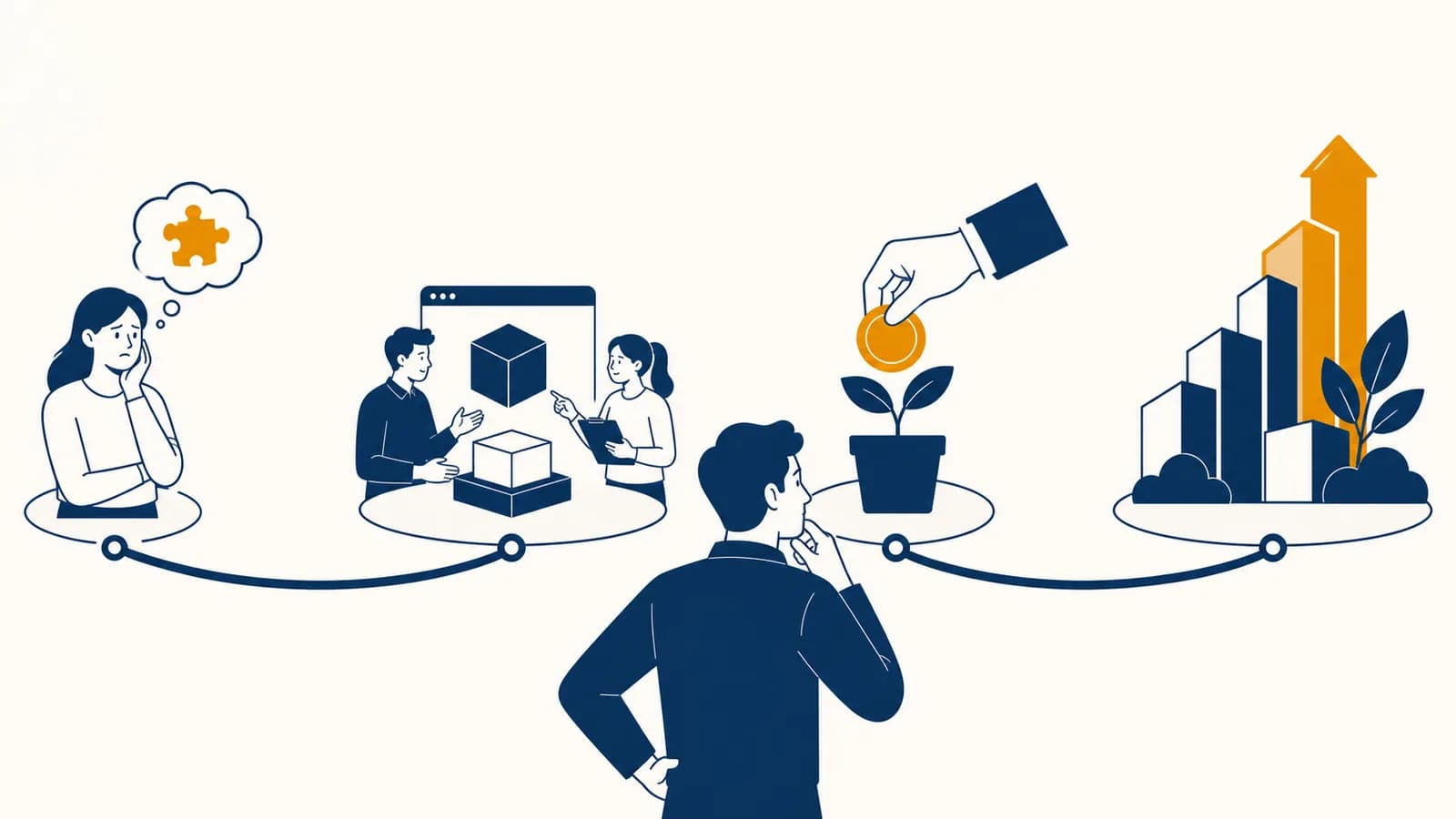
Entrepreneurship and startup development is a business process that turns an identified customer problem into a tested, organized, and financially sustainable venture, in the context of creating and growing an enterprise. A person searching for how to start a business, develop a startup idea, write a business model, find customers, or raise startup funding is asking about parts of this process. It exists because a promising idea is not yet a working business: founders need a disciplined way to test demand, deliver value, collect revenue, manage costs, and decide what to change.
Imagine a student who notices that local sports teams struggle to find last minute substitute players. A matching app sounds useful, but the idea rests on untested beliefs. Do captains consider the problem serious? Will players respond quickly? Will either group pay? Can the service operate safely? Entrepreneurship replaces guesses like these with evidence and decisions.
What entrepreneurship and startup development actually are
Entrepreneurship is the work of organizing resources under uncertainty to create and capture value. Startup development is the related process of testing the problem, solution, market, operations, and economics until the venture finds a repeatable way to serve customers.
An entrepreneur combines people, information, time, equipment, money, and relationships. The entrepreneur does not need to invent a new technology. A mobile bicycle repair service, a tutoring cooperative, and a medical software company can all be entrepreneurial ventures if someone designs an offer and accepts the risk of building an organization around it.
A startup is usually designed to discover and grow a repeatable business model. That makes it different from a mature company, which already knows much more about its customers, delivery system, and expected costs. The startup searches. The established firm executes a known system while still improving it.
“An app that finds substitute players” describes a possible product. It does not establish demand, a buyer, a price, or a workable delivery system.
“Local clubs pay a monthly fee for verified player matches delivered within two hours” states a customer, an offer, revenue, and an operating promise that can be tested.
This topic belongs to the wider study of Business because every startup connects marketing, accounting, operations, strategy, and people. The founder may begin with a product, but the venture survives only if those functions work together.
How a startup develops from problem to repeatable business
A startup develops through a loop: identify a specific problem, state risky assumptions, test them cheaply, build the smallest useful offer, measure customer behavior, and revise the model. Each cycle should replace an important uncertainty with usable evidence.
The order matters. Building first can consume months while preserving the biggest uncertainty: perhaps nobody cares enough to switch or pay. A useful test targets the belief that could most seriously damage the venture if it is false.
Name a recognizable group, the job they are trying to do, the obstacle, and the current alternative. “Busy parents who need a dependable school pickup when plans change” is testable. “Everyone needs transport” is not.
Write down what must be true about urgency, purchasing authority, access to customers, technology, rules, costs, and competitors. Rank assumptions by danger and lack of evidence.
Interview customers about past behavior, offer a manual version, place a preorder page, or test a sales conversation. Match the test to the assumption rather than collecting broad opinions.
Create the smallest version that delivers the main benefit and produces learning. It can be a spreadsheet and human service behind a simple form. “Minimum” describes scope, not carelessness.
Track actions tied to value, such as completed orders, repeat use, referrals, cancellations, support needs, and payment. Compliments are weaker evidence because agreeing costs the customer nothing.
Keep the model when evidence supports it, revise a weak assumption, or end the attempt before it consumes more resources. Stopping one model can preserve the team and knowledge for a better one.
Suppose the sports matching team predicts that club captains will pay for fast substitutions. It first handles requests through a form and group messages. Ten completed matches reveal more than ten enthusiastic interview comments because actual use exposes response time, trust checks, scheduling errors, and willingness to pay.
What a business model actually is
A business model is a connected explanation of who the venture serves, what valuable result it offers, how it reaches and serves customers, how money enters and leaves, and which resources and partners make the system possible.
The parts must fit one another. A low priced service cannot depend on lengthy individual sales meetings unless another source covers that expense. A promise of delivery within an hour requires nearby inventory or available workers. A product for hospitals faces a different buying process from one sold directly to individual patients.
| Model question | Sports matching example | Evidence to seek |
|---|---|---|
| Who has the problem? | Amateur club captains with late player cancellations | Records of cancellations and failed replacement attempts |
| What result is offered? | A verified available player found quickly | Completed matches and time to fill a request |
| Who pays? | The club, the captain, or the player | Purchases under alternative price offers |
| How is it delivered? | A request form, matching system, alerts, and identity checks | Completion rate, support work, and trust incidents |
| What drives cost? | Verification, messaging, payment fees, support, and customer acquisition | Invoices, staff time, and cost per completed match |
A model is a system of hypotheses until transactions and operating records support it. Founders should therefore attach a test and a measure to each important box. The exercise is less about filling a neat template and more about finding contradictions before the market exposes them expensively.
The customer and the user may be different. A school buys attendance software, teachers operate it, students appear in it, and administrators judge the results. Each group can accept or block the sale for a different reason.
How customer discovery finds a problem worth solving
Customer discovery is a structured search for evidence about customers’ real situations, past actions, priorities, alternatives, and buying constraints. It identifies a problem worth solving by comparing what people say with what they already spend, endure, or avoid.
A weak interview asks, “Would you use an app that solves this?” The description invites politeness and imagination. A stronger interview asks, “Tell me about the last time a player cancelled. What did you do next? How long did it take? Who was involved? What did it cost?” Past events reveal existing behavior and consequences.
A useful problem is specific and consequential
A useful problem belongs to a defined group, occurs often enough or hurts enough to prompt action, and has a poor current solution. “People dislike scheduling” is vague. “Independent music teachers lose paid lesson time when cancellations cannot be refilled” gives the team a user, event, consequence, and opening for a test.
Segments expose different needs
A market segment is a group whose members share relevant needs and buying behavior. University sports clubs and professional clubs may both need substitute players, but their budgets, rules, risk standards, and speed requirements differ. Mixing their answers can produce an offer suited to neither.
Commitment is stronger than interest
Evidence becomes stronger as the customer gives up something scarce. A positive comment costs little. Providing records takes effort. Booking a trial reserves time. Paying a deposit commits money. No single action proves the whole model, but costly actions reduce the chance that courtesy is being mistaken for demand.
A café owner says food waste is a major concern. Instead of pitching an inventory tool, the founder asks to see last week’s ordering and disposal records. If no records exist, that itself is evidence: the first useful product may be a simple measurement service rather than prediction software.
Discovery also reveals the customer’s language. Sales pages work better when they name the event and result customers recognize, rather than repeating the founder’s technical description. Later, disciplined follow up can become part of a practical customer relationship system that records conversations, purchases, support requests, and renewal signals.
How startup economics show if growth creates value
Startup economics compare the money earned from serving customers with the costs of acquiring and serving them. Revenue can rise while the business weakens, so founders examine contribution margin, cash flow, customer acquisition cost, retention, and capacity together.
Begin with one sale. If a meal kit sells for $30, ingredients cost $11, packaging costs $2, payment processing costs $1, and delivery labor tied to that order costs $7, the contribution from that order is $9. The arithmetic is visible:
Worked example: available to cover fixed costs and profit.
If monthly fixed costs are $1,800, dividing them by the $9 contribution gives 200 orders to cover those costs. This is a simplified break even calculation. It assumes the contribution stays constant and ignores timing, taxes, financing, and capacity changes, so the founder must update it with real records.
Worked example: orders for the period.
Customer acquisition cost estimates what the business spends to gain a new customer. If a test campaign costs $600 and produces 20 first purchases, the observed acquisition cost is $30 per new customer. That figure has meaning only with a clear period, cost definition, and customer definition. Excluding sales labor can make it look falsely cheap.
Lifetime value estimates the contribution a customer may generate across the relationship. It is uncertain because future retention and purchasing can change. Founders should show the assumptions instead of treating a forecast as cash already earned. A cohort, meaning customers who began in the same period, helps reveal how repeat behavior changes over time.
Profit and cash are not the same. A sale made on credit can appear as revenue before payment arrives. A business can report profit yet run out of cash while waiting for customers to pay or while buying inventory in advance.
Budgets, cash forecasts, and bookkeeping connect these tests to methods for managing business money. The goal is not to make early estimates look certain. It is to expose which assumption could empty the bank account first.
Startup versus small business
A startup searches for a repeatable model under high uncertainty and often aims for rapid expansion, while a small business commonly applies a known model to serve a defined market. Either can be innovative, profitable, ambitious, or locally important.
A neighborhood bakery may know its offer, location, production method, and customer pattern before opening. Its main challenge is executing those choices well. A company developing a new food preservation material may still be discovering the product, approval path, manufacturing process, buyer, and price. The second venture has more linked unknowns.
Use a familiar revenue model, serve a reachable local or specialist market, add capacity through staff or locations, and plan around operating consistency.
Search for an uncertain model, test a product or market that may be new, design for repeatability, and accept that the original model may change substantially.
The distinction affects planning. A bank considering a bakery can inspect equipment, lease terms, local demand, and comparable firms. An experimental materials startup may depend on technical milestones and future contracts, so it may seek investors willing to accept a greater chance of loss. Neither financing route makes one venture more legitimate.
A venture can also change category. A founder might test a scalable software marketplace but discover that customers mainly value expert consulting. Choosing a steady service business can be a sound decision even if it rejects the original growth story.
How funding changes ownership, risk, and speed
Startup funding supplies resources before operations can fully pay for themselves, but every source changes the venture’s obligations. Customer revenue preserves ownership, debt requires repayment, and equity gives investors a share of future value and usually some rights.
Bootstrapping uses internal resources
Bootstrapping means building with founders’ savings, current income, early customer payments, and reinvested revenue. It can force close attention to sales and costs. It can also limit testing speed or place too much personal financial risk on founders. Presales reduce that risk only if the team can deliver what it promised.
Debt trades present cash for repayment
A loan supplies cash while the owners retain their shares, but principal and interest must be paid under agreed terms. Predictable cash flow makes repayment easier to plan. A highly uncertain startup can struggle with fixed payments before its model works. Guarantees and security can expose assets if the venture fails.
Equity exchanges ownership for capital
An equity investor buys part of the company. There is no ordinary loan repayment schedule, but founders give up a portion of ownership and may share control over major decisions. Investors generally expect the company to increase greatly in value, which can create pressure for speed and scale.
Dilution example: Two founders own 1,000 shares between them. If the company issues 250 new shares to an investor, the founders still own 1,000 shares, but their combined share becomes .
The best source depends on the model. A service that can invoice its first customer next month may not need outside equity. A regulated medical device may require lengthy development and testing before sales. Funding should pay for a defined advance in evidence, capacity, or market access, not simply extend unclear activity.
How startup teams turn experiments into operations
A startup team turns experiments into operations by assigning decision rights, documenting repeatable work, setting service standards, measuring outcomes, and improving bottlenecks. The aim is to deliver the promised result consistently without depending on one founder’s memory or constant rescue.
Early work is often improvised on purpose. The founder personally welcomes every customer to learn where confusion occurs. Once the pattern is known, a checklist, training note, or automated message can preserve the useful parts. Standardization should follow learning closely enough to prevent avoidable errors, but not freeze a process that is still being tested.
Roles need outcomes and authority
“Handle growth” is not a usable role. “Increase qualified trial bookings while keeping acquisition spending within the agreed limit” names an outcome and boundary. The person also needs authority to choose channels and run approved tests. Clear roles reduce duplicate work and prevent decisions from waiting for the founder.
Capacity sets a real ceiling
A business cannot sell unlimited work if delivery depends on scarce hours, machines, stock, or appointments. If one tutor can teach five one hour sessions each weekday, the weekly ceiling is 25 sessions before cancellations and administrative time. Growth beyond that needs a price change, scheduling change, another tutor, or a different format.
Quality becomes a measurable promise
Quality should describe an observable result: orders packed correctly, support requests answered within an agreed time, or scheduled sessions completed. Measures tell the team where the process fails. They do not replace judgment, especially when a measure encourages people to rush or avoid difficult cases.
Hiring adds coordination as well as labor. Founders need methods for priorities, feedback, conflict, and accountability. Leading and managing a working team becomes visible in daily choices about who decides, how errors are discussed, and which results count.
5 mistakes people make with startup development
Most startup mistakes come from treating assumptions as facts, measuring attention instead of value, or expanding before the model works. Five common errors are building too much, interviewing badly, confusing revenue with sound economics, scaling early, and ignoring constraints.
1. Building the full product before testing demand
A polished product can answer technical questions while leaving the market question untouched. The safer first test may be a landing page, sample, paid pilot, or manually delivered service. The chosen test should expose customer behavior without pretending that an unfinished product is complete.
2. Asking people to predict their own behavior
People often mean well when they say they would buy, exercise, subscribe, or switch providers. Their future behavior still depends on price, timing, habit, approval, and competing priorities. Ask about recent events, observe present behavior, and seek a proportionate commitment.
3. Celebrating revenue while losing money on each sale
More orders can accelerate losses if variable costs exceed the selling price. Even a positive contribution may be too small to cover support and fixed costs. Calculate the economics per order, then test how refunds, discounts, idle time, and customer acquisition alter them.
4. Scaling a process that has not become repeatable
Advertising can send more people into a confusing signup process. Hiring can multiply an undefined method. Expansion makes both strengths and defects larger. Before increasing volume, check that a defined customer repeatedly receives value and that delivery quality holds as demand rises.
5. Treating law, safety, and ethics as later problems
Some constraints shape the product itself. A service handling children, health information, payments, food, employment, or transport may need specific consent, records, insurance, qualifications, or protections. Founders should obtain qualified advice for their jurisdiction instead of copying another company’s terms.
The takeaway: Test the most dangerous assumption before spending heavily, and judge evidence by what customers do, what delivery requires, and what the numbers show.
How entrepreneurs protect an idea without hiding it
Entrepreneurs protect a venture by controlling confidential information, documenting ownership, choosing suitable intellectual property protections, and learning openly enough to test demand. Total secrecy usually blocks customer evidence, while careless disclosure can surrender useful rights or knowledge.
Different assets receive different forms of protection. Copyright can cover original expression such as software code or artwork, but not the general business idea. Trade marks identify commercial source through names or signs. Patents may protect qualifying inventions under jurisdiction specific rules. Trade secrets depend on information remaining secret and being handled as such.
Contracts can assign work created by employees or contractors, set confidentiality duties, and record founder ownership. A vague handshake may become expensive when a founder leaves or an investor examines the company. Requirements differ by place and facts, so a startup should use guidance on business law and compliance as a map for questions, then consult a qualified local professional where consequences are serious.
An idea alone is rarely the whole advantage. Customer knowledge, trusted relationships, protected technology, reliable operations, useful data, brand recognition, and learning speed can be harder to copy than a product description.
What founders should measure before calling a startup successful
Founders should measure evidence of customer value, repeat behavior, sustainable economics, reliable delivery, and sufficient cash. A large audience or busy team may signal activity, but success depends on behavior connected to the venture’s stated model and stage.
A prelaunch team might measure completed problem interviews and paid pilot commitments. A subscription product might examine activation, continued use, cancellation, support demand, acquisition cost, and contribution. A marketplace must often watch both sides: enough buyers without sellers creates disappointment, while enough sellers without buyers produces idle supply.
| Question | Useful measure | Misleading substitute |
|---|---|---|
| Do customers reach the promised result? | Completed task or verified outcome | Page visits alone |
| Do they return? | Repeat purchase or retained use by cohort | Total registrations |
| Does each sale help the business? | Contribution after variable costs | Gross revenue alone |
| Can the team deliver reliably? | Error, delay, and completion rates | Hours worked |
| Can the venture keep operating? | Cash balance and forecast cash movements | Accounting profit alone |
Measures can conflict. Faster delivery may raise cost. Aggressive discounts may increase first purchases but attract customers who never return. A useful dashboard shows the tradeoff instead of selecting only the flattering number. Definitions should stay stable enough for comparison, with any change recorded.
Entrepreneurial thinking connects every business function
Entrepreneurial thinking connects the whole subject of business by turning customer evidence into coordinated choices about product, marketing, finance, people, operations, and law. Its lasting discipline is simple: state the assumption, test it fairly, and act on the result.
The next time you notice a repeated inconvenience, write one sentence naming the affected person, the event, the consequence, and the current workaround. Then identify the riskiest belief in your proposed solution. Choose one small action that could disprove it. That is the beginning of startup development, because the action converts an attractive story into evidence a business can use.