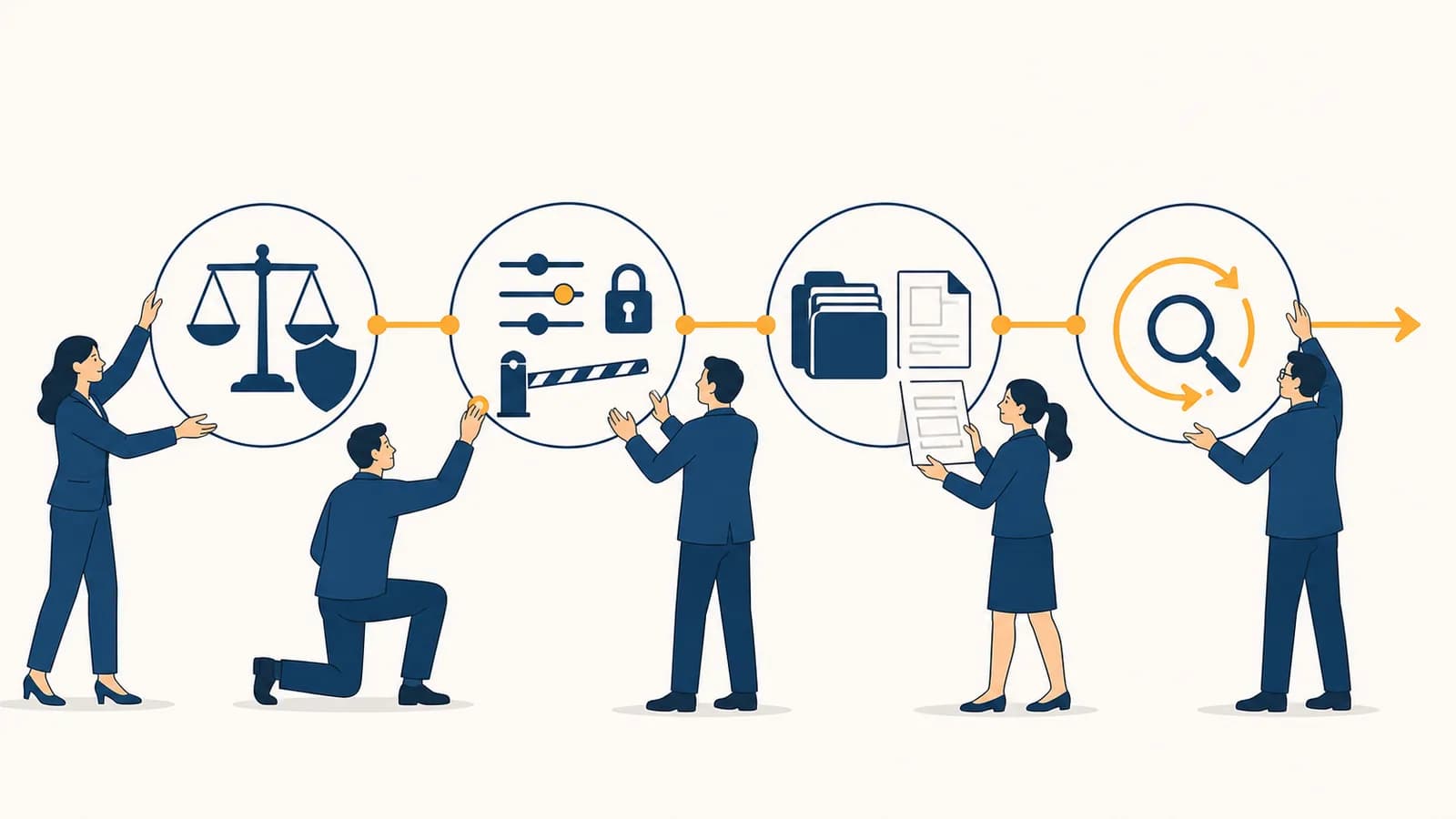
Compliance and legal considerations are a system of duties, decisions, and controls that keeps an organization within applicable law, regulation, contracts, and formal commitments, in the context of business. Business legal compliance means identifying the rules that apply, turning them into working procedures, checking results, and correcting failures. It exists to protect people, fair markets, public interests, and the organization itself. A privacy notice, a machine guard, a truthful advert, and a documented hiring decision can all be compliance work, but each answers a different legal risk.
Law depends on place and facts. A rule that applies to one product, worker, customer, or country may not apply to another. General compliance education is not a substitute for advice on a specific case.
What compliance and legal obligations actually are
Compliance is the organized practice of finding the binding requirements that apply to a business and making its conduct match them. Legal considerations are the questions managers must examine because a choice may create duties, rights, liability, reporting requirements, or limits on what the business may do.
The word compliance can sound like a pile of forms. The real object is conduct. A food producer must control hazards. An employer must make lawful employment decisions. A lender must communicate terms as required. A company collecting personal information must handle it under the data rules that govern that activity. Records matter because they help the organization operate consistently and show what happened, but a perfect file cannot make unsafe or deceptive conduct lawful.
An obligation can come from several sources:
- Statutes are laws passed by a legislature. They can create rights, prohibitions, regulators, and penalties.
- Regulations contain more detailed requirements made under legal authority. They often specify processes, disclosures, limits, or technical standards.
- Court decisions interpret law and can establish binding precedent within a legal system.
- Licences and permits place conditions on activities such as selling alcohol, operating vehicles, handling waste, or providing regulated professional services.
- Contracts create obligations between parties, such as delivery terms, confidentiality duties, service levels, and audit rights.
- Voluntary commitments can become legally important when a business promises them to customers, investors, or the public. A published claim may be tested against consumer protection or advertising law.
A useful first distinction is between a requirement and a control. “Do not make misleading advertising claims” is a requirement. Requiring evidence and legal review before publishing a health claim is a control. The control is the business mechanism designed to produce the required result.
This chain connects law to everyday work. Studying Business becomes more concrete when a legal sentence is traced into a checkout screen, shift schedule, supplier contract, or incident log.
How a compliance system works
A compliance system works by mapping obligations to activities, assigning owners, designing preventive and detective controls, training the people involved, preserving evidence, and responding to problems. It is a repeating management cycle because laws, products, staff, suppliers, and business locations all change.
Name the product, customer, location, data, worker, transaction, and supplier involved. Scope determines which rules can apply.
Record the requirement, its source, the affected process, its owner, key dates, and the evidence needed. Note any uncertainty that requires qualified legal interpretation.
Ask how the duty could be broken, who could be harmed, how likely the failure is, and how serious its consequences could be.
Change the process so that the correct action is easier and failures can be detected. Use approvals, system limits, separation of duties, checklists, inspections, or exception reports as appropriate.
Give people instructions suited to their actual decisions. A cashier, software developer, recruiter, and board member need different training.
Test controls, examine complaints and incidents, correct harm where possible, identify causes, and update the system.
Suppose a bakery begins shipping packaged biscuits to supermarkets. The activity has changed. The compliance map may now include ingredient specifications, allergen controls, package labels, weights and measures, delivery contracts, product traceability, worker safety, and advertising claims. Copying a generic “food policy” does not complete the task. Each obligation must connect to an owner and an operation.
A good register is alive. The product manager may own label content, purchasing may own approved suppliers, production may own batch records, and quality staff may test the combined process. A named owner does not absorb all legal liability. Ownership means someone has authority and a clear duty to make the control work.
Compliance versus ethics and risk management
Compliance asks what the organization must do under binding requirements, ethics asks what it should do, and risk management asks what uncertainty could affect its objectives. They overlap, but none replaces the others. A lawful decision can still be unfair, harmful, or commercially reckless.
Which rule applies, what conduct does it require, who owns the process, and what evidence will demonstrate performance?
Who could be harmed even if the rule is met, what values should guide the choice, and what uncertainty threatens the business objective?
Imagine an app asks users to accept a long notice before collecting location data. The consent screen might meet one narrow formal rule yet still confuse people about continuous tracking. Ethics tests fairness and respect. Risk management tests exposure to customer loss, security incidents, service failure, and regulatory action. Compliance tests every applicable legal basis, notice, choice, retention, access, and security requirement.
Company policies create another common confusion. A policy is an internal rule, not automatically a law. It may translate a legal duty, set a higher standard, or simply organize work. Breaking it can still matter because contracts, employment procedures, regulatory expectations, or claims about company practice may give the policy legal significance.
The three disciplines support each other. turning goals into operating plans helps leaders place legal constraints inside budgets, product choices, and schedules instead of treating them as an inspection at the end.
How legal obligations become business controls
Legal obligations become controls when a broad duty is translated into a specific action, owner, trigger, frequency, evidence record, and response to failure. This translation is where compliance becomes operational: each control must address a defined risk without making the process impossible to use.
Consider an online shop that advertises a bottle as “clinically proven to improve memory.” In the United States, the Federal Trade Commission states that advertising claims must be truthful, cannot be deceptive or unfair, and must be supported by evidence. That broad standard must be converted into a publishing process.
The marketing writer enters the exact proposed claim and its intended audience. A product specialist attaches the evidence. A reviewer checks what the words and images expressly say and what they imply. Higher risk health claims go to a qualified reviewer. The content system blocks publication until approval is recorded. After release, complaints and new evidence are monitored.
This design has both preventive controls, which aim to stop a bad claim before publication, and detective controls, which reveal problems after an action. A mandatory approval is preventive. A monthly sample of published pages is detective. A corrective control removes or repairs the claim, contacts affected parties if needed, and addresses the cause.
| Control field | Question it answers | Advertising example |
|---|---|---|
| Objective | What result must the control produce? | Claims are accurate and supported before publication. |
| Owner | Who is accountable for operation? | Marketing approvals manager. |
| Trigger | When does it operate? | A new or changed product claim is submitted. |
| Action | What exactly is done? | Review wording, context, evidence, and required disclosure. |
| Evidence | What shows that it happened? | Dated approval, claim text, evidence file, and reviewer identity. |
| Exception | What happens when it fails? | Block publication and escalate unresolved claims. |
Control strength depends on design and operation. A well designed approval that staff bypass is ineffective. A control that always runs but checks the wrong fact is also ineffective. Testing therefore asks two separate questions: could this design reasonably prevent or detect the failure, and did it operate as designed during the period examined?
How compliance shows up in products, sales, and customers
Compliance appears throughout the customer relationship: product design, safety, labels, prices, marketing, sales terms, payment, delivery, complaints, refunds, and support. The applicable rules vary by product and place, but the working method stays consistent: test the complete customer experience against each duty.
A label is not judged only by the sentence a copywriter intended. Size, placement, images, omitted facts, and the likely understanding of the audience can change the message. A prominent headline may create an impression that a small disclaimer cannot fix. A sales representative can also create risk by making unsupported promises that never appear in the official brochure.
Product teams need requirements early because compliance can change the product itself. A toy may need different materials or warnings. A financial application may need a different information flow. An accessible service may require keyboard operation, captions, or another mode of interaction under the rules that apply. Late review often discovers that code, packaging, contracts, and training all need revision at once.
A refund example: a store’s internal “no returns” sign does not cancel rights that consumer law gives a buyer. The legal result depends on the jurisdiction, type of sale, product condition, and reason for return.
Complaint handling is a control and a source of evidence. A single complaint may reveal a misunderstanding. Repeated complaints about the same fee, breakage, side effect, or cancellation route can indicate a process failure. Coding complaints by product, cause, seriousness, and outcome helps the business see patterns without treating every unhappy comment as proof of a legal breach.
Sales teams also meet contract law. A contract forms a set of enforceable promises when the legal requirements for formation are present in the relevant system. Standard terms can allocate delivery responsibilities, intellectual property rights, confidentiality, liability, dispute processes, and termination rights. A negotiated promise in an email may conflict with the standard form, so authority and version control matter. Skills in building agreements and commercial relationships help people identify the commitments that must later be delivered.
How compliance shows up in work, data, and supply chains
Compliance shapes how a business hires and protects workers, collects and secures personal information, buys goods, pays suppliers, and checks third parties. These areas share one mechanism: the company remains responsible for its own decisions even when software, contractors, or vendors perform part of the work.
Employment decisions need consistent reasons and records
Employment compliance covers recruitment, pay, working time, safety, leave, accommodation, discipline, dismissal, worker classification, and protected activity. The exact rights vary. In the United States, for example, the Equal Employment Opportunity Commission enforces federal laws that prohibit specified forms of employment discrimination, while coverage and protections depend on the particular law and facts.
A structured hiring process can require job related criteria, consistent interview questions, recorded scoring, accessibility adjustments, and a review of unusual rejections. The purpose is not paperwork for its own sake. It makes decisions more consistent, gives managers useful evidence, and exposes criteria that may be irrelevant or discriminatory. The wider field of lawful hiring and people management connects these controls to pay, development, performance, and retention.
Safety duties must change physical work
Workplace safety compliance is visible in guards, ventilation, maintenance, protective equipment, training, hazard communication, reporting, and work stoppage. Under United States occupational safety law, covered employers have a responsibility to provide a safe workplace and follow applicable standards. A signed training sheet does not repair a missing machine guard.
Data protection starts with purpose
Personal information can include obvious identifiers and information that identifies a person indirectly when combined with other data. Under the UK GDPR, the principles include lawfulness, fairness and transparency, purpose limitation, data minimisation, accuracy, storage limitation, security, and accountability. Other jurisdictions use different frameworks.
A business should therefore identify why it collects each field, what legal basis applies where required, who can access it, how long it is kept, where it moves, and how a person can exercise applicable rights. “We might need it someday” is a weak purpose. Collecting less data reduces both legal exposure and the amount attackers can steal.
Third parties extend the process, not the excuse
A supplier can introduce unsafe components, unlawful labour practices, sanctions exposure, bribery risk, data leakage, or false origin claims. Due diligence should match the risk. It can include identity checks, ownership information, capability evidence, contract terms, certifications, audit rights, testing, performance monitoring, and escalation. A questionnaire alone proves only what the supplier said.
The purchasing team must also watch concentration and substitution. An approved factory may outsource production, a software vendor may add a subprocessor, or scarce material may be replaced without authorization. Change notification clauses and incoming checks help a business detect when the facts behind approval have changed.
Four mistakes people make with compliance
Most compliance failures are not caused by a total absence of rules. They arise because a business copies generic policies, treats training as proof, gives ownership without authority, or hides weak signals. Each mistake breaks the connection between a requirement and actual conduct.
1. Copying a policy without mapping the process
A policy can say that customer data is deleted when no longer needed. It does not identify which databases hold the data, who starts deletion, which backups are affected, what retention exceptions apply, or how completion is checked. The repair is a data inventory, a defined retention schedule, system rules, owners, exception handling, and testing.
2. Treating training as the control
Training gives people knowledge. It does not guarantee action, especially when targets, software, or supervisors reward the opposite behaviour. A cashier can learn age restricted sales rules and still face a till that allows any date to be entered. Training works better beside system prompts, manager review, test purchases where lawful, and consequences applied consistently.
3. Giving responsibility without authority
A compliance officer who can identify a dangerous launch but cannot pause it is only an adviser. Clear escalation routes matter. Higher risk exceptions may need approval from a senior executive, legal specialist, safety leader, or board committee. The person making the decision should see the known facts, unresolved questions, possible harm, and proposed safeguards.
4. Punishing the person who reports a problem
Fear destroys information. If staff expect retaliation or embarrassment, managers learn about failures later, after harm spreads. Reporting routes need confidentiality appropriate to the case, protection against retaliation, fair investigation, feedback where possible, and action against deliberately false reports without using that possibility to silence honest concerns.
Numbers can also mislead. “Everyone completed training” measures attendance, not understanding or behaviour. “No complaints” may mean customers are satisfied, or it may mean the complaint route is hidden. Useful measures connect to the risk: overdue safety actions, unsupported claims found in samples, access rights removed late, repeat supplier defects, or time taken to contain a serious incident.
What changes for a small business
A small business may use simpler controls, but its legal duties do not disappear merely because it has fewer staff. The right design matches the organization’s size, risk, sector, and resources while preserving clear ownership, evidence, independent checking where needed, and timely escalation.
A ten person repair shop probably does not need a compliance department. It may need a current licence calendar, safety inspections, approved waste contractor records, clear estimates, secure customer records, payroll checks, and an outside adviser for unusual issues. One person can hold several roles, but conflicts still need attention. The employee who receives cash should not be the only person reconciling it.
Prioritization is necessary. A simple method scores the likelihood of a failure and the seriousness of its impact. The multiplication is not legal truth, but it helps compare issues if the definitions are consistent.
If likelihood is scored 3 out of 5 and impact 4 out of 5, the visible calculation is . The team should still read the facts behind 12.
Legal deadlines, irreversible harm, vulnerable people, criminal exposure, and threats to life or health may demand priority regardless of a neat score. Low frequency events can still require strong controls. The score supports judgment; it does not make the judgment.
How responsibility works across a business
Responsibility is distributed across the organization: leaders set direction and resources, managers own processes, specialists interpret and advise, workers follow controls and report problems, and independent reviewers test performance. Legal accountability depends on the jurisdiction and facts, so a job title alone does not settle liability.
A practical governance model often uses three kinds of work. Operating teams build compliance into sales, production, hiring, payments, and technology. Risk, legal, privacy, safety, or compliance specialists advise and challenge. Internal audit or another sufficiently independent reviewer tests selected areas and reports findings. A small organization can adapt the structure without pretending that self review is always independent.
Boards and senior leaders need information that supports decisions, not a folder of raw incidents. Reports should distinguish severe cases from minor errors, show repeat causes, state overdue actions, identify accepted risks, and make unclear ownership visible. Leaders also reveal priorities through budgets and incentives. A sales target that can only be met by rushing required checks is a compliance design problem.
A warehouse worker reports a damaged forklift brake. The worker removes it from service under the procedure. The supervisor secures a replacement and records the defect. Maintenance repairs and tests the vehicle. Safety staff check for similar faults. Management asks why scheduled inspection did not detect it. Each role owns a different part of the response.
Specialists are valuable because some questions require professional judgment. Lawyers can interpret legal uncertainty and advise on privilege where it applies. Engineers can assess technical safety. Accountants can test financial records. Their involvement does not free managers from understanding the business decision or giving accurate facts.
What compliance evidence actually is
Good compliance evidence is relevant, reliable, dated, attributable, protected, and retained for an appropriate period. It shows both what rule or control was expected and what actually occurred. Evidence can support accountability, but records must reflect real work rather than being created after the event.
Examples include signed contracts, system logs, test results, inspection records, approval histories, training assessments, meeting decisions, complaint files, invoices, access reviews, maintenance records, and proof of corrective action. The needed record depends on the duty. Some laws prescribe form and retention. Others focus on conduct, leaving the organization to decide how to prove it.
Version control answers which instruction or term applied on a particular date. Access control protects sensitive investigations and personal data. A retention schedule balances legal preservation duties against storage limitation and security risk. When litigation, investigation, or a formal request is expected, ordinary deletion may need to stop for relevant material under applicable rules.
Evidence quality also matters. A spreadsheet that anyone can alter without a log is weaker than a controlled system record. A certificate can expire or cover a different site. A photograph can show a guard installed once, not that it stayed in place. Reviewers should ask what the evidence proves, what it does not prove, and how it could be wrong.
How a compliance response works
A compliance failure can cause injury, customer loss, invalid transactions, repayment, contract claims, licence restrictions, regulatory orders, financial penalties, criminal proceedings, or reputational damage. The correct response is to protect people, preserve facts, meet reporting duties, investigate fairly, repair harm, and prevent recurrence.
Response starts with triage. Is anyone in immediate danger? Is unsafe equipment still operating? Is personal information still exposed? Are customers still seeing a misleading price? Containment comes before a polished report. The team then preserves relevant evidence and identifies any legal or contractual notification deadlines with qualified help.
An investigation should separate fact finding from assumption. It needs a defined scope, impartial investigators, protected records, interviews that do not coach answers, and findings connected to evidence. Fairness matters to the people involved and to the reliability of the result.
Root cause analysis asks why the control failed. “Employee error” is often incomplete. Perhaps the instruction was unclear, workload made the required step impossible, software allowed an override, supervision ignored earlier warnings, or incentives rewarded speed. Corrective action should address the cause, assign an owner and date, test completion, and check that the fix did not create a new risk.
Compliance turns legal limits into business capability
Compliance is part of management because every business model depends on permissions, duties, promises, and trust. A company that can identify applicable rules, build workable controls, detect weak signals, and correct failure can make decisions with better information and fewer preventable surprises.
The useful habit is simple: take one real process and follow it. Choose a customer order, job application, marketing claim, supplier approval, or data field. Name the legal source, requirement, owner, control, evidence, exception route, and review date. Missing answers show where the system is relying on memory or hope.
Rules also shape behaviour through ordinary management. Promotions, targets, meeting agendas, software defaults, and responses to bad news tell employees what the organization truly rewards. That is why the way workplace culture shapes conduct belongs beside policies and legal advice in any serious compliance design.
The takeaway: Compliance is not the claim that a business follows the law. It is the traceable chain that connects each applicable duty to decisions, controls, evidence, reporting, and correction. Find one broken link, and you have found useful work to do.