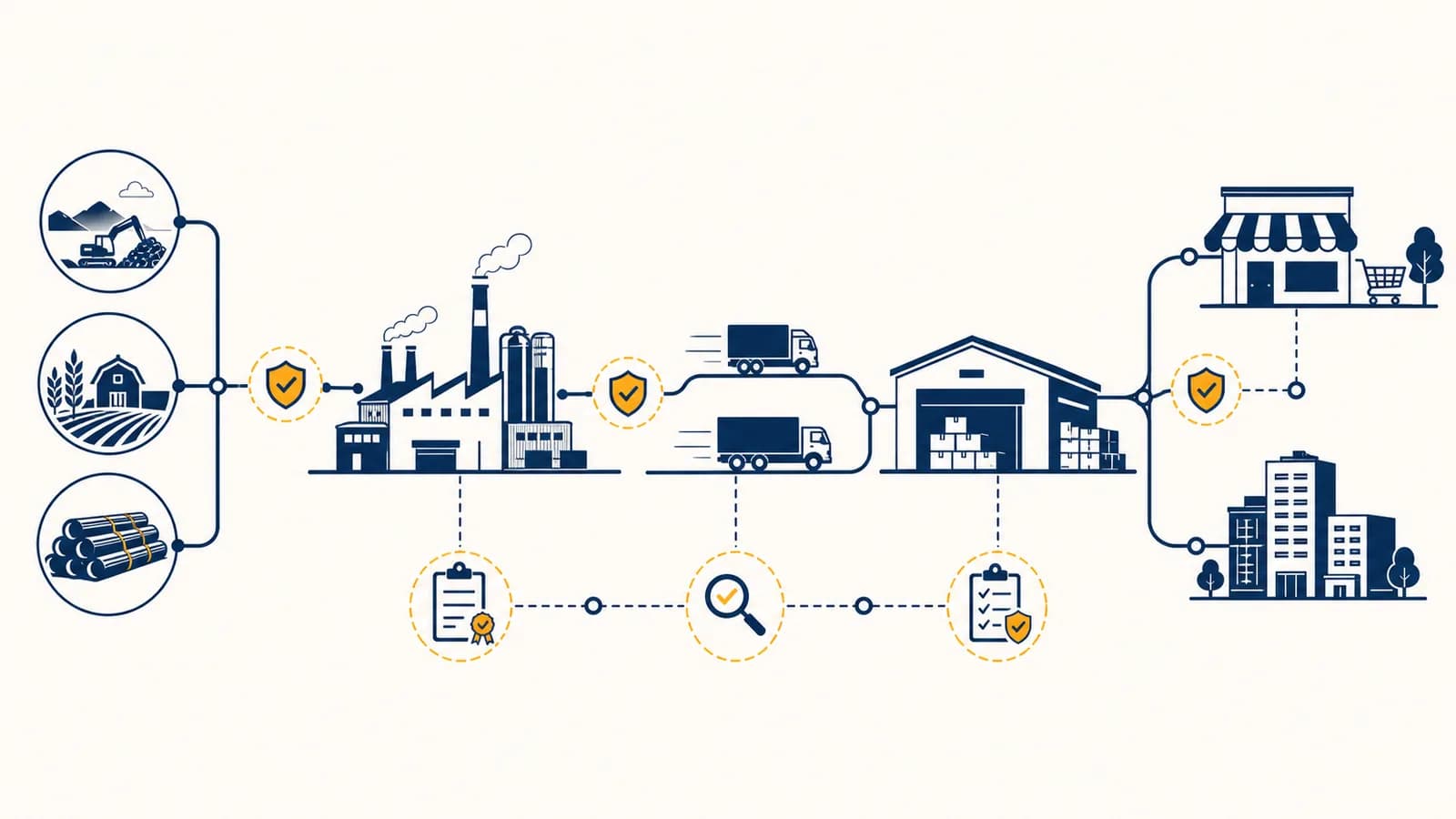
Most supply chain headaches begin as small, visible risks
Risk, compliance, and supply chain management are one connected job: spot what could interrupt the movement of goods, check which rules apply, and build controls before a small failure becomes an expensive delay. By the end, you can map a supply chain, distinguish risks from compliance duties, estimate exposure, and choose practical controls.
A supply chain is the network that turns inputs into something a customer can use. It includes raw materials, factories, transport, warehouses, software, payment systems, and people. A risk is an uncertain event that could damage cost, time, quality, safety, or reputation. Compliance means meeting an obligation imposed by law, a regulator, a contract, or an internal policy.
These ideas connect because a product rarely moves through only one organization. A seller may design it, another company may manufacture it, a carrier may transport it, and a platform may collect payment. Every handoff creates a place where information, materials, or responsibility can go missing.
The physical chain is only half the picture. A parallel information chain carries purchase orders, specifications, certificates, customs records, invoices, and delivery confirmations. If a shipment arrives but its certificate does not, the goods may still be unusable. If a database shows the wrong batch number, a recall may target too much stock or miss the affected units.
This is why prevention starts with visibility. A team cannot control a supplier, route, document, or computer system it has not identified. The first useful artifact is not a thick policy manual. It is a plain map of what moves, who handles it, what evidence follows it, and where failure would stop the process.
What is the difference between risk and compliance?
Risk asks what might go wrong and how much harm could follow. Compliance asks which promises and rules must be satisfied, then what evidence proves they were satisfied. Some risks have no legal consequence, while one compliance failure can create several business risks at once.
A late truck is mainly an operational risk. A shipment with a missing customs declaration is both an operational risk and a compliance problem. A supplier that changes a material without approval may create quality, safety, contractual, and reputation risks in one act.
What event could prevent the intended result, how likely is it, how severe would the effect be, and how quickly could we detect it?
What requirement applies, who owns it, what must happen, and which record will show that it happened on time?
The distinction changes how a team responds. A risk can be accepted if the expected loss is small and the control would cost more than the harm it prevents. A binding requirement is different. The company must meet it or stop the affected activity, even if noncompliance seems unlikely to be discovered.
Contracts matter here. A customer may require a particular inspection, security practice, or delivery record even where no statute does. Internal policies also create work, though they can usually be revised through the company’s own process. Keeping the source of each requirement beside it prevents employees from treating every preference as law or every law as optional.
A passed audit does not prove that future work is safe. An audit samples evidence from a period. Conditions can change the next day when staff, software, materials, or suppliers change.
Good compliance therefore runs as a repeated process, not an annual performance. People identify obligations, assign owners, perform controls, save evidence, test the controls, and correct failures. Records should connect each requirement to the transaction or product it governs. The design resembles a well planned system of databases that keep operational data usable, because relationships and identifiers matter as much as individual documents.
How do you map a supply chain you cannot fully see?
Start with one product and trace its materials, decisions, records, and payments backward to their sources and forward to the customer. Name direct suppliers first, then ask which upstream providers or shared services could stop several direct suppliers at the same time.
Companies often know their direct suppliers well. Visibility fades beyond them. A direct supplier may depend on a specialist processor, a single port, or the same cloud service as several competitors. Those hidden common dependencies matter because they turn several apparently separate risks into one concentrated risk.
Set a boundary small enough to inspect. Record the customer promise, including quantity, quality, place, and delivery time.
List materials, labor, machines, transport, energy, software, money, and approvals. Include an input only if its loss could stop or degrade the result.
For each transfer, identify who sends, who receives, what acceptance check occurs, and which record confirms it.
Ask suppliers about their own critical providers, routes, facilities, and systems. Mark any resource used by several branches.
Follow a recent order from request to delivery. Correct the map wherever actual work differs from the stated process.
Location adds another layer. A supplier address is not enough. The relevant question is what that location depends on: roads, ports, water, power, political borders, and nearby hazards. The study of geographic systems and human activity helps explain why two sites with similar buildings can have very different exposure.
Maps can also combine observations with business records. Flood extent, fire boundaries, vegetation, and transport disruption can be observed over large areas through satellite based remote sensing. Such evidence does not predict every interruption, but it can reveal that a supposedly separate group of facilities shares the same physical hazard.
A complete map is not a realistic goal. Supply networks change, and suppliers may protect commercial information. Record confidence instead. Confirmed facts, supplier statements, and assumptions should look different on the map. That makes uncertainty visible and gives the team a sensible order for further checks.
How can risk be scored without pretending to know the future?
Risk scoring is a consistent way to compare uncertain events, not a forecast with scientific precision. Define probability and impact scales in plain language, score with available evidence, record uncertainty, and use the result to decide which risks deserve analysis or action first.
A common starting model multiplies probability by impact. The numbers are ranks, not measurements. A probability score of four does not necessarily mean an event is twice as likely as a score of two. That limitation should remain visible when people compare totals.
If probability is rated 3 out of 5 and impact is rated 4 out of 5, the score is out of a possible 25.
The scale needs written anchors. For impact, a score of one might mean work continues with a minor correction, while five might mean a prolonged stop, serious injury, or loss beyond an agreed financial boundary. For probability, descriptions can refer to observed frequency or known conditions. Clear anchors reduce arguments caused by people using the same number for different ideas.
Expected monetary loss can help where probability and cost estimates are defensible. Suppose a component failure has a one in ten chance during a project and would cost $40,000 to correct. The visible arithmetic gives an expected loss of . This does not mean the company will lose $4,000. It describes an average across many comparable decisions.
A proposed inspection costing $1,500 that removes half of that expected loss produces an expected benefit of $2,000. Subtracting the $1,500 control cost leaves an expected net benefit of $500. The logic belongs to comparing costs with expected benefits, but the decision still has to consider safety limits, legal duties, and uncertainty.
Do not let a neat score erase important differences. A rare fatal hazard cannot be treated like a frequent paperwork delay just because multiplication gives the same result. Record impact types separately, identify nonnegotiable limits, and show the range when estimates are weak. A useful register invites revision instead of hiding uncertainty behind decimals.
Which controls prevent failures instead of documenting them?
Preventive controls stop an error before it enters the chain, detective controls find it after entry, and corrective controls limit damage and restore normal work. Strong systems combine all three, assign each control to a named owner, and specify the evidence it produces.
A purchasing system that blocks an unapproved supplier is preventive. An invoice review that finds a mismatched price is detective. A recall procedure is corrective. Prevention usually avoids more damage, but it can also slow work or reject valid exceptions. Detection provides a second chance when prevention is impractical or imperfect.
A food producer receives packaging with the correct artwork but the wrong barrier material. A preventive control compares the approved material code with the purchase order. A receiving test detects a mismatch. Batch records identify affected goods, while a corrective process holds them before release.
The best control sits close to the cause. Asking a warehouse worker to catch an incorrect engineering specification at the loading dock is late and unreliable. Requiring an approved specification before the purchase order can be issued addresses the error where it begins. Automatic checks work well for exact rules, while trained judgment is needed for unusual conditions and ambiguous evidence.
Each control should answer six practical questions: what triggers it, who performs it, what they compare, what counts as a failure, where evidence is stored, and what happens next. “Review supplier documents” is too vague to test. “The receiving specialist matches the certificate batch number to the delivery record before stock release” can be observed and audited.
Controls can fail quietly. A required field may be filled with meaningless text. An approver may click through alerts. A backup may exist but never restore correctly. Test the operating result, not only the written design. Sampling records, observing work, and running controlled simulations can reveal the difference.
Control cost also includes delay and attention. If every order needs senior approval, the queue itself may become a supply risk. Set approval thresholds that match exposure, allow defined exceptions, and review false alarms. The aim is a system that people can follow during busy, ordinary work.
What makes a supplier review useful?
A useful supplier review tests evidence connected to the product and risk in question. It checks capability, capacity, traceability, financial and operational dependencies, compliance records, and response plans. A generic questionnaire is only a starting point because answers without verification reveal little.
Begin with the consequence of supplier failure. A supplier of replaceable office stationery does not need the same review as the only maker of a safety related component. Segmentation keeps effort proportional. It also prevents a long form from becoming a substitute for thinking.
Evidence can include certifications, test reports, process records, insurance documents, financial statements, security practices, and samples of traceability data. The right evidence depends on the risk. Check who issued it, what facility and period it covers, and whether the scope matches the item being bought. An impressive certificate for the wrong site proves nothing about the actual order.
Ask for recovery facts, not confidence. “We have a backup plan” is weak evidence. Ask which alternate site can make the item, what equipment it needs, how qualification works, and when the last recovery test occurred.
Contracts can turn expectations into enforceable duties. Useful clauses define notification times, change approval, audit access, record retention, data handling, subcontracting, continuity planning, and remedies. A clause still needs an operational owner. Legal staff may draft it, but purchasing, quality, security, and logistics must know when to use it.
Supplier monitoring should follow signals tied to failure: late or incomplete deliveries, rejected batches, unexplained changes, missing records, slow corrective action, or repeated system outages. A single incident may be noise. A pattern can show declining process control. The review should end with a decision, an owner, and a due date, not a colored dashboard alone.
How should a team respond when disruption begins?
Response begins by protecting people, containing the affected goods or systems, and establishing a reliable set of facts. The team then chooses continuity actions, communicates to defined audiences, preserves evidence, and tracks recovery until normal controls are working again.
The first report is often incomplete. Separate facts, estimates, and assumptions. Record times and sources. Give one person authority to maintain the incident log, because competing spreadsheets create disagreement exactly when decisions need a shared picture.
- Protect and contain. Stop unsafe work, quarantine suspect stock, restrict compromised access, or pause a shipment if continued movement could increase harm.
- Define the boundary. Identify affected products, batches, sites, orders, customers, records, and time periods. Traceability determines how narrow this boundary can be.
- Keep priority work running. Use approved alternate suppliers, stock, routes, sites, or manual procedures. Record every temporary exception.
- Communicate by obligation and need. Tell employees, customers, suppliers, insurers, and authorities what they need to act. Avoid claims that the evidence cannot support.
- Recover and verify. Restore normal work, test the restored controls, reconcile temporary records, and investigate the cause.
A workaround creates its own risk. Buying from an unapproved supplier may solve a shortage while introducing unknown quality. Manual order entry may keep shipments moving while weakening validation and traceability. Emergency procedures should state which controls may change, who may approve that change, and how later reconciliation occurs.
After recovery, compare the plan with what people actually did. Keep adaptations that worked, fix missing contacts and unusable instructions, and assign actions with dates. The review should not search for a convenient person to blame. It should find the technical and organizational conditions that allowed the loss to spread.
Prevention becomes ordinary work when evidence follows every decision
Risk and compliance improve when they are built into purchasing, design, production, shipping, and payment rather than added during an audit. The practical standard is simple: important decisions have defined inputs, named owners, visible controls, retained evidence, and a response when conditions change.
Start with one product that matters. Map its chain and information trail. Choose the few failures that could cause the greatest harm. Link each one to an existing control, then test whether that control really operates. Gaps become a short action list rather than a vague demand to “manage risk better.”
Measures should help people act. Track overdue corrective actions, supplier changes awaiting approval, failed checks, missing records, and time needed to recover a tested process. Counts without context can mislead, so pair them with severity and exposure. Ten minor documentation errors may matter less than one uncontained safety defect.
The takeaway: Preventable supply chain headaches shrink when a company knows its dependencies, turns obligations into testable controls, keeps traceable evidence, and rehearses what to do when those controls fail.
No map stays finished. Products change, suppliers move work, software is replaced, and new contracts create new duties. Add change triggers to the process so that a new material, facility, route, subcontractor, or system causes the relevant risk and compliance checks before approval.
The result is not the absence of disruption. It is a chain that reveals trouble earlier, contains it more narrowly, and recovers with less guessing. That outcome comes from repeated, inspectable work: clear requirements, reliable records, tested controls, and decisions whose reasoning can be checked after the pressure has passed.