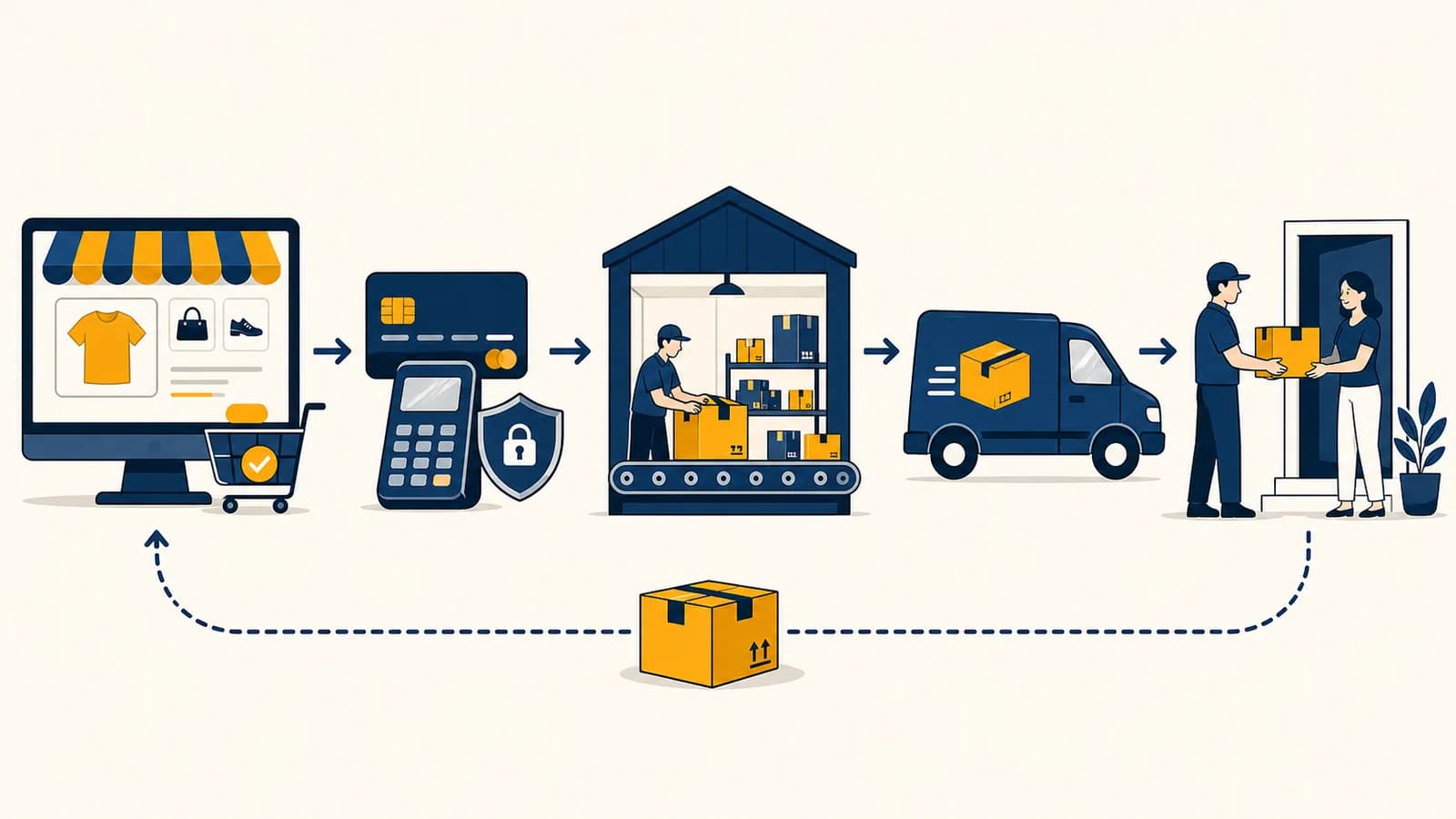
E-commerce is a retail system that lets buyers discover, order, and pay for goods or services through digital channels, in the context of business. An online store connects a product catalogue, shopping cart, checkout, payment service, inventory record, and delivery process. People searching for how e-commerce works, online retail, digital payments, or internet shopping are asking about this connected system. It exists to let a transaction happen without the buyer and seller being in the same shop.
What e-commerce actually is
E-commerce is the exchange of value through an electronic ordering process. The product may be physical, digital, or a service, but the defining feature is that the buyer submits the order through a website, app, marketplace, or other digital interface.
A useful way to understand e-commerce is to separate the customer-facing shop from the business systems behind it. The shop displays descriptions, images, prices, delivery promises, and policies. Behind the screen, software checks stock, requests payment, creates an order, tells a warehouse what to pick, sends messages, and records the sale.
Online retail is the part of e-commerce that sells directly to the final customer. E-commerce also includes a wholesaler taking a restaurant's supply order through a portal, a designer selling a downloadable template, and one person selling a used bicycle to another through a marketplace. The parties and products differ, but each transaction needs an offer, acceptance, payment terms, and fulfilment.
This chain is part of Business because every technical action supports a commercial decision. Someone chooses the target customer, product range, price, promise, sales channel, and level of service. Software can execute those choices quickly, but it cannot make an unprofitable offer profitable.
How an online storefront works
An online storefront turns a catalogue into a searchable set of offers and guides a buyer toward a cart. It combines product data, price rules, stock information, navigation, search, recommendations, and page design to answer the buyer's practical questions before checkout.
A product record usually contains a name, description, images, category, price, tax status, shipping weight, stock keeping unit, and available variants. A blue shirt in three sizes is one product with several variants. Each variant needs its own stock count because selling the last medium shirt must not remove the small and large shirts.
A catalogue is structured data, not a stack of pages
The catalogue is the source of facts that pages display. If a merchant changes a price in the product record, the listing page, product page, cart, and promotion rules should all use the new value. Separate copies create errors, such as one price in search results and another at checkout.
Categories help people browse when they know the type of item but not its exact name. Search helps when they can describe the item. Filters narrow a large set by properties such as size, colour, compatibility, or availability. Good product information reduces uncertainty, which is one reason accurate dimensions and delivery dates can matter more than elaborate slogans.
A shopper needs a cable for a particular laptop. The useful page identifies the connector standard, length, power rating, compatible models, price, current stock, and arrival estimate. A page that says only “premium charging” has not supplied enough information for a safe purchase.
A cart is a temporary order draft. It stores the chosen variant, quantity, current price, discounts, and sometimes an estimated delivery charge. The store must check these facts again at checkout because stock or eligibility may have changed while the customer was browsing.
How checkout and payment work
Checkout converts a cart into a confirmed order by collecting identity, delivery, tax, and payment information, then validating each part. A payment approval does not itself finish the sale: the merchant must also create an order and later provide what was promised.
The store checks that items still exist, quantities are available, prices are current, and any discount applies to this customer and basket.
The system adds item prices, shipping, and applicable taxes, then subtracts valid discounts or credits. The buyer sees the final amount before confirming.
A payment provider sends an authorization request through the relevant financial network. The payer's bank or payment service approves or declines it based on the account and its risk checks.
The store saves an order number, items, address, total, payment status, and time. It must avoid creating duplicate orders if a page refresh repeats a request.
The merchant completes the charge according to its process. Financial institutions then move the money, less any agreed fees, into the merchant's account.
Card details should not be scattered across a merchant's systems. Payment providers can replace sensitive account details with a token, a reference that the store can use for an approved purpose without treating it as the original card number. Encryption protects data in transit, while access controls and industry security requirements reduce the number of people and systems that can handle it.
An approval is not a guarantee. A payment can later be refunded, reversed after a dispute, or found to involve fraud. The order record and proof of fulfilment still matter after checkout.
A failed payment also needs a designed path. The store should keep the cart, explain what the customer can try, and avoid claiming that a vague technical error is the buyer's fault. Payment performance joins technology with the methods businesses use to turn interest into a completed sale.
How inventory, fulfilment, and returns work
Fulfilment is the process that converts an accepted order into delivery or access, while inventory control keeps the promise tied to actual supply. For physical goods, this covers reservation, picking, packing, carrier handoff, tracking, delivery, and any return.
Inventory begins with units that are physically on hand, but a store also needs to know which units are available to promise. If ten items sit on a shelf and three already belong to paid orders, only seven should normally remain available. A safety buffer may reduce the sellable count further when damage, counting errors, or delayed updates are possible.
If 40 units are on hand, 9 are reserved, and 3 form a safety buffer, the store can offer 28 units: 40 minus 9 minus 3.
Once an order reaches a warehouse, a worker or automated system receives a pick list. The item is found, checked against the order, packed to survive transport, labelled, and handed to a carrier. Tracking events are reports from stages in that network. They are useful evidence, but an estimated arrival date remains a forecast rather than a physical guarantee.
A retailer may hold its own stock, ask a specialist fulfilment company to store and ship it, or use dropshipping, where a supplier sends the product after the retailer makes the sale. Dropshipping reduces the retailer's need to buy and store inventory upfront. It also gives the retailer less direct control over packing, stock accuracy, and dispatch speed, even though the customer still sees the retailer as responsible.
Returns run the chain in reverse, but they are not simply “shipping backwards.” The business authorizes the return, receives or verifies the item, assesses its condition, decides whether it can be resold, repaired, liquidated, or discarded, updates inventory, and issues the agreed refund. Each choice has a cost. A clear returns policy helps the buyer decide before ordering and gives staff a consistent rule afterward.
E-commerce versus marketplaces and social commerce
An independent online store is a sales channel controlled mainly by one merchant, while a marketplace hosts offers from many sellers and sets shared transaction rules. Social commerce places discovery and sometimes checkout inside a social platform. A business can use all three at once.
The merchant controls the brand presentation, catalogue structure, customer experience, and many data choices. It must attract visitors and operate more of the system itself.
The platform gathers buyers and standardizes listing, payment, ranking, and dispute processes. The seller gains access to demand but accepts fees, comparison with rivals, and platform rules.
A marketplace is not the seller of every item merely because it runs the website. Depending on the transaction, the platform may supply search, payment, identity checks, or dispute tools while an outside merchant owns the stock and fulfils the order. The listing should make the responsible seller and the applicable policy clear.
Social commerce shortens the distance between seeing an item and ordering it. A creator's post, a live demonstration, or a shoppable image can lead directly to a product. This may make discovery efficient, but popularity signals do not prove quality, fit, safety, or value. The buyer still needs product facts and a clear seller identity.
Channel choice affects more than marketing. It changes fees, access to customer information, return handling, price competition, and the risk that a rule change will disrupt sales. A merchant comparing channels should calculate the full cost per completed and retained order, not select the place with the highest visitor count.
How the economics of an online order work
An online order creates revenue only once, but it can create costs at discovery, payment, packing, delivery, service, and return. Profit depends on the contribution left after the costs caused by that order, then on whether that contribution can cover the business's fixed costs.
Suppose a shop sells a bag for $60. This worked example assumes the bag costs the shop $24, fulfilment and delivery cost $8, the payment fee is $2.10, advertising assigned to the order costs $10, and a $3 allowance reflects expected return costs across many orders.
The arithmetic is visible: $24 plus $8 plus $2.10 plus $10 plus $3 equals $47.10. Checking the total against its components can expose an error before it reaches a decision. The contribution is therefore $60 minus $47.10, which equals $12.90.
For this order, $60.00 minus $47.10 leaves $12.90 to help pay fixed costs and, after those are covered, profit.
Dashboards and spreadsheets can present incorrect inputs beautifully, so managers must reconcile totals with their components. The shop still has fixed costs such as software subscriptions, salaries, insurance, and facilities. If it spends more than $12.90 of extra effort or discounting to secure this order, the order can stop contributing to those fixed costs.
Revenue, cash, and profit are different. Revenue records the value of the sale under the business's accounting rules. Cash may arrive later, after a payment service settles funds. Profit also recognizes relevant expenses. Owners learn to separate those measures through budgeting, cash flow, and financial control.
How e-commerce data guides decisions
E-commerce data records events along the buying process and helps a business locate causes, not just totals. Useful analysis connects traffic source, product view, cart action, checkout, payment, fulfilment, return, and repeat purchase while respecting consent and data protection rules.
A conversion rate compares completed orders with a defined set of visits or users. The denominator must be stated. If a store records 2,000 eligible visits and 50 result in orders, its visit conversion rate for that period is 2.5 percent. A rate based on users may differ because one user can visit several times.
In the worked example, 50 divided by 2,000, then multiplied by 100 percent, equals 2.5 percent.
A funnel breaks that total into stages. If many people view a product but few add it to a cart, the offer, information, price, or stock may be the problem. If people reach checkout but payment fails, the cause may sit in form design, unexpected charges, authentication, or the payment service. Data identifies where to investigate; controlled tests and customer evidence help identify why.
Average order value, return rate, gross margin, fulfilment time, repeat purchase rate, and customer service contacts each reveal a different part of performance. One metric can improve while the business worsens. A large discount might raise order count but reduce contribution. A restrictive returns process might lower recorded returns while increasing complaints and discouraging future purchases.
Define the event before reading the chart. “Checkout started,” “order created,” “payment approved,” and “order delivered” are different events. Mixing them produces confident but false conclusions.
Analysts join records, test definitions, segment customers fairly, and explain uncertainty. The wider discipline of turning operational data into business intelligence shows why a measure needs context, ownership, and a decision it can improve.
How e-commerce shows up in real jobs
E-commerce work is distributed across commercial, technical, creative, financial, and operational roles. Each role owns part of the transaction, but no role can judge performance in isolation because a change to price, design, code, or delivery affects the same customer order.
Merchandising decides what the digital shelf says
An e-commerce merchandiser selects products to feature, organizes categories, checks product information, plans promotions, and watches stock. The work combines customer understanding with arithmetic. Featuring an item that is almost sold out may waste attention, while hiding an overstocked seasonal item may leave cash tied up in inventory.
Product and engineering make the transaction reliable
Product managers, designers, and software engineers shape search, product pages, accounts, checkout, integrations, and internal tools. They translate a business rule such as “one discount per order” into interface behaviour, validation logic, tests, and records. They also plan for slow services, repeated clicks, expired stock, and partial failures.
Operations make the digital promise physical
Warehouse teams, inventory planners, carrier managers, and customer service staff handle the part customers can touch. They investigate missing parcels, stock differences, damaged items, address problems, and refunds. Their evidence should flow back into product descriptions, packaging choices, supplier decisions, and delivery promises.
Risk and finance protect the exchange
Fraud analysts look for orders that do not fit normal patterns, but a risk rule has two possible errors. It can approve fraud or reject a genuine customer. Finance teams reconcile orders, fees, refunds, taxes, and money received. Legal and privacy specialists examine claims, contracts, consent, accessibility, consumer rights, and the handling of personal data in each market.
A retailer promises faster delivery. Marketing changes the message, engineers update the displayed estimate, inventory planners place stock closer to demand, warehouse leaders adjust cut-off times, finance checks the added cost, and support prepares for exceptions. The promise works only if the whole operating system can keep it.
Four mistakes people make with e-commerce
Most e-commerce mistakes come from treating one visible result as the whole system. Traffic does not guarantee demand, revenue does not guarantee profit, a payment does not guarantee fulfilment, and automation does not remove responsibility for the rules it applies.
1. Treating visits as customers
A visit shows that a page loaded under a measurement rule. It does not prove that the visitor understood the offer, intended to buy, or was even a person rather than automated traffic. Managers should trace qualified visits through specific actions and compare acquisition cost with retained contribution, not celebrate attention by itself.
2. Setting a price from a competitor's price
A rival's $40 price says nothing by itself about that rival's product cost, delivery contract, return rate, service level, or objective. A merchant needs its own cost structure and customer value evidence. Competitor prices provide market context, not a complete calculation.
3. Automating a broken policy
Software applies instructions at scale. If a refund rule is unfair, a recommendation rewards misleading products, or a fraud filter rejects a group of legitimate buyers, faster execution spreads the harm. Teams should test outcomes, provide a route for review, and assign a person who owns the policy.
4. Optimizing one stage at another stage's expense
A dramatic product image may increase clicks while hiding useful detail. A checkout shortcut may increase orders while accepting bad addresses. Thin packaging may cut packing cost while increasing damage. The correct unit of analysis is often the delivered, kept, and supportable order, not the easiest stage to measure.
The sentence is a test, not a slogan. A business can apply it to every change: identify the promise, check the evidence shown before purchase, follow what the operation delivers, and count what happens afterward.
What makes an online store trustworthy?
A trustworthy online store makes the seller, offer, total cost, delivery terms, return process, and data practices clear before payment. It also protects account and payment information, confirms actions accurately, and provides reachable support when the automated path cannot solve a problem.
Useful trust signals are specific. A real business identity and contact route can be checked. Product claims can be compared with specifications and independent evidence. The checkout shows the full payable total before confirmation. Delivery and return terms state conditions rather than hiding them behind vague reassurance. Secure transport protects the connection, but a padlock icon alone does not prove that the seller is honest or the product is good.
Buyers can pause before paying and check the seller, product, recurring charges, delivery date, returns address, and payment protections available to them. Merchants can reduce suspicion by writing precise policies, limiting data collection, patching systems, controlling staff access, and responding consistently when an order goes wrong.
How do taxes, currencies, and international orders work?
International e-commerce adds rules based on the seller, buyer, product, and destination. The checkout may need to calculate tax, convert or display currency, restrict products, collect customs information, and explain which party pays duties and import charges.
Tax is not a universal percentage that a store can attach everywhere. The applicable rule can depend on the type of product, the locations of the parties, transaction value, and the seller's registration duties. Businesses use configured tax services and qualified advice for the places where they trade. The customer needs to know whether displayed prices include tax and whether more may be collected on import.
Currency display also carries a promise. If a page shows one currency but the payment is processed in another, the customer's provider may perform conversion and charge under its own terms. A clear checkout identifies the currency that will actually be charged. International fulfilment then adds commodity descriptions, declared values, carrier documents, restricted goods, customs delays, and a harder returns route.
How do subscriptions and digital products change the model?
Subscriptions create repeated transactions under an agreed schedule, while digital products replace physical delivery with controlled access or a file. Both reduce some warehouse work, but they add obligations around consent, access, renewal, cancellation, licensing, support, and payment failure.
A subscription checkout should state the amount, billing interval, trial conditions if any, renewal rule, and cancellation method before the buyer agrees. The system stores a payment reference, attempts charges on schedule, records each invoice, and handles failures. A failed renewal should not silently create an unlimited debt or an endless retry loop. The business needs a stated policy for notices, access, retries, and cancellation.
A digital product still has fulfilment. The store may generate a download link, create an account entitlement, issue a licence key, or grant access to a course. It must prevent accidental duplicate delivery while letting a genuine buyer recover access. The product description should distinguish ownership from a limited licence and state compatibility, updates, and usage restrictions clearly.
The takeaway: Follow one order all the way through. Ask what the customer was promised, which system recorded each change, where money moved, who performed the work, what could fail, and whether the order produced contribution after its real costs.
E-commerce makes business decisions visible
E-commerce makes a business model observable one order at a time. Product choice appears in the catalogue, positioning appears in the offer, operations appear in delivery, finance appears in the margin, and responsibility appears most clearly when something goes wrong.
The subject becomes practical when you inspect a real purchase. Before ordering, notice the seller, product facts, price components, delivery promise, and return terms. After ordering, map the confirmation, payment status, stock movement, tracking events, packaging, and support. Then ask which choices created value for the customer and which costs the seller had to absorb.
That exercise turns a familiar website into a working model of supply, demand, marketing, accounting, operations, technology, law, and decision-making. It also reveals the standard by which online retail should be judged: the business must make a clear promise, keep it at a sustainable cost, and correct the transaction when it fails.