What is a culture-fair IQ test?
A culture-fair IQ test is a standardized reasoning assessment designed to reduce the advantage that vocabulary, school-taught facts, and familiarity with one culture can give a test taker. It usually replaces language-heavy questions with visual problems involving shapes, sequences, categories, and spatial relationships.
The word fair describes an aim, not a guarantee. These tests try to make language and specific background knowledge less important, so the score depends more heavily on how a person detects rules and solves unfamiliar problems. Knowing that aim makes it easier to judge what a score can show, what may have influenced it, and when another kind of evidence is needed.
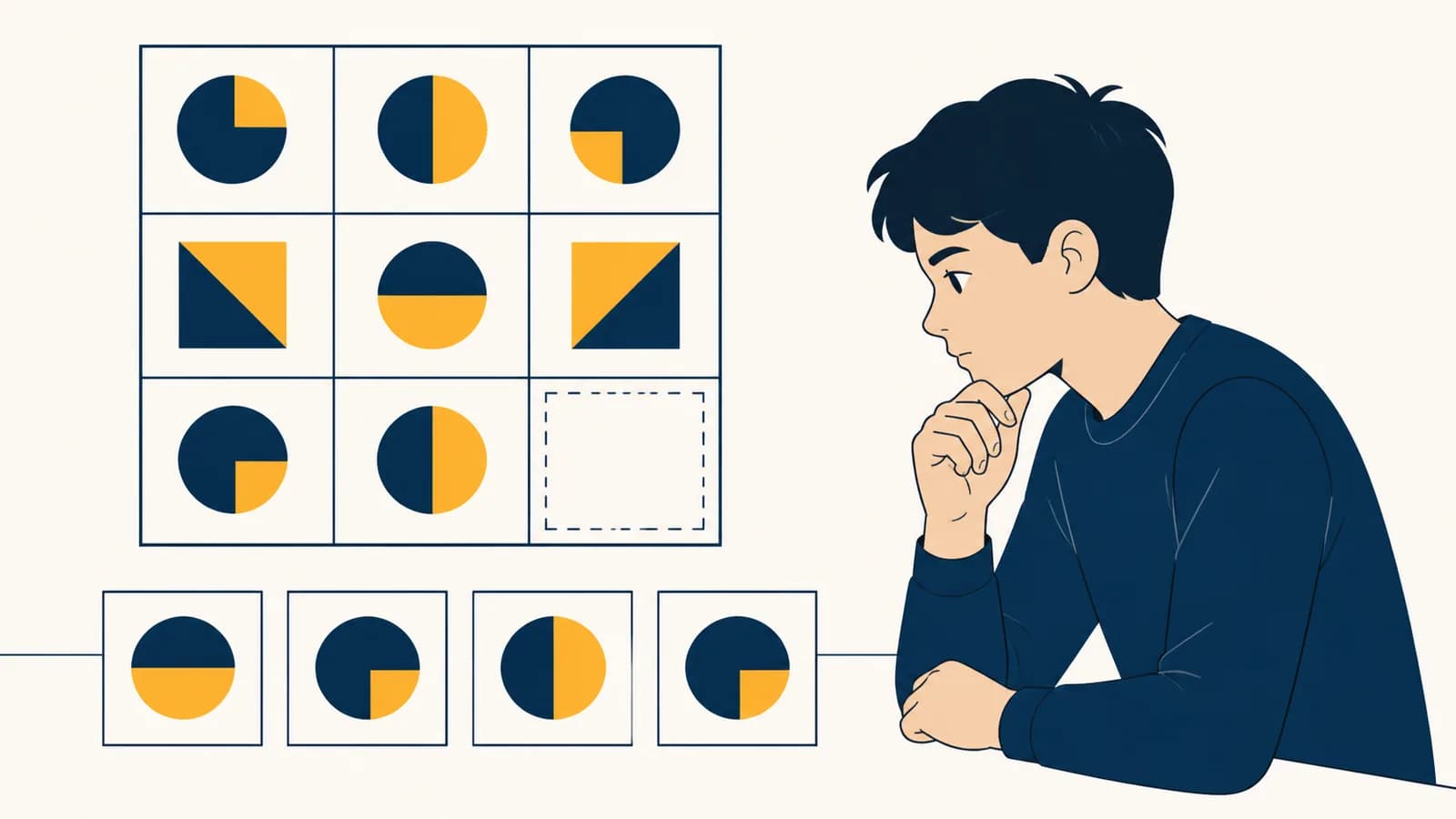
A typical item shows a row or grid of designs with one part missing. The test taker chooses the option that completes the pattern. Another item may ask which shape does not belong, which pieces combine to make a target, or which transformation turns one design into another. Spoken or written instructions may still be necessary, but the reasoning task itself uses little language.
Culture-fair does not mean culture-free. A nonverbal format can reduce some sources of cultural loading, especially vocabulary and learned facts, but it cannot remove every effect of schooling, experience, expectations, or testing conditions.
Many culture-fair tests focus on fluid reasoning, the ability to identify relationships and solve new problems without depending heavily on memorized knowledge. That is one part of intelligence. It is not a complete inventory of language, memory, creativity, practical judgment, social knowledge, or learned academic skill.
How can a test measure reasoning without much language?
A nonverbal reasoning item presents visible information, hides one part of its rule, and asks the test taker to infer the missing result. The response can reveal pattern detection, comparison, mental rotation, or rule combination without requiring a large vocabulary or culture-specific factual knowledge.
Consider a simple sequence: one dot, two dots, three dots, then a blank. The rule is an increase of one dot at each step, so four dots complete it. Harder items layer rules. A matrix might add one shape across each row while rotating another shape down each column. The solver must identify both changes and apply them at their intersection.
The important move is not spotting a picture that merely looks plausible. It is finding a rule that accounts for all the given information. That habit also appears in Ratios & Proportions, where a valid relationship must stay consistent across more than one pair of values.
Test designers arrange items from easier to harder, sample several kinds of rule, and use fixed scoring instructions. Standardization means that the task is administered and scored according to set procedures. It does not mean that every person experiences the task in exactly the same way.
Define a rare word, explain a proverb, or answer a question that depends on facts usually taught in a particular school system.
Select the design that completes a visual sequence, matches a spatial rule, or differs from the others for one consistent reason.
Lower language demand changes what interferes with the measurement. A learner may have strong reasoning but limited skill in the test language. Removing an obscure word gives that learner a better chance to show the targeted reasoning. Yet vision, attention, motor responses, familiarity with diagrams, and comfort under timed conditions can still affect performance.
Why is culture-fair different from culture-free?
Culture-fair means that a test is designed to limit avoidable cultural demands; culture-free would mean that culture has no effect at all. The second claim is too strong because people learn how to interpret pictures, grids, instructions, time limits, and testing situations through experience.
A page of abstract shapes can look neutral because it contains no names, historical events, or idioms. The page still assumes that the reader treats rows and columns as organized information, searches for a single intended rule, and accepts that one answer is best. Formal schooling often gives practice with all of those conventions.
Two equally capable students see a matrix puzzle. One has solved many worksheet grids and logic games. The other has strong practical problem-solving skill but little experience with printed puzzles. The item contains no difficult vocabulary, yet their familiarity with its format is different.
Culture also affects the meaning attached to speed, guessing, interaction with an examiner, and unfamiliar authority. Some people are taught to answer quickly even when uncertain. Others are taught to avoid a response until they are sure. A timed multiple-choice score can partly reflect those learned approaches.
Biology and experience are not rival explanations that can be separated by looking at one score. Vision, attention, memory, stress responses, learning, and prior practice all meet during performance. Neuroscience helps explain why a test result is an observed performance under conditions, not a direct reading of a fixed quantity inside the brain.
For this reason, careful writers use culture-reduced, low-language, or nonverbal reasoning when those terms describe the test more precisely. A title cannot establish fairness. Evidence from the people, languages, and decisions for which the test will be used must do that work.
How does a raw answer become an IQ score?
A raw score is usually the number of credited answers. A test manual compares that result with scores from an appropriate norm group, often within an age band, and converts the comparison to a standard scale. Modern IQ is therefore a relative score, not a percentage correct.
The conversion matters because a raw total has little meaning by itself. Twelve correct answers could be unusually high on one form and ordinary on another. It could also mean something different at different ages. Norms provide the reference needed to interpret the same total.
If a hypothetical norm group has a raw mean of 24 and a raw standard deviation of 4, then a raw score of 28 gives and an illustrated IQ of . Actual manuals may use age-specific lookup tables and more complex conversions.
On the common scale used in many IQ tests, 100 is the norm-group mean and 15 points represent one standard deviation. The arithmetic gives useful landmarks, but a particular test manual controls the real conversion. Some instruments use a different scale, and raw scores do not always follow a perfect bell-shaped distribution.
This standardization is an application of Mathematics for comparing quantities. It creates a common scale, but it does not turn a measurement into perfect truth. Every test has measurement error. Professional reports often give a score range or confidence interval because several nearby scores may be consistent with the observed performance.
The norm group is part of the meaning. Its ages, schooling, languages, location, selection method, and testing date can affect the comparison. A score based on unsuitable or outdated norms may look precise while answering the wrong question. The useful question is not only “What is the IQ?” but “Compared with whom, on which test, under what conditions?”
What evidence shows that a test is fair?
A fair test needs evidence that it measures the intended ability consistently and supports the proposed use across relevant groups. Reviewers examine item content, administration, norms, reliability, validity, group response patterns, access needs, and the consequences of decisions based on scores.
Reliability concerns consistency. If irrelevant details cause scores to swing widely, interpretation becomes weak. Validity concerns whether evidence supports a particular interpretation and use of the score. A test may score consistently while consistently measuring something other than the ability its label suggests.
| Question | Evidence to inspect | What a problem could mean |
|---|---|---|
| Are the items accessible? | Language review, visual design review, disability access, and trials with intended test takers | The format may block some people before the target reasoning is measured |
| Are scores consistent? | Reliability estimates and information about measurement error | Small score differences may not be meaningful |
| Does the score support its use? | Validity evidence tied to the intended decision | Evidence for research use may not justify school placement or hiring |
| Are comparisons appropriate? | Representative, relevant, and current norm samples | The reference group may not fit the person being assessed |
| Do items behave similarly across groups? | Item-level statistical analysis followed by expert review | An item may contain an unintended group-specific demand |
One useful statistical method is differential item functioning. Researchers compare people from different groups who have similar estimated standing on the tested ability. If one group is then more likely to answer a particular item correctly, the item is flagged for investigation. The result is a signal, not automatic proof of unfairness; specialists still have to inspect the content and the model.
Fairness also depends on use. A test validated for describing group patterns in research has not automatically been validated for diagnosing one person. A result that adds useful information to a broad assessment may be too limited to act as the sole gatekeeper for a course, job, or service.
Fairness belongs to the whole testing process. A carefully designed item can still be used unfairly through poor instructions, unsuitable norms, inaccessible delivery, careless scoring, or a decision that asks more of the score than the evidence supports.
Computer delivery adds another layer. Software may present items, enforce timing, and calculate scores, but people must still decide what the data mean and check unusual cases. Principles from Human in the Loop Development apply whenever a score feeds a consequential recommendation.
When is a culture-fair test useful?
A culture-fair test is useful when language or culture-specific knowledge would obscure the reasoning ability of interest. It can contribute to multilingual assessment, educational planning, cognitive research, and some clinical or employment evaluations, provided its norms and validity fit the exact purpose.
Suppose a student recently began learning the school’s teaching language. A vocabulary subtest may show what the student can express in that language, which is useful information, but it may underestimate reasoning that does not depend on those words. A low-language matrix task offers another observation. The contrast between the results can guide further questions.
State exactly what the assessment must inform, such as instructional support, research description, or further clinical evaluation.
Confirm that the test, language demands, age norms, access provisions, and validation evidence fit the person and purpose.
Note interruptions, misunderstanding, fatigue, sensory barriers, timing changes, and accommodations that may affect interpretation.
Interpret the score with background information, observation, other assessments, and the uncertainty reported for the measure.
Low-language testing may also help a person with a speech or language difficulty, but “nonverbal” does not mean universally accessible. A visual test may be unsuitable for someone with impaired vision. Pointing, drawing, or manipulating pieces can create barriers for someone with a motor disability. An assessor must distinguish the target ability from the response method.
High-stakes decisions require special care. An IQ score alone cannot establish a complete clinical diagnosis, determine a person’s learning potential, or describe adaptive functioning in daily life. School records, developmental history, language background, observed strategies, achievement measures, and practical functioning may all change the interpretation.
Can an online culture-fair IQ test give a trustworthy result?
An online test can present genuine pattern-reasoning tasks, but a polished score screen does not establish trustworthy measurement. Confidence depends on named test content, suitable norms, published reliability and validity evidence, controlled administration, secure scoring, and an interpretation limited to the test’s supported use.
Many casual quizzes reveal only the number correct and then convert it to an “IQ” without explaining the comparison group. That conversion has no clear reference. Even a sound item set can produce a weak result if a phone crops the diagrams, the timer lags, answers can be rehearsed, or the room is full of interruptions.
Do not treat an anonymous online score as a diagnosis. If a result could affect education, disability support, treatment, or employment, use a qualified professional and a test approved for that purpose.
Before taking a result seriously, look for the test publisher or author, the population used to create norms, the age range, administration rules, evidence for reliability and validity, and a clear explanation of score uncertainty. Also check how personal data are stored and shared. Missing information is itself information about the quality of the claim.
Practice effects matter too. Repeated exposure can teach common matrix rules and response strategies. A later score may reflect both reasoning and familiarity with the task. Professional test users control access to items partly to preserve the meaning of future results.
A fairer format still needs careful interpretation
Culture-fair IQ tests solve a real measurement problem: they reduce demands that can hide a person’s nonverbal reasoning. They do not erase culture, measure every valuable ability, or produce a context-free rank. Their strongest use is as one well-chosen source of evidence within a larger assessment.
A sensible interpretation names the construct, the reference group, and the testing conditions. It reports uncertainty instead of treating a small score difference as a hard boundary. It also separates what was observed from what is inferred. “This person solved these visual rule problems at this level under these conditions” is defensible. “This number is the person’s total intelligence” is not.
The same discipline applies to comparisons between people or groups. First ask whether the instrument measures the same construct in a comparable way, whether access and administration were equivalent, and whether the norms fit. Then examine alternative explanations before attaching a broad label to a narrow score.
The takeaway: A culture-fair IQ test mainly estimates nonverbal reasoning while reducing vocabulary and culture-specific knowledge demands. Its score becomes useful only when the test is well supported, the comparison group fits, the conditions are recorded, and the result is combined with other evidence.