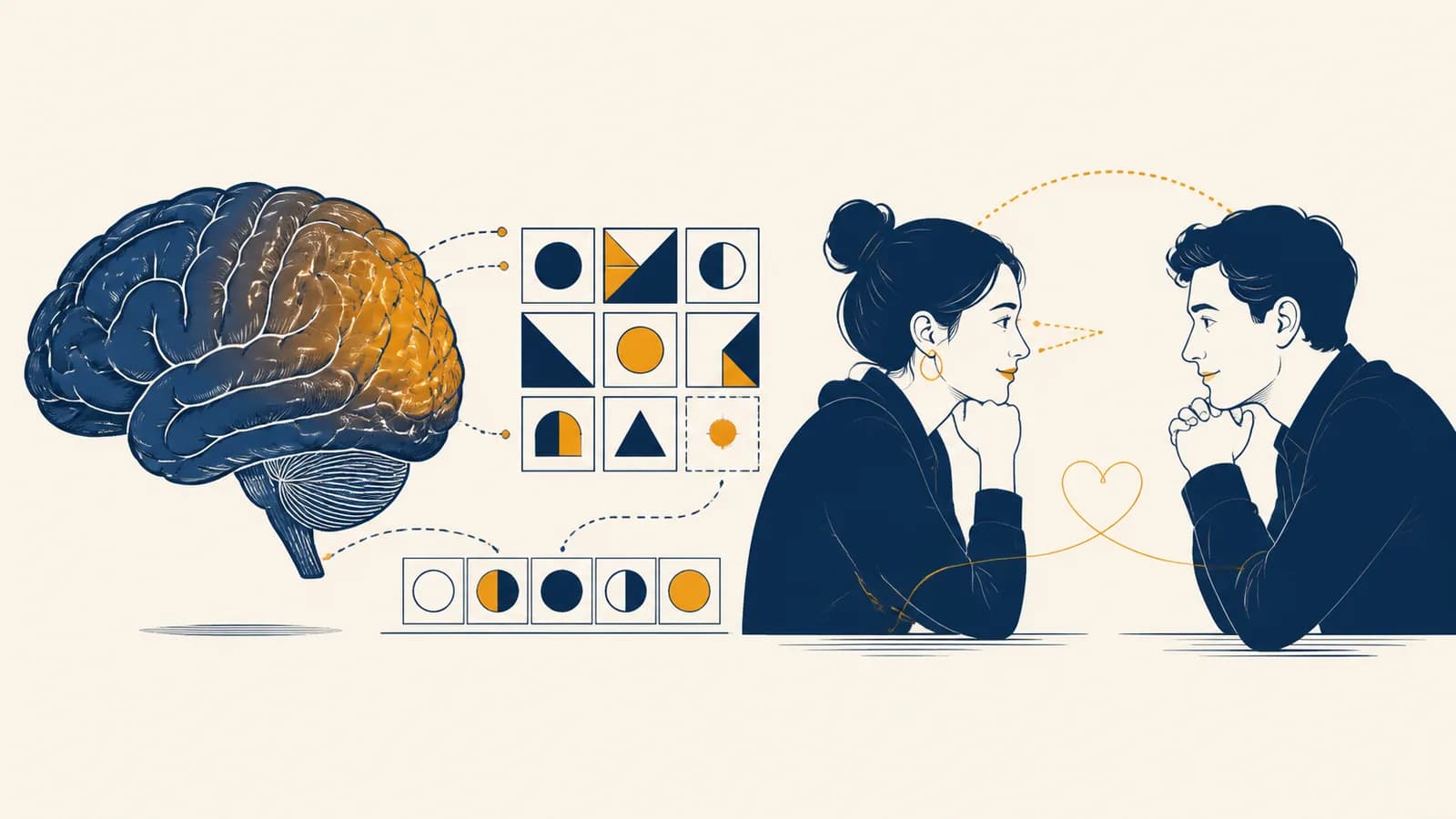
IQ and EQ measure different kinds of performance
IQ measures performance on standardized reasoning tasks, while EQ describes skill in recognizing, understanding, and managing emotions. The difference between IQ and EQ is therefore a difference in what is being assessed, how it is scored, and what the result can reasonably predict.
An intelligence quotient, or IQ, is a score produced by a test with tasks such as finding patterns, holding information in mind, defining words, and solving visual problems. Test makers compare a person's performance with the performance of a carefully selected reference group of the same age. A modern IQ score is not a direct reading of brain power. It is a position within that comparison group.
Emotional intelligence is a broader idea. In research, it may mean the ability to identify emotions, use emotional information, understand how feelings change, and regulate responses. Outside research, people often use emotional quotient, or EQ, for qualities such as empathy, tact, calmness, motivation, and social skill. Those qualities overlap, but they are not identical.
A standardized score from tasks designed to sample reasoning and cognitive performance. Scores are compared with an age based reference group.
A name for emotional abilities or traits. The meaning and scoring depend heavily on the model and test being used.
The distinction matters because the labels can make two unlike measurements look like matching gauges. IQ has a long psychometric tradition and a familiar standard score. EQ has several competing definitions, including ability tests, self report questionnaires, and workplace competency systems. Before comparing two scores, ask what produced each one.
What does an IQ score actually represent?
An IQ score represents how a person performed on a selected set of cognitive tasks compared with people of the same age in the test's norm group. It summarizes observed test performance; it does not measure every form of intelligence or set a permanent limit.
Early intelligence tests sometimes used the ratio of a child's estimated mental age to chronological age. The historical formula multiplied that ratio by 100. Modern tests generally do something different: they convert raw task results into a standardized score based on the distribution of results in a norm sample. The word quotient remains, even though the old ratio is usually gone.
Many widely used IQ scales are set so that the reference group has a mean of 100 and a standard deviation of 15. On such a scale, 85 is one standard deviation below the mean and 115 is one standard deviation above it. Those values describe positions on the scale, not percentages of questions answered correctly.
The conversion uses the same reasoning taught in ratios and proportions: a raw difference becomes meaningful only after it is placed against a defined reference. If two tests use different norms, task mixes, or score scales, the printed numbers are not automatically interchangeable.
If a raw result is one standard deviation above its norm group mean, then the converted score is . Actual test publishers may use lookup tables and more detailed models.
A full assessment also reports more than a single total. It can show differences among verbal reasoning, visual spatial reasoning, working memory, and processing speed. A qualified examiner considers confidence intervals, testing conditions, language background, disability, and the reason for assessment. A score obtained while someone is ill, exhausted, distressed, or unfamiliar with the testing language may give a distorted picture.
What does EQ actually measure?
EQ may measure performance on emotion related problems, a person's description of their own habits, or another person's rating of workplace behavior. These methods answer different questions, so there is no single universal EQ scale that works like a standard IQ score.
An ability based emotional intelligence test might ask a person to identify an emotion in a face or judge how feelings may change as a situation unfolds. A self report test asks for agreement with statements about empathy, self control, or awareness. A workplace assessment may gather ratings from managers and colleagues. Each method has a distinct source of error.
The mechanism is easier to see as a sequence. A colleague answers sharply. You notice the change in tone, consider possible causes, control the urge to answer in kind, and choose a response that gathers more information. Emotion does not replace reasoning in this sequence. It supplies information that reasoning can use.
Body state also shapes this process. Stress hormones can alter attention, memory retrieval, and readiness to act. Learning how hormones affect the body and brain helps explain why emotional regulation is partly a biological task, not simply a command to calm down. Sleep, pain, hunger, and threat can all change the signals a person is trying to manage.
An EQ number needs a method. Ask whether it came from an ability task, a self report questionnaire, or ratings by other people. The same label can hide very different evidence.
Self reports are useful when the question concerns beliefs about one's own behavior. They are weaker when insight is itself the skill under examination. A person can sincerely overestimate how well they read a room. Ability tasks avoid that problem, but researchers must decide which emotional answer counts as best. Ratings by other people capture visible behavior, yet they may also reflect popularity, bias, or limited observation.
Are IQ and EQ opposites?
IQ and EQ are not opposite forces, and a person does not have to trade one for the other. Cognitive reasoning and emotional skill can work together, vary independently, and contribute to different parts of the same decision or relationship.
Consider a doctor explaining a diagnosis. Medical knowledge and reasoning help the doctor interpret evidence. Emotional perception helps the doctor notice confusion or fear. Regulation helps the doctor remain clear under pressure. Communication turns the analysis into instructions the patient can follow. Calling the first part IQ and every other part EQ is too simple, but the example shows why the abilities are complementary.
A team discovers an error the night before a deadline. One member traces the faulty calculation. Another notices that blame is stopping people from sharing information and resets the conversation. The repair needs accurate analysis and effective emotional behavior.
Personality also enters the picture. Patience, sociability, conscientiousness, and willingness to cooperate can affect behavior in emotional situations. They should not automatically be renamed emotional intelligence. Someone may understand another person's feelings accurately and still choose not to help. Skill, values, and action are separate parts of the result.
The popular picture of a brilliant but socially helpless person and a warm but intellectually weak person creates a false seesaw. Real profiles contain many combinations. A person can be strong at abstract reasoning and emotional regulation, weak at both, or uneven within either domain. Broad labels hide those patterns.
This is also why a single incident proves little. Missing a social cue does not establish low EQ, just as one arithmetic error does not establish low IQ. Repeated performance across suitable tasks gives better evidence. Context can then explain why the same person performs differently at school, at work, or among close friends.
What can IQ predict, and what can it miss?
IQ scores can help predict performance in tasks that demand learning, reasoning, and handling complex information, especially when the test resembles the demands being predicted. They cannot by themselves determine achievement, character, creativity, practical judgment, or the course of a life.
A prediction is a probability, not a verdict. If a test score is associated with later school performance, people with the same score can still have different results. Teaching quality, prior knowledge, health, effort, opportunity, discrimination, and family resources all affect what happens next. Prediction becomes less precise for an individual than it appears in a group pattern.
IQ testing can be useful in educational and clinical assessment. A pattern of scores may help identify learning needs, support planning, or add evidence to an evaluation. It should be interpreted alongside schoolwork, developmental history, observation, and other measures. Decisions become fragile when institutions treat one number as the person.
Culture and language need careful handling too. Test designers try to reduce irrelevant knowledge demands and build representative norm groups, but no task floats outside culture. Instructions use language, puzzle styles can be more familiar to some people, and access to schooling affects practiced skills. A fair interpretation asks which abilities the test sampled and which barriers may have changed the result.
Genes contribute to differences in cognitive traits, but genetic influence is not a fixed personal percentage and does not make an outcome unchangeable. The biology is spread across many variants and develops through interaction with environments. The subject page on the biology of genetics explains why inherited influence is different from destiny.
Can emotional intelligence be learned?
Many emotional skills can improve through instruction, practice, feedback, and changes to the environment. Progress is usually specific: a person may learn to label feelings more accurately or pause during conflict without acquiring every quality that popular accounts group under EQ.
Useful training turns a vague goal into an observable behavior. “Become more emotionally intelligent” gives no clear action. “Before replying during conflict, identify the feeling, check the evidence for your interpretation, and ask one neutral question” can be practiced and reviewed.
Name the body sensation, facial expression, tone, or thought that indicates an emotional change.
“They looked away” is an observation. “They disrespect me” is one possible interpretation.
Decide what the situation needs, such as accurate information, a boundary, repair, or time to cool down.
Use a response, observe its effect, and adjust. Feedback connects intention with actual impact.
Regulation does not mean suppressing every feeling or displaying constant calm. Anger can signal a crossed boundary. Fear can signal danger. The skill lies in testing what the signal means and choosing behavior suited to the evidence and goal. Sometimes the sound response is to leave, object, or ask for help.
Environment design is part of improvement. A pause before sending a message, a written agenda for a tense meeting, or enough sleep before a difficult conversation can reduce demands on self control. Readers who want the body mechanisms behind these changes can use the site's biology foundations to connect behavior with nervous and endocrine systems.
How should you judge an IQ or EQ test?
Judge a test by its defined purpose, standardization, reliability, validity, norm group, and limits. A polished report or precise looking number is not enough. Good measurement explains what was tested, who provided the comparison, and which decisions the result supports.
Reliability asks whether the measurement is reasonably consistent. Validity asks whether evidence supports the interpretation being made. A bathroom scale that is always five kilograms high may be consistent but inaccurate. Psychological tests are more complex, yet the distinction remains useful.
- Find the construct. Does “intelligence” mean general reasoning, a set of cognitive abilities, self described empathy, or visible social behavior?
- Find the comparison group. Check the ages, languages, locations, and testing conditions represented by the norms.
- Inspect the evidence. Look for technical information about reliability and about validity for the specific use being proposed.
- Check who interprets it. Clinical and educational decisions may require a qualified professional who can combine test data with other evidence.
- Reject oversized claims. A short online quiz cannot establish career fit, relationship quality, or future success simply because it prints a score.
Commercial EQ tools deserve special care because two products may share the name while measuring different things. One may score emotional problem solving. Another may summarize personality statements. A third may turn colleague ratings into leadership categories. Their numbers have no shared meaning unless the developers establish one.
Ask for the test's full name. “I scored 120 on IQ” or “I have high EQ” is incomplete without the instrument, version, date, conditions, and intended interpretation.
Privacy matters as well. Cognitive and emotional assessments can contain sensitive information. Before taking a school, workplace, or online test, check who receives the responses, how long records are kept, and whether the result will influence a real decision. Consent should be informed, especially when an employer or institution requests the assessment.
How do IQ and EQ show up in school, work, and daily life?
IQ related abilities often appear in learning speed, problem solving, and handling complex information. EQ related skills often appear in conflict, cooperation, and self management. Most serious tasks require both, plus knowledge, practice, motivation, health, and a supportive environment.
In school, reasoning helps a student compare arguments or learn an unfamiliar method. Emotional awareness helps the student notice rising frustration before abandoning the task. A teacher needs subject knowledge to diagnose an error and social judgment to correct it without humiliating the learner.
At work, job knowledge changes what ability looks like. An experienced mechanic can recognize a fault pattern that a general reasoning test never samples. A nurse combines clinical observation with communication. A programmer must understand systems and ask precise questions when requirements conflict. Skill grows from ability interacting with training and repeated experience.
A hiring team defines the work first. It uses a job relevant exercise for analysis, structured questions for past behavior, and the same scoring guide for every candidate. It does not infer a complete personality from an IQ score or treat a branded EQ score as proof of kindness.
Daily decisions reveal the same mixture. Planning a budget uses arithmetic and delayed gratification. Settling an argument uses memory, language, emotional control, and knowledge of the relationship. Asking which quotient “wins” removes the task, even though the task determines which abilities matter.
Scores also interact with opportunity. A person cannot display trained skill they were never allowed to learn. Good teaching, accessible tools, stable housing, health care, and safe practice can change performance without changing the meaning of intelligence into something mystical. Ability develops and acts inside material conditions.
A useful profile is larger than either quotient
IQ and EQ are best treated as limited descriptions of performance, not rival measures of human worth. IQ has a more standardized scoring tradition; EQ covers several emotional models. Both become useful only when their definitions, methods, uncertainty, and intended decisions are visible.
If you receive a score, translate it back into evidence. Identify the tasks, the comparison group, the testing conditions, and the claimed prediction. Then add the information the score leaves out: learned knowledge, health, goals, values, opportunities, and observed behavior across time.
The takeaway: IQ mainly summarizes performance on standardized cognitive tasks. EQ refers to emotional abilities or traits and has no single universal scale. Neither score can stand in for a complete person, and neither should make a high stakes decision alone.
The most useful question is not which quotient matters more. Ask what the situation demands, which evidence measures that demand well, and what other facts are needed. That approach turns two catchy labels into careful decisions about learning, work, relationships, and support.