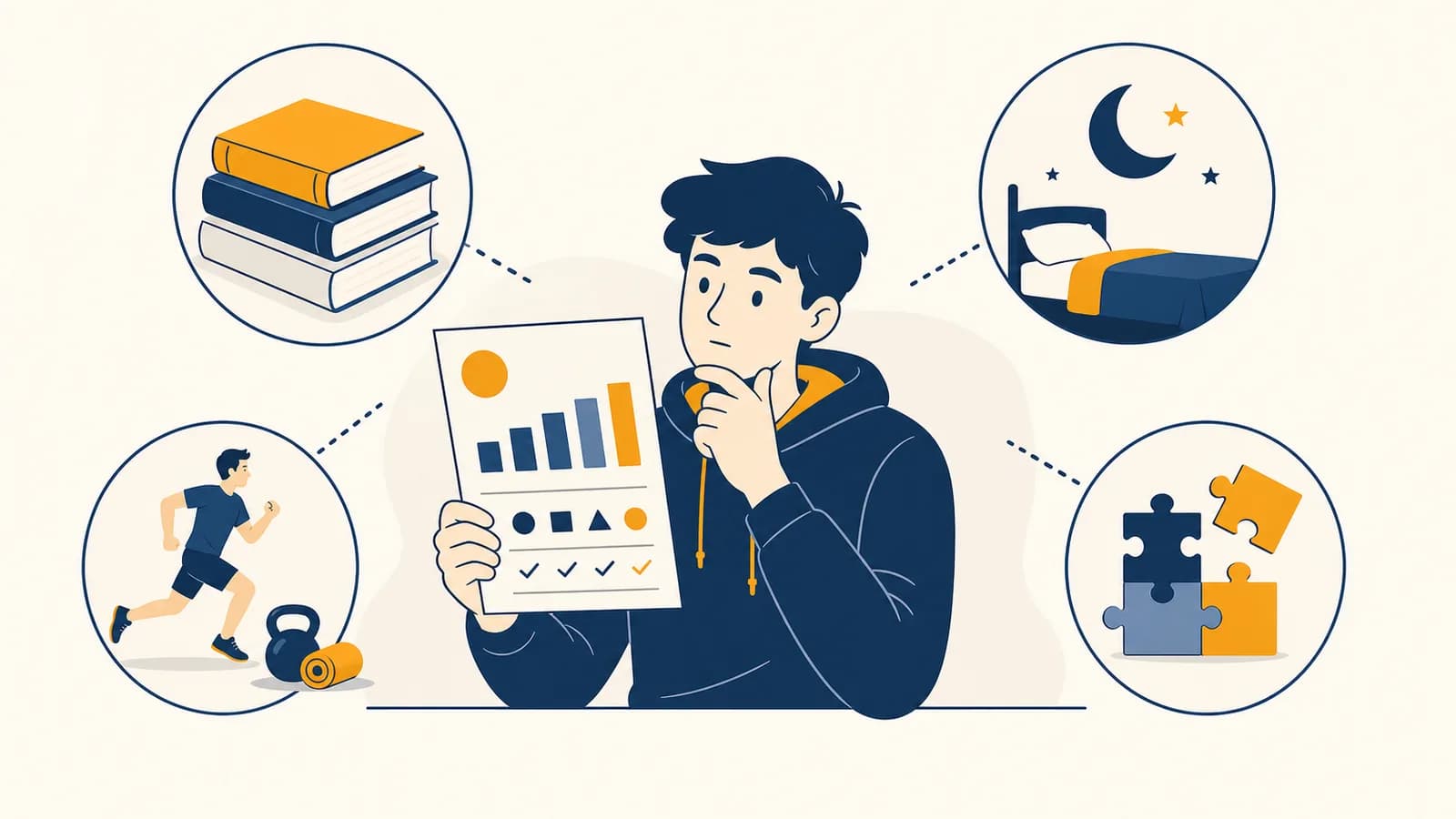
IQ can change, but there is no reliable shortcut
You can improve your IQ test score, and some experiences can strengthen the abilities that IQ tests measure, but no exercise turns intelligence up like a dial. Education has the best evidence for lasting gains. Practice, sleep, health, and test conditions also affect scores, often without changing general intelligence itself. To judge any claim about improving IQ, separate three outcomes: getting better at one task, performing closer to your normal level, and gaining abilities that transfer to unfamiliar problems.
You answer more items correctly on a particular test. Familiarity, strategy, motivation, health, and genuine learning can all contribute.
You reason, learn, or solve unfamiliar problems better across several tasks. This transfer is harder to produce and harder to prove.
This distinction explains many arguments about IQ. A brain training company can show that customers improved on its puzzles and still fail to show that they became better at unrelated reasoning. A student can gain knowledge that helps on verbal questions, while showing little change on a new spatial task. Both effects are real, but they are different effects.
IQ is also not a complete inventory of a mind. Standard tests sample abilities such as verbal comprehension, working memory, processing speed, and reasoning. They do not directly measure judgment, curiosity, persistence, practical knowledge, social skill, or creativity. Those qualities affect what a person can accomplish, even when they never appear in an IQ score.
What does an IQ score actually measure?
An IQ score shows how a person performed on a standardized set of cognitive tasks compared with people of the same age in a reference sample. It is an estimate based on selected tasks, not a direct reading of brain power or a fixed biological quantity.
Modern intelligence tests combine several subtests. One may ask you to define words. Another may require you to hold digits in mind and rearrange them. Others use patterns, shapes, or timed symbol matching. People who do well on one kind of cognitive task tend, on average, to do well on others. Psychologists model that shared pattern as general intelligence, often written as g.
The final score is standardized against a norm group. On a common IQ scale, the mean is 100 and the standard deviation is 15. A score does not mean that someone with 120 has exactly 20 percent more intelligence than someone with 100. The scale describes relative position, not an amount with a true zero.
If scores follow the normal curve used for standardization, about 68 percent fall within one standard deviation of the mean. The calculation connects a standardized score, or z score, to the familiar IQ scale. The ideas behind standard deviation and normal distributions belong to Mathematics, and they matter because an IQ number has meaning only in relation to a comparison group.
A result one standard deviation above the norm has , so .
Two more distinctions help. Fluid intelligence concerns reasoning through unfamiliar problems with little dependence on learned facts. Crystallized intelligence concerns acquired knowledge and the ability to use it. The boundary is not clean. Solving a new problem still depends on language, attention, and strategies learned before the test.
Why can an IQ score change without intelligence changing?
A score can move because the test samples performance on one day. Practice, anxiety, fatigue, illness, distractions, effort, and chance all affect the observed result. Psychologists therefore treat any single score as an estimate with measurement error, not an exact personal constant.
Retesting is a clear example. You may learn the instructions, recognize item types, manage time better, or remember a method that worked. A 2007 meta-analysis by John Hausknecht and colleagues combined 50 studies of cognitive ability tests and found a practice effect, with larger effects when coaching accompanied practice and when people received an identical form. That evidence supports a careful conclusion: repeated testing can raise scores, but the gain may partly reflect test familiarity.
A change smaller than a test's uncertainty is not proof of a real change. Professionally administered reports often include a confidence interval because repeated measurements are never perfectly identical.
Scores can also shift when test norms change. A test publisher compares raw performance with a reference sample collected at a particular time. Population performance has changed across generations, a pattern called the Flynn effect. A 2014 meta-analysis by Lisa Trahan and colleagues estimated an average rise of 2.31 standard score points per decade across the studies it analyzed, though the size varied by test and setting. This does not mean each person gained that amount during a decade. It means different norm groups performed differently.
The same logic applies to online tests. A short quiz may use a narrow item bank, weak norms, or no disclosed reliability data. A result from such a quiz cannot be compared confidently with a score from a properly normed battery administered under standard conditions. Even two sound tests may emphasize different abilities.
Can education raise intelligence?
Yes. Education is the intervention with the clearest evidence for lasting increases in intelligence test performance. Schooling builds knowledge and also gives repeated practice in reading, calculation, abstract rules, sustained attention, and solving unfamiliar problems under guidance.
A major 2018 meta-analysis by Stuart Ritchie and Elliot Tucker-Drob examined 42 data sets with more than 600,000 participants. The designs included changes in compulsory schooling laws and school entry cutoffs, which help separate the effect of education from the tendency of higher scoring students to stay in school longer. The authors estimated that one additional year of education was associated with roughly 1 to 5 IQ points of benefit, depending on the study design and outcome.
That range is not a promise that enrolling for one more year will add a set number of points to any individual. It is an estimate across groups, and schooling differs in quality, content, attendance, and support. It does show that measured intelligence is responsive to sustained environments for learning.
A student spends a year learning algebra. Months of translating words into equations, holding intermediate values in mind, and checking constraints may improve performance on unfamiliar quantitative problems. Memorizing the answers to one reasoning test would produce a narrower gain.
Education works through accumulated changes. Vocabulary grows through thousands of encounters with words. Mathematical reasoning grows as a learner connects representations, receives correction, and applies methods to new problems. Scientific thinking grows through forming hypotheses and comparing them with evidence. These are demanding forms of practice, spread across many contexts, which gives learning more chances to transfer.
Genes influence differences in cognitive ability, but heritability does not mean immutability. Heritability describes variation within a particular population living in particular environments. It does not say that an individual's score cannot change, and it does not assign a fixed percentage of one person's intelligence to genes. The interaction between inherited variation and environments becomes easier to reason about after studying selection and variation in Evolution.
Height offers a useful analogy. Genetic differences influence height, while childhood nutrition and disease also affect growth. Intelligence is more complicated than height, but the logic is the same: evidence for genetic influence does not make the environment irrelevant.
Do brain games, chess, or music lessons raise IQ?
Training usually improves the trained skill, but evidence for broad increases in intelligence is weak. Brain games can make you better at their tasks. Chess and music can build valuable expertise. None has reliably shown large transfer to unrelated cognitive abilities under strong experimental controls.
Researchers call improvement on similar tasks near transfer. Improvement on substantially different tasks is far transfer. Near transfer is common because the new task can reuse practiced representations or procedures. Far transfer requires a useful principle to survive changes in surface details, instructions, and context.
After practising one memory sequence task, you improve on a similar sequence task with different symbols.
After practising that memory task, you become better at unfamiliar verbal reasoning, school mathematics, or planning daily work.
A 2016 meta-analysis by Monica Melby-Lervåg, Thomas Redick, and Charles Hulme reviewed working memory training. It found short-term improvement on trained or closely related memory measures, but no convincing benefit on broader outcomes when trained groups were compared with active control groups. Active controls matter because they match expectations, contact, and time spent doing an activity.
A 2026 meta-analysis by Geng Li and colleagues reached a more positive result, reporting improved cognitive task performance and repeatable changes in task-related brain activation across 45 neuroimaging studies. This confirms that training can change performance and brain activity. It does not, by itself, prove a general rise in intelligence. That claim still depends on which outcome tasks improved, how far they were from the trained task, and what the control groups did.
Chess and music have real value without serving as IQ treatments. Chess develops chess knowledge, calculation of positions, and pattern recognition. Music study develops musical perception and performance. Claims of general cognitive improvement are difficult to interpret because people who choose long training may differ from nonparticipants before lessons begin. Random assignment and a credible comparison activity give stronger evidence than a simple correlation.
Computer analogies can make this error tempting. Training one task is less like upgrading an entire processor and more like optimizing one routine. Learning how a computer allocates memory in Operating Systems: The Invisible Manager also shows why a system's observed speed depends on the workload, available resources, and management rules, not one universal performance number.
What do sleep, exercise, and health change?
Sleep, physical activity, nutrition, and health affect the brain's ability to perform, but restoring impaired performance is not the same as permanently increasing general intelligence. Their clearest benefit is helping attention, memory, and learning operate without avoidable interference.
Sleep supports alertness and memory processes. A 2017 meta-analysis by Cassandra Lowe and colleagues examined experiments that restricted sleep and found poorer cognitive performance across several domains, including sustained attention and executive function. The review did not find enough evidence to establish an effect on intelligence itself. A tired person may therefore score below their usual level without having lost general intelligence.
Exercise has firmer evidence for general cognitive health than for a predictable IQ gain in every age group. A 2024 meta-analysis of randomized trials in children and adolescents reported improvements in general and fluid intelligence measures, while also finding substantial variation among the included exercise programs and populations. Physical activity is sensible for health and may support learning, but the study does not justify a guaranteed points claim for one routine.
Protect performance before trying to enhance it. Sleep loss, untreated vision or hearing problems, severe stress, substance use, and some medical conditions can reduce test performance or learning.
The brain is part of the body. The mechanisms behind oxygen delivery, hormones, sensory input, sleep, and neural signaling sit within Human Biology. Correcting a problem in one of these systems may allow someone to think and learn closer to their normal capacity. It should not be marketed as a way to manufacture extraordinary intelligence.
A sudden or marked change in memory, attention, language, or reasoning deserves medical attention, especially when it disrupts daily life. An online IQ test cannot diagnose a learning disorder, attention disorder, brain injury, dementia, or mood condition. Qualified clinicians choose tests for a purpose and interpret scores alongside history, symptoms, behavior, and other evidence.
How can you improve thinking in practice?
Build transferable knowledge, practise the exact abilities your goals require, and protect the conditions that make learning possible. Track real outcomes such as problems solved, material remembered, and errors corrected. Treat an IQ score as one possible measurement, not the target of daily life.
Name something observable, such as reading technical text, estimating quantities, writing clear arguments, or solving unfamiliar algebra problems.
Reasoning needs material to reason with. Build vocabulary, facts, concepts, and procedures in the area where you want better performance.
Recall ideas without looking, attempt problems before reading solutions, and study mistakes. Feedback should identify the wrong step rather than display only the answer.
Apply one principle to problems with different wording and settings. Variation tests whether you learned the rule or memorized the surface pattern.
Use fresh tasks that were not part of practice. If performance rises only on repeated items, describe the gain accurately as task specific.
This method is less glamorous than a daily score from an app, but it matches how durable expertise develops. A learner acquires connected knowledge, retrieves it, gets correction, and reorganizes weak parts. Over time, difficult operations become more efficient, leaving more attention available for the next layer of a problem.
Use comparisons carefully. If you test progress, keep conditions similar and avoid taking the same form repeatedly. Record sleep, interruptions, time limits, and assistance. For school or work goals, a direct measure often answers the useful question better than IQ does. A new reading passage tests reading transfer. A fresh program specification tests programming. A mixed problem set tests mathematical selection and execution.
Suppose you practise logic puzzles for six weeks. Save a set of unfamiliar puzzles for the end, and also test a different task you hope will improve, such as evaluating arguments in articles. Improvement only on familiar puzzle types is still progress, but it is evidence of narrow learning rather than a general rise in intelligence.
Be suspicious of any product that reports only users' improvement from their first session to their last. A convincing test needs a comparison group doing another credible activity, an outcome that was not trained directly, and follow up after practice ends. It should report all planned outcomes, including null results.
Better abilities matter more than a better number
IQ scores are useful when a sound test answers a clear question. They can help psychologists describe patterns of cognitive strengths and difficulties, and they can support research about learning and development. They become misleading when treated as a complete rank of human value or a fixed ceiling on achievement.
The most defensible answer to “Can you improve your IQ?” is conditional. Education can produce lasting gains in measured cognitive ability. Retesting and coaching can raise a score partly through familiarity. Brain games mostly improve similar tasks. Sleep, exercise, and health support the machinery of performance and learning. Individual results vary, and a score change must be judged against measurement error and practice effects.
The takeaway: Do not chase IQ points in isolation. Build knowledge, practise across varied problems, seek feedback, sleep adequately, stay physically active, and judge progress on new tasks that matter outside the training session.
A higher IQ score can be meaningful, but it is evidence that needs interpretation. The stronger goal is broader competence: understanding more, detecting mistakes sooner, and applying what you know when the problem changes. Those gains can be observed directly in the work you are able to do.