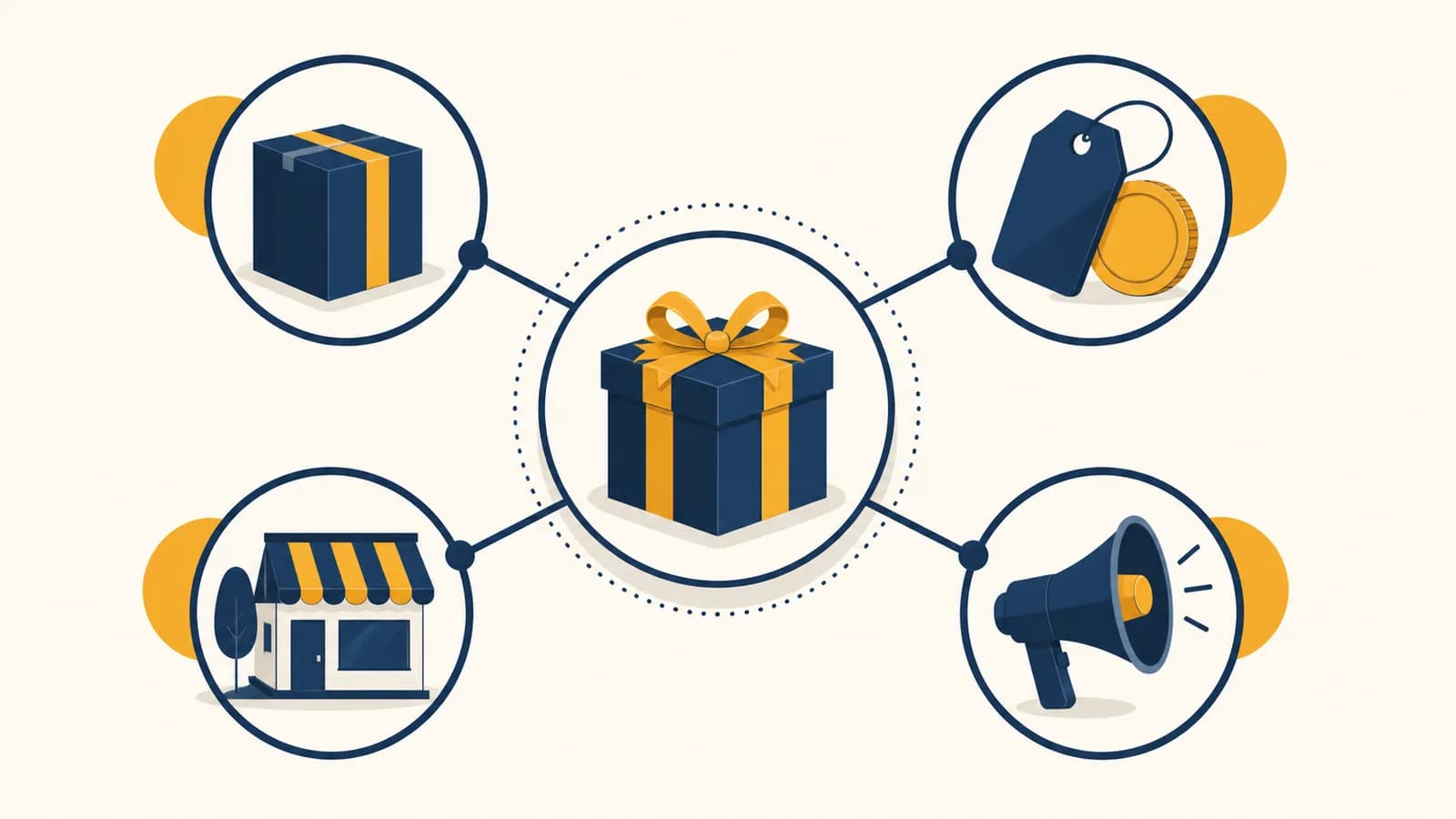
The marketing mix is a decision framework that coordinates product, price, place, and promotion, in the context of bringing an offer to a chosen market. These four parts are called the 4 Ps of marketing. A business uses them to decide what it will sell, what customers will pay, where they can buy it, and how they will hear and think about it. The idea exists because those choices affect one another. A premium product sold at a bargain price through an inconvenient channel sends conflicting signals, even if each choice looks reasonable on its own.
Consider a bakery introducing a lunch box for nearby office workers. The food, portion, packaging, dietary options, and name belong to product. The amount charged and any meal deal belong to price. The shop counter, delivery app, and advance ordering page belong to place. Window signs, search results, samples, and customer emails belong to promotion. The bakery has a marketing mix even if nobody uses that phrase in the kitchen.
What the marketing mix actually is
The marketing mix is the controllable set of choices an organisation combines to create, deliver, and communicate value to a target customer. Its four traditional elements are product, price, place, and promotion, and the mix succeeds when those elements support one clear position.
Controllable does not mean unlimited. A firm cannot command the economy, a competitor, the weather, or a customer's income. It can choose a recipe, a price, a retailer, and an advertising message within those conditions. The mix turns a broad intention such as “serve commuters who need a quick breakfast” into decisions that staff can carry out.
The four labels are prompts, not separate departments. Product includes the total offer, not only the physical object. Price includes payment terms and discounts, not only the number on a tag. Place covers distribution and access, not only a building. Promotion includes every deliberate communication with the market, not only paid adverts.
The mix starts with a target market and a value proposition. A target market is the group the organisation intends to serve. A value proposition is the reason that group should choose the offer. Those ideas sit within the foundations of customers, value, and exchange. Without them, the 4 Ps become a checklist of unrelated activities.
One mix, one audience. A company can serve several segments, but it may need a different mix for each one. The same train operator can sell a flexible business ticket and a restricted advance ticket through different prices, conditions, channels, and messages.
How the four Ps work together
The four Ps work as a connected system: the product creates a promised benefit, the price frames its cost and position, place makes it available, and promotion sets expectations. Managers test each decision against the same customer, objective, and value proposition.
A useful sequence begins with evidence rather than a slogan. Research identifies a customer problem and the alternatives already available. The organisation then defines an offer, works out a viable price, designs access, and communicates the result. Feedback can force an earlier decision to change, so the process is a loop rather than a one-way production line.
Imagine a company selling a durable school backpack. Thick fabric, repairable zips, and a long guarantee support a promise of reliability. A higher price can be credible because the features and guarantee reduce replacement risk. Specialist school suppliers and a detailed website give room to explain construction. Promotion can show load tests and repair instructions. Each P supplies evidence for the same promise.
Now change only one choice. If the firm uses a message about long life but supplies weak straps, promotion creates disappointment faster. If it builds a good bag but sells only through a website that parents cannot find before term starts, place blocks demand. If frequent discounts train buyers to wait, price weakens the intended position. Coordination is therefore about cause and effect, not visual consistency alone.
State who is buying and what progress they want, such as a parent seeking one backpack that will survive several school years.
Specify the benefit, the relevant alternative, and the evidence that makes the promise believable.
Decide the offer, payment, route to market, and communication needed to deliver that value.
Look for contradictions, calculate whether the economics work, and confirm that operations can deliver the promise.
Track customer behaviour, costs, returns, complaints, and channel performance, then change the limiting part of the mix.
What product actually is
Product is the complete bundle of benefits, features, services, and signals offered to solve a customer problem. It can be a physical good, a service, an experience, or a combination, and it includes everything that shapes use and perceived value.
A phone is more than glass and electronics. Its product decisions include the operating system, storage, camera, battery life, packaging, warranty, software updates, repair options, brand name, and range of models. Buyers may compare technical features, but they also judge expected reliability, ease of use, status, and support.
The core benefit is what the customer is trying to achieve
The core benefit is the result the buyer wants, not the object itself. A drill buyer wants controlled holes. A museum visitor wants learning, enjoyment, or shared time. A payroll software customer wants staff paid correctly and on time. Naming the benefit prevents a team from treating familiar features as permanent requirements.
The actual product makes the benefit usable
The actual product consists of the design, functions, quality level, name, and packaging through which the benefit is delivered. For a reusable bottle, this includes capacity, lid mechanism, insulation, materials, weight, colour, and shape. Those choices involve tradeoffs. A larger bottle holds more but weighs more. A complicated cap may prevent leaks but be harder to clean.
The augmented product reduces effort and risk
The augmented product adds services and assurances around the main offer. Delivery, installation, training, guarantees, returns, repairs, and customer support can determine which supplier wins. Two laptops with similar specifications may feel like different offers if one comes with dependable local repair and the other has uncertain support.
A café sees customers abandoning takeaway drinks on crowded trains. It tests a cup with a tighter lid and a narrower base that fits carriage tables. The coffee recipe stays the same, but the product improves because the whole use situation has been considered.
Product performance should be judged against the promised job. Useful evidence can include repeat purchase, product returns, warranty claims, task completion, customer support topics, and observation of real use. A feature that nobody uses adds cost and complexity without adding much value.
How price works
Price works by exchanging access to the offer for money, time, data, attention, commitment, or another sacrifice. It affects revenue directly, signals market position, changes demand, and determines how value is divided among the customer, seller, and channel partners.
A price is not chosen simply by adding a profit to cost. Costs create a lower boundary over time, customer willingness to pay creates an upper boundary, and competing alternatives shape the range between them. Business objectives matter too. A firm may seek profit per sale, rapid adoption, stable cash flow, capacity use, or entry into a new segment.
If a lunch box sells for £8 and its food, packaging, and transaction costs total £5, its contribution is £3 before fixed costs.
Contribution is not the same as profit. Rent, permanent staff salaries, equipment, insurance, and other fixed costs still have to be paid. If the bakery sells 200 lunch boxes, the arithmetic gives toward those fixed costs and then profit. A discount changes this quickly. Cutting the price from £8 to £7 while variable cost stays at £5 reduces unit contribution from £3 to £2.
Customer response can be less obvious. A lower price may increase demand, but it can also suggest lower quality, annoy recent full price buyers, or make later increases difficult. A high price can fund service and signal exclusivity, yet it also excludes customers. Good pricing tests the assumptions behind these effects. The wider set of methods is covered in how firms calculate, frame, and adjust prices.
How place works
Place works by moving an offer, information, and payment between producer and customer at the required location and time. It includes distribution channels, transport, storage, stock, shop design, digital access, delivery, and the number of intermediaries involved.
A channel can be direct, such as a maker selling through its own shop, or indirect, such as a maker selling through a wholesaler and then a supermarket. Direct selling gives the producer more control over customer data, presentation, and service. Indirect selling can provide reach, local stock, and customer trust, but intermediaries need compensation and may carry competing products.
Producer sells to customer through its own store, sales team, website, or app. Control is higher, but the producer must build demand, fulfil orders, and handle service.
Retailers, marketplaces, agents, distributors, or wholesalers connect producer and customer. Reach can grow faster, but margin, control, and customer information are shared.
Availability has several dimensions. A product must be findable, in stock, deliverable to the customer's area, offered at a useful time, and easy enough to purchase. A restaurant may have strong demand but lose orders if its delivery radius is too small. A replacement machine part may be expensive, yet immediate local availability can matter more than a lower distant price because downtime costs the buyer money.
Place decisions also determine operations. Wide distribution requires stock forecasts, replenishment rules, transport, returns handling, and consistent product information. Perishable food needs temperature control and rapid movement. Digital products avoid physical stock but still need reliable hosting, compatible devices, account access, and payment systems. “Online” is a channel choice, not the absence of distribution.
A sale can move without the product moving. A customer may order a sofa in a showroom, pay through a finance provider, receive updates by text, and take delivery from a regional warehouse. Place maps every handoff, not only the checkout.
How promotion works
Promotion works by sending a chosen message to a chosen audience through suitable communication channels, then creating an observable response. It can build awareness, explain value, reduce doubt, prompt action, support use, or repair trust after a problem.
Promotion includes advertising, sales promotions, public relations, personal selling, direct communication, product demonstrations, sponsorship, and useful content. Each tool does a different job. A short video can demonstrate a stain remover. A salesperson can answer complex procurement questions. A press statement can explain a product recall. A discount code can prompt action, but it cannot repair a weak product.
The objective determines what response counts
A useful objective names the audience, intended response, timing, and evidence. “Increase awareness” is incomplete unless the team defines whose awareness and how it will be detected. For a local theatre, success might mean more people in nearby postcodes recognise the new season and visit the programme page. Ticket sales matter later, but awareness and purchase are different stages.
The message connects evidence to a customer concern
A strong message states a relevant benefit and gives the audience a reason to believe it. “Ready in four minutes” is clearer than “ultimate convenience” if cooking time can be verified. A demonstration, specification, customer case, certification, trial, or guarantee can supply evidence. Claims must match what the product and operations can deliver.
The channel changes who receives and interprets the message
A channel is not neutral. Search advertising reaches people expressing an intention through their query. Outdoor advertising reaches people near a location repeatedly but offers little room for detail. Email reaches known contacts and can be tailored, provided they have a legitimate reason to receive it. Personal selling allows questions but costs staff time. The best choice follows audience behaviour and message needs.
Teams can learn by tracing exposure, attention, response, purchase, and later behaviour, while recognising that one measure rarely proves causation. A click shows an action, not satisfaction. A discount redemption shows that the code was used, not that the promotion created an extra sale. Experiments using comparable groups can give stronger evidence where they are practical and ethical.
Campaign planning becomes more detailed in the guide to promotional tools and public relations, including the difference between paid messages and earned attention.
The marketing mix versus marketing strategy
Marketing strategy sets the market, objective, and basis for winning; the marketing mix turns that direction into controllable product, price, place, and promotion choices. Strategy answers where and how to compete. The mix answers what the organisation will actually do.
A cycling repair shop chooses daily commuters in one town and aims to win through dependable same-day repairs that reduce missed work.
It offers fixed service packages, publishes prices, locates near the station, accepts early drop offs, and promotes turnaround times with evidence.
The distinction prevents activity without direction. Posting frequently on social media is a promotion action, not a strategy. Redesigning packaging is a product action. Opening a marketplace account is a place action. Each may help, but only if it addresses the chosen customer and advances the objective.
The mix also differs from a brand. A brand is the set of identifiers, memories, associations, and expectations linked to an organisation or offer. The mix helps create those expectations through repeated experience. If a hotel claims calm comfort but uses surprise fees, crowded check in, and noisy rooms, its price, place, and product teach a stronger lesson than its logo.
This sentence is a working principle, not a claim that every choice must look identical. A low introductory price can fit a premium subscription if its purpose and end date are clear. A mass retailer can suit a specialist product if trained staff and presentation preserve the explanation buyers need. Fit means the choices make sense together for the target customer.
How the marketing mix shows up in a product launch
In a product launch, the marketing mix becomes a set of linked hypotheses that can be tested before and after release. The team defines the user problem, builds the offer, models economics, secures availability, communicates a promise, and watches real behaviour.
A college canteen plans a preordered breakfast pot for students with early classes. Research suggests that speed and predictable cost matter. The canteen must decide what goes in the pot, what to charge, where collection happens, and how students learn the ordering routine.
Product: The canteen tests a filling recipe, a sealed container, allergy information, and a portion that fits in a bag. It offers one standard pot and one plant-based version to keep preparation manageable. Product evidence comes from tasting, observed eating, waste, repeat orders, and questions at collection.
Price: Suppose ingredients, packaging, and payment cost £1.80 per pot. At a £3 selling price, contribution is per pot before fixed costs. The team checks nearby alternatives and student budgets, but it also asks if the contribution can cover setup, staff time that does not vary per pot, and unsold stock.
Place: Students order by a cutoff time, then collect from a separate counter near the main entrance. The location reduces queues only if pots are sorted and ready. Collection data reveals late demand, missed pickups, and crowded minutes. If people want to buy after the cutoff, the canteen must decide whether limited walk-up stock is operationally possible.
Promotion: The message promises a breakfast ready for collection before class and explains the cutoff. Posters near evening exits reach students planning the next day. A message in the college app can link to ordering. The first communication sets accurate expectations about collection point, ingredients, and timing.
Assume the canteen prepares 100 pots, sells 80, and cannot reuse the remaining 20. Revenue is . Production-related cost is , assuming the whole variable cost is incurred for every prepared pot. The amount left before fixed costs is , not , because the second calculation ignores waste. Place and product forecasting have changed the economics of price.
The visible proportions come directly from the worked example, not from an industry statistic. The launch team could reduce the next batch, extend the valid ordering window, improve reminders, or change the recipe to reduce spoilage. Each response affects more than one P, so the team should state what it expects to happen and test that expectation.
Four mistakes people make with the marketing mix
Most marketing mix errors come from treating the 4 Ps as isolated boxes, starting with internal preferences, confusing communication with value, or measuring activity instead of customer response. Each mistake hides a broken link between the organisation's choice and the customer's experience.
1. Choosing tactics before choosing a customer
A team decides it needs a podcast, an app, or recyclable packaging before stating whose problem it is solving. The tactic then searches for a purpose. Start with a defined customer, use situation, and alternative. Packaging may be valuable, but the reason could be storage, protection, legal information, lower waste, easier use, or brand recognition. Each reason leads to a different design.
2. Copying one P from a competitor
A lower competitor price looks attractive without the rest of the competitor's system. That business may use fewer features, cheaper distribution, a larger order size, advertising income, or a different profit objective. Copying its price without its cost structure can destroy contribution. Copying its channel may also fail if your customers need advice that its customers do not.
3. Asking promotion to repair the product
More communication can produce more first purchases, but it also exposes more people to late delivery, confusing instructions, or poor service. Complaints may indicate that the promise is wrong, the delivery process is failing, or the product does not solve the expected problem. The appropriate response could sit in any P. A new slogan is rarely enough.
4. Counting outputs as outcomes
A team reports adverts published, samples handed out, shops stocked, and features released. These are outputs produced by the organisation. Outcomes show a change in the market, such as qualified enquiries, completed trials, repeat purchases, lower returns, greater availability, or improved contribution. Output measures help manage work, but they do not establish that customers received value.
Use a diagnostic question. If sales disappoint, ask where the path broke: did the intended buyer notice the offer, understand it, believe it, find it, afford it, use it successfully, and want it again? Each answer points toward a different mix decision.
How services use the marketing mix
Services use the same four Ps, but the product is often intangible, produced during delivery, and shaped by people and processes. Customers therefore rely heavily on evidence such as staff behaviour, booking clarity, premises, reviews, guarantees, and visible standards.
For a driving school, product includes lesson length, instructor skill, car condition, teaching method, scheduling, progress feedback, and support before the test. Price includes package terms and cancellation rules. Place includes the pickup area and booking system. Promotion must describe realistic learning support without promising an outcome the school cannot control.
Some textbooks extend the framework to 7 Ps by adding people, process, and physical evidence. People deliver the service, process controls how it happens, and physical evidence gives customers visible clues about an intangible offer. The extension is useful, but the basic discipline remains the same: coordinate controllable choices around customer value.
How digital channels change the marketing mix
Digital channels change the speed, data, reach, and cost structure of mix decisions, but they do not remove any P. Software still needs a product, a price or funding model, a method of access, and communication that earns attention and trust.
A language learning app may change its lessons after observing where users stop, offer monthly and annual plans, distribute through app stores, and promote through search or creator demonstrations. Those choices are linked. App store rules affect payment and access. A free trial affects price and onboarding. Notifications are part of promotion, but their frequency also changes the product experience.
Digital measurement creates a temptation to optimise what is easy to count. Clicks, opens, screen views, and installations can help locate friction, yet none automatically proves lasting value. A useful dashboard connects early behaviour with completion, retention, support needs, refunds, revenue, and costs. Privacy, consent, security, and accessibility are design constraints across the mix, not small print added after launch.
A coherent marketing mix turns promises into evidence
A coherent marketing mix makes marketing observable: the offer performs a job, the price reflects an exchange, the channel supplies access, and the communication sets an honest expectation. Together, those decisions show what an organisation believes customers value and how it intends to deliver it.
The 4 Ps are useful because they force broad claims into testable choices. “High quality” must appear in materials, design, support, or performance. “Convenient” must appear in ordering, location, stock, delivery, or use. “Good value” must make sense beside the customer's alternatives and total sacrifice. If the evidence is missing, the claim is only decoration.
To analyse any offer you meet, write Product, Price, Place, and Promotion on four lines. Record what the organisation actually does, then name the target customer and promised benefit. Circle contradictions. The exercise works on a supermarket meal, a streaming service, a charity appeal, a college course, or a local plumber.
That habit connects the framework to how marketing identifies, creates, communicates, and delivers value. It also gives you a practical test: change one P on paper, predict the effect on the other three, and look for evidence in customer behaviour before declaring the change successful.
The takeaway: The marketing mix is not four independent tactics. It is a coordinated set of choices whose quality can be judged by fit, economics, delivery, and customer response.