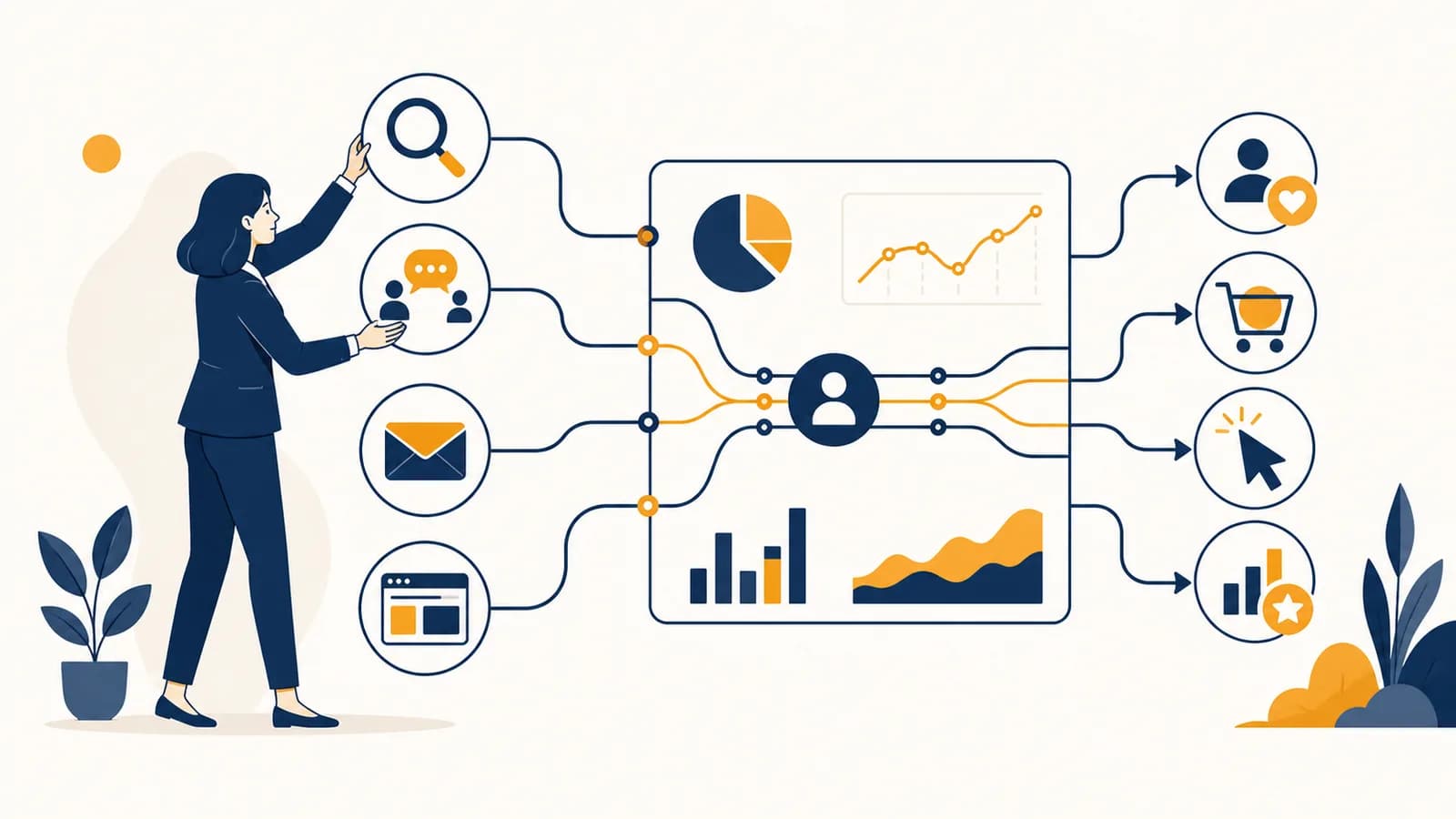
Digital marketing is a set of methods that uses connected devices and digital channels to find, persuade, serve, and retain customers, in the context of marketing. It includes search engine marketing, social media marketing, content marketing, online advertising, websites, analytics, and email campaigns. The idea exists because buyers use phones, computers, apps, and search engines while choosing what to notice, trust, and buy. Unlike a poster that gives every passerby the same message, a digital campaign can show different messages to different groups, record many responses, and adjust what happens next.
What digital marketing actually is
Digital marketing is the planned use of websites, search engines, social platforms, email, apps, and online advertising to create and exchange value with a chosen audience. Its defining feature is not the screen. It is the connected system linking messages, actions, data, and follow-up.
A business does not begin with an Instagram post or a banner advert. It begins with a marketing problem. A new bakery may need nearby people to know it exists. A software company may need trial users to become paying customers. A charity may need previous donors to give again. Digital channels are tools for solving such problems.
Four elements appear in most digital marketing systems:
- An audience: a defined group with a need, preference, location, behaviour, or relationship to the organisation.
- An offer: the product, service, information, event, or action being presented.
- A channel: the route that carries the message, such as search results, a video platform, an email inbox, or a website.
- A response: an observable action, such as viewing a page, requesting a quote, buying, renewing, or unsubscribing.
This structure connects digital activity to how product, price, place, and promotion work together. A beautiful advert cannot rescue an unsuitable product, an unaffordable price, or a delivery method that customers cannot use.
Digital does not mean automatic. Software can place adverts, send messages, and calculate results, but people still choose the objective, audience, promise, evidence, budget, and limits.
How a digital marketing campaign works
A digital campaign works by turning a business objective into a measurable customer action, choosing an audience and channel, publishing a suitable message, recording responses, and changing the campaign using evidence. Each step should connect to the next, or the data will describe activity without showing progress.
Name the commercial or organisational result. “Increase monthly trial sign-ups” is more useful than “get attention” because it defines the desired change.
Specify who has the problem, what they already know, what may stop them acting, and what evidence they need. An existing customer and a person meeting the brand for the first time need different messages.
Match the offer to the audience's readiness. A free comparison sheet may suit early research. A product demonstration or trial may suit someone already comparing suppliers.
Connect the advert, post, or search result to a page where the promised action is clear. Remove missing information, confusing forms, and surprises about price or delivery.
Compare results with the objective. Change one meaningful variable, such as the audience, headline, evidence, or landing page, then see whether the outcome improves.
Suppose a bicycle repair shop wants 20 additional bookings next month. It creates a page for a fixed-price safety check, runs a local search advert, and records completed booking forms. If 800 advert views produce 40 site visits and 8 bookings, the team can inspect two separate problems: getting a view to become a visit, and getting a visit to become a booking.
The shop's advert promises a same-week safety check, but the landing page only says “contact us.” Rewriting the page to show the service, price, available times, and booking button repairs the path between the promise and the action. More advert spending would not fix that broken path.
This is why campaign planning is a chain of connected decisions. If a link fails, activity at the top of the chain may rise while sales stay flat.
How digital channels perform different jobs
Digital channels differ in how people encounter them, what the user intends to do, and what the organisation controls. Search captures expressed demand, social media interrupts or joins attention, email continues a known relationship, and websites provide a destination where fuller decisions can happen.
Search captures an active question
Search marketing places useful pages or paid listings near queries that reveal intent. “How to clean running shoes” suggests an information need. “Buy waterproof running shoes size 8” suggests stronger purchase intent. The same person may use both queries at different stages.
Search engine optimisation improves pages so search systems can understand, access, and judge their usefulness. Paid search places adverts through an auction in which bids matter, but relevance and expected usefulness can also affect placement. Paying is not a permanent purchase of a position.
Social media distributes content through networks and recommendations
Social platforms show content through followed accounts, sharing, paid placement, and recommendation systems. A person may not be looking for the product at all. The message must therefore earn attention before it can explain the offer.
Organic social activity uses posts that spread without a payment for each placement. Paid social activity buys distribution to selected groups. Both depend on creative work, moderation, and a clear next action. “Going viral” is not a dependable plan because wide sharing can produce an audience with little interest in buying.
Email continues a permission-based relationship
Email marketing sends messages to people whose addresses an organisation has legitimately collected and is allowed to use. It can welcome a new subscriber, confirm an order, teach a customer, announce an offer, or invite a previous buyer back. The useful distinction is relationship stage, not simply list size.
A fuller treatment of permission, segmentation, and campaign email shows why an inbox is a relationship channel rather than a free advertising space.
A website turns interest into an owned experience
A website is a collection of pages controlled by an organisation, although it still depends on hosting, browsers, and other technical services. It can explain products, answer objections, take payments, collect enquiries, publish support material, and provide evidence such as specifications or return terms.
| Channel | Typical user state | Useful marketing job | Common weak measure |
|---|---|---|---|
| Search | Actively asking | Answer or capture demand | Ranking without useful visits |
| Social | Browsing or participating | Create discovery and conversation | Likes without relevant action |
| Known contact checking messages | Continue a relationship | List size without consent or response | |
| Website | Investigating or acting | Explain, reassure, convert, and serve | Traffic without task completion |
Digital marketing versus traditional marketing
Digital marketing uses connected channels that can record and react to many user actions, while traditional marketing commonly uses print, broadcast, outdoor media, post, and physical events. Neither is automatically better. The better choice depends on audience, context, reach, cost, message, and objective.
A bus shelter poster gives the same nearby audience a fixed message. It can build repeated local awareness, including among people who are not searching or scrolling.
A local search advert appears after a relevant query. It can send a visitor to a booking page and record that route, but it misses people who never make the query.
The distinction is sometimes blurred. A television advert may display a web address. A shop receipt may contain a QR code. A live event may collect registrations online. These are mixed systems, and the correct unit of analysis is the customer's complete route rather than the label attached to one medium.
Digital measurement is also incomplete. A person might see a podcast advert, search the brand later, read reviews on another device, visit a shop, and pay at the counter. The search visit is visible to the website, but it did not create every part of the decision. Traditional media can influence digital activity, and digital activity can lead to an offline sale.
A complete promotion plan may combine advertising, sales promotion, personal selling, publicity, and direct communication. Promotional tactics and public relations expand the choices around paid messages, public attention, direct response, and long-term reputation.
How audience targeting and personalization work
Audience targeting selects which people are eligible to receive a message, while personalization changes content or timing using known or inferred information. Both aim to improve relevance, but both can exclude suitable customers, use weak assumptions, or cross privacy boundaries if handled carelessly.
Targeting can use broad context. A raincoat advert on a weather page uses the page's subject. A restaurant advert limited to people near the restaurant uses location. A campaign shown only during opening hours uses time. These choices do not require the marketer to know a person's identity.
Targeting can also use a relationship. A retailer may distinguish people who subscribed, placed an item in a basket, bought recently, or have not purchased for a long time. Such groups are often called segments. A segment is useful only if its members share a difference that should change the marketing decision.
Useful segmentation test: If two groups will receive the same offer, message, timing, and service, separating them may add reporting work without improving a customer decision.
Personalization ranges from simple to complex. Addressing a message by name is cosmetic if the rest is irrelevant. Showing compatible printer ink based on a printer already bought is functional because the known product changes what is useful. Recommending a product based on browsing is an inference, and the inference can be wrong if the device is shared or the visit was research for someone else.
Marketers often use first-party data, which an organisation collects through its own interactions, such as purchases, account settings, support requests, and declared preferences. They may also receive data from partners or advertising systems. The origin affects accuracy, permission, control, and the explanations a customer should receive.
How digital marketing measurement works
Digital marketing measurement converts recorded events into indicators tied to an objective. Impressions count displays, clicks count selected links, conversions count defined actions, and revenue records sales value. A useful metric shows a meaningful stage of customer behaviour and states what the tracking system can actually observe.
The basic rates are ratios. They make campaigns of different sizes easier to compare, but they do not explain why results differ.
If 120 clicks come from 6,000 recorded impressions, CTR is .
A click-through rate describes the move from a recorded display to a click. It does not show that the visitor read the page, liked the product, or bought. For that, the marketer needs later events.
If 18 purchases come from 600 eligible visits, the recorded conversion rate is .
The denominator must be named. A purchase rate per visitor can differ from a purchase rate per visit because one visitor may return several times. “Conversion rate rose” is incomplete unless the action, population, and time window stay comparable.
Costs can also be related to results. If a campaign spends £900 and records 30 new customers, its observed customer acquisition cost is per customer. That number becomes useful only beside the value and margin of those customers. Revenue is not profit, because fulfilling the order and running the business also cost money.
Tests improve decisions when they compare like with like. In an A/B test, eligible users are assigned between version A and version B, and the marketer compares a defined result. Changing the headline, price, audience, and page at once makes the cause unclear. A small early difference can also be random, so decisions need enough observations and a planned stopping rule.
Attribution assigns credit, but it does not reveal the whole cause
Attribution is a rule for assigning conversion credit to marketing contacts. A last-click rule gives credit to the final recorded click. A first-click rule gives it to the earliest recorded click. Multi-touch rules divide credit across several contacts. Each rule answers a bookkeeping question, not a complete causal question.
Tracking gaps appear when people reject storage, change devices, use private browsing, encounter offline media, or buy through another route. Even perfect event recording would show sequence rather than prove causation. An experiment that changes exposure for comparable groups can provide stronger evidence about incremental effect.
How digital marketing shows up in a product launch
In a product launch, digital marketing connects positioning, audience research, channel choices, sales support, and feedback. The campaign must explain who the product is for, which problem it solves, why its difference matters, and what action a prospective customer should take next.
Imagine a company launching a refillable school pen. Before promotion, it interviews students, parents, teachers, and retailers. Students complain about ink leaks and scratchy writing. Parents focus on replacement cost. Teachers care about reliability during lessons. Retailers care about packaging, stock, and returns. These are different decision contexts around one product.
The launch team chooses a position: a dependable everyday pen with replaceable ink cartridges and a design that makes refilling clear. The team then creates separate evidence for separate audiences. A short demonstration video shows the refill action. A product page lists compatible cartridges and delivery details. A retailer page provides case quantities and contact information. A search page answers compatibility questions.
The message must match the product's actual design and the price buyers see. Work on choosing a market position and product message supplies the promise that digital channels distribute.
After launch, search queries and support requests expose gaps. If buyers repeatedly ask whether a cartridge fits, the team should improve the compatibility information. If many visitors reach checkout but leave after seeing delivery times, another advert may produce more of the same abandonment. The feedback should change the offer, page, service, or message according to the failure.
5 mistakes people make with digital marketing
Most digital marketing mistakes come from confusing visible activity with useful progress. High traffic, frequent posting, detailed dashboards, and precise audience settings can all look productive while the offer, customer path, measurement rule, or permission to communicate remains weak.
1. Starting with a platform instead of an objective
“We need to be on every social app” chooses tools before defining the job. A better brief states the audience, desired action, constraint, and time period. The platform can then be judged by its ability to reach that audience in the right context.
2. Optimising a proxy that has no clear route to value
Views, reactions, followers, and clicks can be useful early signals. They become vanity metrics when a team celebrates them without testing their relation to enquiries, sales, retention, service, or learning. A cheap click is expensive if it brings people who immediately discover the offer is unsuitable.
3. Treating correlation as proof of cause
Sales may rise during a campaign because demand is seasonal, a competitor ran out of stock, or stores improved product placement. A dashboard can show that events happened together. It cannot automatically separate the campaign's effect from every other change.
4. Making the advert better than the experience
A strong promise creates disappointment if the page is slow, the price is hidden, the form fails, or customer support contradicts the advert. Marketing includes the exchange and relationship, not only the message that attracts attention.
5. Collecting data without a defined use or permission
More fields do not automatically produce better marketing. Every requested detail adds effort for the customer and responsibility for the organisation. Teams should know why they collect it, how it will improve a decision, who can access it, how long it is kept, and what choice the person has.
A dashboard is a model of recorded behaviour. Missing events, duplicate events, tracking choices, identity errors, and attribution rules can all change the picture without changing what customers actually did.
How search intent changes the right content
Search intent is the likely task behind a query, and it changes what a useful page should provide. A learner seeking a definition needs explanation, a buyer comparing options needs evidence, and an existing customer reporting a fault needs support rather than a sales pitch.
Marketers often group intent into informational, comparative, transactional, and navigational patterns, but real queries can overlap. “Best budget camera for sports” asks for comparison and may lead to purchase. “Brand return policy” seeks a particular site and may decide whether a purchase continues.
The page should finish the user's task. A definition page needs clear terms and examples. A comparison page needs criteria, trade-offs, and disclosed limits. A product page needs specifications, price, availability, delivery, returns, and a clear action. Copying the same sales paragraph across all three ignores the reason each visitor arrived.
How digital marketing works for a small business
Small-business digital marketing works best when a firm makes a clear offer, keeps essential information accurate, chooses a few channels its customers actually use, and measures enquiries or sales. Limited time makes focus and a reliable customer path more valuable than constant publishing.
A local electrician might keep service areas, opening hours, emergency availability, credentials, and contact options consistent across its website and relevant listings. Search pages can answer specific service questions. After a completed job, a permitted follow-up can request feedback or remind the customer about a scheduled inspection.
The business does not need every available tool. It needs to know which jobs create acceptable margin, where suitable customers look, what evidence reduces risk, and how an enquiry becomes a booked job. Recording the source of qualified calls may be more useful than counting every site visit.
A café can spend its next hour filming a general trend video or correcting an outdated menu and opening time on the page local customers find. The second task may look less creative, but it fixes information used near a visit decision.
How privacy changes digital marketing
Privacy changes digital marketing by limiting what data organisations should collect, how they gain permission, how long they retain information, and which inferences they make. Good practice links each data item to a clear purpose and gives people understandable choices rather than hiding behind technical language.
Consent is not a decorative pop-up. A valid choice depends on the situation and applicable law, but the general marketing question is simple: does the person understand what will happen, and do they have a meaningful option? An email address supplied for a receipt does not automatically express interest in unrelated promotions.
Data minimisation means collecting what a stated task needs. A newsletter may need an address and topic choice, but not a date of birth. Security matters because customer information creates obligations as well as marketing possibilities. Accuracy matters too. A confident personalization system can still act on a mistaken identity or stale preference.
Limits can improve strategy. Contextual advertising asks what fits the current page or situation. Customer preference centres let people state what they want. Aggregate reporting looks for group patterns without requiring every individual to be identifiable to every marketer.
Collect every available field because it might become useful, keep it indefinitely, and send broad promotions unless a person finds the opt-out.
State the use, collect the minimum suitable data, protect it, review retention, respect choices, and test whether the use improves the promised customer experience.
Digital marketing makes marketing decisions visible
Digital marketing makes many marketing decisions observable through messages, pages, audience rules, customer actions, and recorded results. Its value comes from connecting those observations to product, price, distribution, promotion, service, and trust, then improving the complete exchange rather than chasing isolated numbers.
The subject is larger than advertising software. It asks who should be served, what value is offered, how an organisation communicates honestly, and how both sides exchange something useful. See how these decisions fit into marketing as a whole to connect digital campaigns with research, buyer behaviour, brands, pricing, channels, and customer relationships.
Next time an advert, search result, creator post, or sales email reaches you, identify the mechanism. Name the intended audience, the offer, the channel, the requested action, and the evidence the sender could record. Then inspect what is missing. You may notice a mismatch between the promise and the page, a metric that stops before value, or a personalization choice based on a weak guess.
The takeaway: A digital campaign is a connected marketing system. Judge it by the customer problem it solves, the path it creates, the evidence it earns, and the trust it preserves.