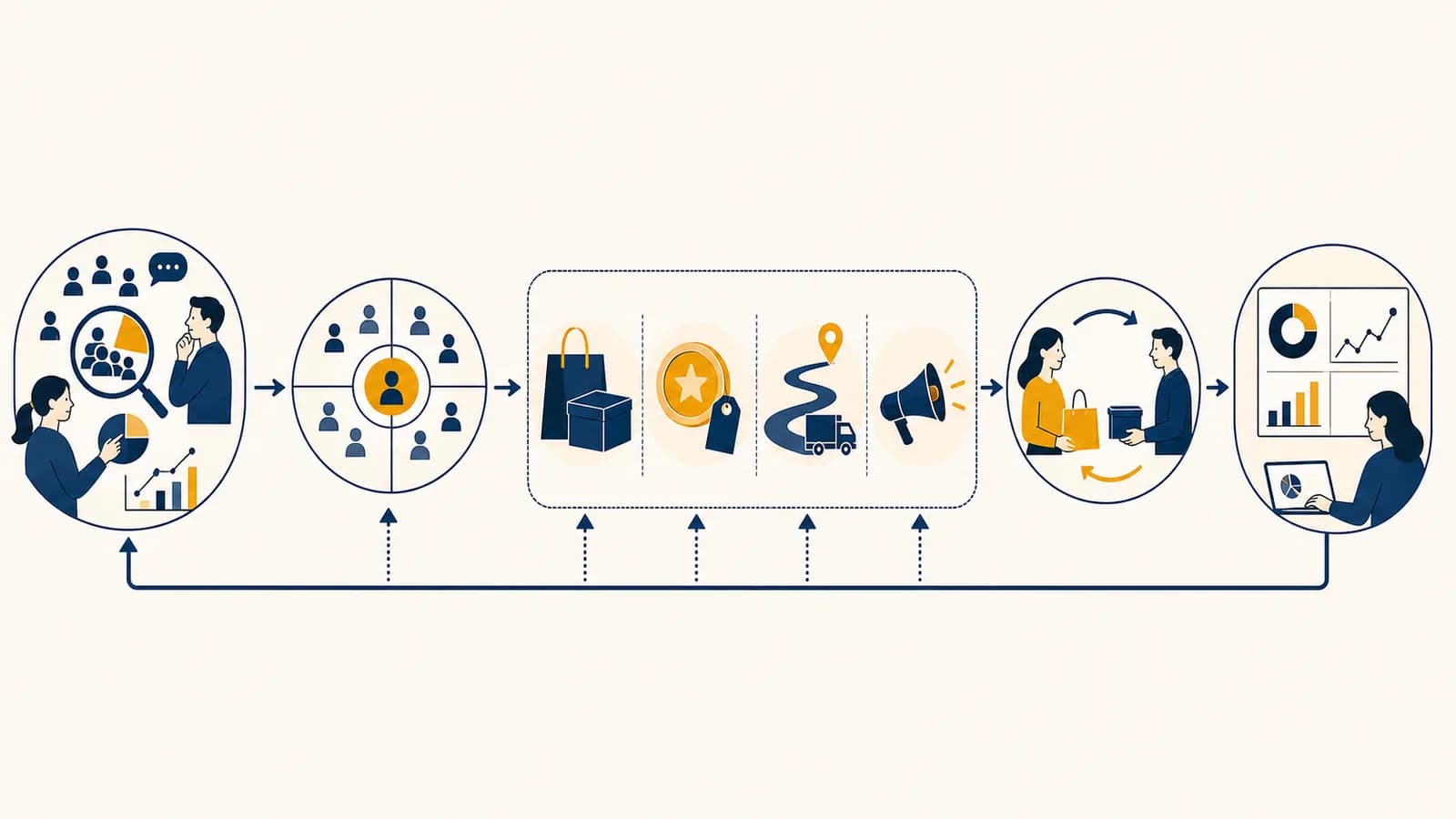
Basic marketing principles are a decision framework that identifies customers, creates useful offers, communicates value, and makes exchange possible in the context of business and public organizations. If you are asking what marketing is, how the four Ps work, what a target market means, or how the marketing mix affects sales, the answer begins with value: a specific group must receive a benefit it considers worth the money, time, attention, or behavior requested. Marketing exists because makers and buyers do not automatically understand, find, trust, or choose one another.
A bakery choosing its morning menu, a hospital encouraging vaccinations, and a game studio setting a subscription price all face the same basic problem. Each must learn what people need, design a suitable offer, make it available, explain it honestly, and check what happened. Those connected decisions are marketing.
What basic marketing principles actually are
Basic marketing principles are the connected rules used to understand a market, choose customers, build an offer, communicate its value, deliver it, and improve it through evidence. They turn a vague wish to “sell more” into a sequence of testable decisions.
The sequence begins with a market, a group of people or organizations that share a need and have some ability to act on it. A market is not everyone who could theoretically use a product. For a bicycle repair shop, nearby riders with damaged or poorly maintained bicycles form a usable market. People living hundreds of kilometres away do not, even if they also own bicycles.
A customer need is a problem, goal, or desired change. A customer may say, “I need a new chain,” but the deeper goal might be a reliable trip to work. Marketing must distinguish the requested item from the result the person values. That difference affects the service, the message, and the price.
A value proposition states why a defined customer should choose one offer over another. “Repairs while you wait, with the price agreed before work begins” is more useful than “excellent service” because a customer can understand and test it. The first statement promises speed and price certainty. The second supplies no decision rule.
Marketing starts before promotion. Choosing whom to serve, what to make, how much to charge, and where to provide it are marketing decisions even when no advertisement exists.
These principles fit into how customer, product, and communication decisions connect across marketing. They are useful because every later technique, including branding, social media, sales promotion, and performance analysis, depends on the quality of these earlier choices.
How marketing works as an exchange of value
Marketing works when each side gives something and receives something it values more. The customer gives money, time, information, or action. The organization provides a product, service, experience, or social benefit that solves a defined problem.
The process is a loop, not a straight line that ends at payment. An organization observes a need and makes a promise. The customer compares that promise with alternatives and the cost of doing nothing. If the customer accepts, the actual experience confirms or contradicts the promise. Complaints, repeat purchases, cancellations, reviews, returns, and recommendations then become evidence for the next decision.
Value is always judged relative to alternatives. A bottle of water can be poor value beside a free drinking fountain and good value where safe water is hard to obtain. The physical product has not changed. The setting, urgency, trust, convenience, and available substitutes have changed.
A school canteen notices that students leave the queue before buying lunch. Interviews show that many have only ten minutes. A prepacked meal is not valuable merely because it tastes good. Its value proposition must include fast collection, a clear price, and enough food for the afternoon.
The canteen can test the mechanism. It marks one collection point, shows the full price before students queue, records how many prepared meals sell, and asks purchasers what slowed them down. A rise in purchases alone would not prove the food improved. It might show that reduced waiting made the existing meal more valuable.
How market research turns uncertainty into evidence
Market research works by replacing assumptions about customers, competitors, and demand with collected evidence. It uses questions, observation, experiments, and existing records to reduce uncertainty before an organization commits substantial time or money to an offer.
Research begins with a decision, not a survey. “Should the canteen offer preordering?” is a decision question. “Do students like lunch?” is too broad because almost any answer leaves the canteen unsure what to do. A good research question identifies the choice, the people affected, and the evidence needed.
State what will change after the research, such as meal size, collection method, opening time, or price.
Use interviews for motives, observation for behavior, transaction records for past choices, and a controlled test for cause and effect.
Ask likely customers, including people who rejected the offer. Loyal buyers alone cannot reveal every barrier.
Separate repeated findings from unusual comments, and check whether different customer groups behave differently.
Connect the evidence to an action, then observe whether the expected result occurs.
Primary research is evidence collected for the current question, such as interviews or a trial. Secondary research already exists, such as census tables, trade reports, competitor price pages, or the organization’s own sales records. Neither type is automatically better. The right source is the one that answers the decision question with acceptable cost and accuracy.
Sampling matters because the people asked can shape the apparent answer. An online poll about a library service misses people without easy internet access. A café asking only current customers misses former customers and passersby who chose a competitor. The detailed tools belong to methods for turning market evidence into consumer insight, but the basic rule is simple: investigate the people whose choice you need to understand.
Research reduces uncertainty; it does not remove it. A small test can fail because the offer is weak, because the wrong people saw it, or because the test occurred at an unusual time. Marketers therefore record what they changed, what stayed constant, and which result would count as evidence against the idea.
How segmentation, targeting, and positioning focus a market
Segmentation divides a broad market into meaningful groups, targeting selects the group an organization can serve well, and positioning defines the distinct place the offer should occupy in that group’s mind. Together, they prevent an offer from becoming vague and interchangeable.
Segmentation finds differences that change a decision
A useful segment shares a trait that affects needs or behavior. Age alone may explain little. “People who commute by bicycle in all weather” is more useful to a repair shop because it suggests urgency, reliability needs, opening hours, and demand for durable parts. Segments can be based on location, behavior, situation, priorities, or patterns of use.
A segment must be identifiable, reachable, substantial enough for the organization’s purpose, and meaningfully different from other segments. A label that changes no product, price, access, or message is decoration rather than segmentation.
Targeting chooses rather than excludes carelessly
A target market is the group for whom the organization designs its main offer. The repair shop might target daily commuters because they value dependable turnaround and return regularly. It can still serve a weekend rider. Targeting decides whose problem shapes the operation first.
Positioning creates a usable comparison
Positioning answers, “Compared with what, and preferred for what reason?” A shop could position itself as the fastest commuter repair option nearby. That claim implies operational duties: stocked common parts, realistic completion times, and staff available before work hours. A position that the operation cannot deliver becomes a source of disappointment.
“Quality bicycle solutions for everyone.” The audience, comparison, and useful difference remain unclear.
“Same-day repairs for local bicycle commuters, with the price approved before work starts.” The customer, benefit, and evidence are visible.
Positioning is not a slogan pasted onto an unchanged product. The promised difference must appear in the actual offer. The connection between features, competitors, and customer perception is developed further in how an offer earns a clear place in a buyer’s mind.
How the marketing mix turns a position into decisions
The marketing mix turns strategy into coordinated choices about product, price, place, and promotion. These four Ps work as a system: each one changes the promise, cost, availability, or meaning of the offer, so a conflict can weaken the whole plan.
Product is the complete offer
Product includes the physical item or service and the surrounding experience. A laptop offer includes its specifications, design, warranty, support, packaging, and setup. A music lesson includes the teacher, schedule, feedback, location, and cancellation policy. Marketers ask which bundle solves the target customer’s problem.
Price is both a cost and a signal
Price is what the customer must give up, usually money but sometimes also time, effort, risk, or personal data. It affects revenue and communicates a clue about quality or intended audience. A low price can reduce a barrier, yet it can also make a safety-sensitive service look doubtful if customers use price as evidence of competence.
Place controls access
Place means how and where the customer finds, buys, receives, or uses the offer. It covers shop location, delivery, stock, websites, app stores, opening times, and intermediaries. A product unavailable at the moment of need creates no exchange, however persuasive its promotion may be.
Promotion communicates and prompts action
Promotion includes advertising, public relations, sales promotions, personal selling, direct messages, product demonstrations, and useful content. Its job can be to create awareness, explain a difference, reduce doubt, remind past customers, or ask for an action. The objective should determine the method.
| Mix decision | Question | Commuter repair example |
|---|---|---|
| Product | What complete result is offered? | Common repairs completed the same day |
| Price | What does the customer give up? | Quoted fee approved before work |
| Place | How is the service accessed? | Shop near a cycle route with early drop-off |
| Promotion | How will the promise be understood? | Local search listing shows hours, services, and booking |
Coordination matters more than filling four boxes. A premium cooking course with expert teachers and individual feedback cannot promise high-touch service, charge a bargain price, accept unlimited students, and keep the promise unchanged. Capacity, cost, access, and message must support the same position.
Marketing versus advertising
Marketing is the full system for researching a market, selecting customers, designing value, setting terms, providing access, communicating, and learning from results. Advertising is one paid communication method inside promotion, which is itself only one part of the marketing mix.
A clinic learns why appointments are missed, changes reminder timing, simplifies booking, offers suitable hours, and measures attendance.
The clinic pays to place a message about available appointments in a local publication or search result.
Advertising can bring attention to an offer, but it cannot repair every defect behind the offer. If booking is confusing, stock is missing, service is rude, or the price contradicts the promised value, more attention may expose the problem faster. Good marketing might recommend redesigning the service before buying media.
Sales is also related but distinct. Marketing creates and communicates a suitable offer for a chosen market. Sales helps a particular prospect decide and completes the exchange. In a small firm, one person may perform both jobs, but the decisions remain different. A salesperson can report repeated objections, and marketing can use those objections to change the offer or explanation.
The quotation is a principle, not a guarantee of repeat purchase. Customers may leave for many reasons, including a changed need or a better alternative. Still, a promotion that promises more than the operation supplies creates a predictable gap between expectation and experience.
How measurement improves marketing decisions
Marketing measurement connects an action to an observable result, compares that result with a defined objective, and guides the next change. Useful measures follow the customer process, so teams can see where attention, interest, purchase, use, or retention breaks down.
A goal such as “improve social media” cannot be measured until the intended result is named. If the purpose is awareness, relevant reach or visits may help. If the purpose is online orders, completed purchases matter more. A large audience response can look impressive while producing no action connected to the objective.
If 24 of 600 product-page visits produce an order, the conversion rate is .
The calculation is exact for the defined data, but its meaning depends on the denominator and time period. Twenty-four orders from 600 page visits is different from 24 orders from 600 unique people. A team must define the measure consistently before comparing it.
Measurement should locate a decision. Suppose 600 people view a page, 120 begin checkout, and 24 order. The first transition rate is . The checkout completion rate is . The team now knows that losses occur both before and during checkout, although the figures alone do not explain why.
A test can then examine one explanation, such as an unexpected delivery fee. The team changes that factor for a comparable group and holds other major elements steady. This does not make every marketing test perfectly controlled, but it produces better evidence than changing the page, price, audience, and checkout at once. More detailed methods appear in ways teams connect marketing activity with performance.
How marketing shows up in daily decisions and paid work
Marketing appears wherever someone must understand a group, shape an offer, communicate a choice, and learn from response. It affects ordinary purchases, community campaigns, creative work, public services, retail operations, product teams, and many roles without “marketing” in their title.
At a supermarket shelf, package size, eye-level placement, brand name, price, nutrition claims, and a temporary discount all influence comparison. Some are product decisions, some are place or price decisions, and some are promotion. The shopper also brings prior experience, budget limits, habits, and a current need. Marketing operates inside that whole choice, not as mind control.
In a product team, a researcher may interview users, a designer may simplify setup, an analyst may study cancellation patterns, and a support worker may record repeated complaints. Their information changes the value proposition even if none creates advertisements. In a theatre, the program, schedule, ticket tiers, venue access, trailers, and press coverage together shape the audience’s decision.
News reports often contain marketing evidence
A report about a product recall reveals a gap between promised and delivered value. A story about a crowded new shop may concern novelty, limited capacity, or well-chosen location. A company announcement about entering a new country raises questions about market size, local needs, competitors, language, distribution, and price. Marketing principles provide specific questions for reading such news.
Jobs use different parts of the same system
A market researcher investigates people and demand. A product marketer defines audiences and positioning. A brand manager coordinates how an offer is recognized and experienced. A media planner chooses where messages appear. A pricing analyst studies costs, demand, and alternatives. A customer success team helps users obtain the promised result and reports barriers. Their outputs feed one another.
Personal projects also create exchanges
A student recruiting volunteers for a cleanup is making a marketing decision. The “price” includes time and effort. The “product” includes the activity and its visible result. Place includes meeting location and transport. Promotion must explain who can join, what will happen, and why the result is worth a Saturday morning.
Four mistakes people make with basic marketing
Most basic marketing errors come from breaking the connection between customer evidence, the offer, and the result. Four common mistakes are starting with promotion, targeting everyone, confusing activity with outcomes, and making a promise the operation cannot consistently keep.
1. Starting with a channel instead of a problem
“We need a video account” starts with a tool. The prior questions are who must act, what prevents that action, and what evidence would change the decision. A short video may suit a visual demonstration. It may be useless for reaching a procurement manager who needs a technical specification and approval documents.
2. Calling everyone the target market
An offer for everyone usually speaks clearly to no one. Different groups value different benefits and accept different costs. A study app might serve students preparing for a specific examination, teachers assigning practice, or adults refreshing a skill. Each group needs distinct features, proof, access, and messages.
3. Reporting activity as if it were an outcome
Publishing ten posts is activity. Reaching qualified applicants, increasing completed bookings, or reducing avoidable cancellations is an outcome. Activity measures help manage work, but they do not show that the work caused the desired change. The chain between exposure and action must be examined.
4. Promising what delivery cannot support
A “reply in five minutes” promise requires staffing, systems, and limits that make five-minute replies possible. If the organization lacks them, the message creates expectations that worsen the experience. Marketers must test claims with the people who make, stock, deliver, support, and refund the offer.
A persuasive claim can still be bad marketing. If it is false, hides a material condition, exploits a vulnerable group, or cannot be delivered, it creates legal, ethical, and commercial risk.
Ethical marketing states the offer accurately, makes important costs and conditions visible, respects consent, and avoids designing confusion as a sales tool. Rules differ by location and industry, but “technically present in tiny text” is a poor standard for information that would change a reasonable customer’s choice.
How basic marketing works with a small budget
Small-budget marketing works by narrowing the audience, solving one costly customer problem well, using accessible evidence, and testing changes on a limited scale. A smaller organization cannot outspend every rival, but it can reduce waste through sharper choices and faster learning.
A new tutoring service does not need a national survey. It can interview students and teachers in the area it can actually serve, inspect the language people use for the problem, offer a small pilot, and record attendance, completion, questions, and referrals. The evidence is local, but so is the initial decision.
Budget should follow the main constraint. If people cannot find the service, improve access or discovery. If they visit but do not enquire, examine relevance, trust, explanation, and price. If they buy once but leave disappointed, repair delivery. Spending more on awareness while the largest failure occurs after purchase sends more people into the same weak experience.
A repair shop chooses one commuter segment, creates one service package, lists the exact work and price, offers 20 appointment slots, and records enquiries, bookings, completed repairs, and reasons for refusal. The limit is deliberate: it protects capacity and makes the first evidence easier to interpret.
Small tests do not excuse careless conclusions. Twenty offered slots can show whether the operation works and reveal objections, but they cannot establish demand across an entire city. The claim should match the evidence: “This package filled most pilot slots” is narrower and more honest than “The city wants this service.”
How marketing changes for services, nonprofits, and personal brands
The principles remain stable across services, nonprofits, and personal brands, but the exchange changes. Marketers must identify the actual beneficiary, decision-maker, cost, evidence of value, and desired behavior instead of assuming that every offer is a packaged product sold for money.
Services must make invisible value easier to judge
A haircut, legal consultation, and repair cannot be inspected fully before purchase. Customers use evidence such as a clear process, relevant qualifications, previous work, recommendations, response quality, and guarantees. Because production and use often happen together, staff behavior and booking systems become part of the product.
Nonprofits may serve one group and receive resources from another
A food bank’s users, donors, volunteers, partner shops, and local agencies participate in different exchanges. Donors may value credible evidence of effective use. Volunteers may value a well-organized way to help. Users need respectful and reliable access. One general message cannot answer every group’s question.
Personal brands still require a real offer
A reputation built around a person is useful only if others can connect it to relevant, demonstrated value. A photographer might position around careful product images for small online shops. A portfolio supplies evidence, a simple booking process supplies access, and reliable delivery supports the promise. Frequent posting without a defined customer or useful work is visibility without position.
The same diagnostic questions apply in each setting: Who acts, who benefits, what do they give up, what result do they seek, what alternatives exist, and what evidence would earn trust? Once those answers are specific, the marketing mix can be adapted without pretending every exchange looks like a shop purchase.
Marketing is a connected system of choices
Marketing succeeds as a connected system, not as a collection of isolated promotional tasks. Research identifies a real problem, strategy selects whom to serve, the mix delivers a coherent offer, measurement tests the result, and ethics sets limits on how value is promised.
The strongest habit is to trace every tactic backward and forward. Backward, ask which customer evidence and objective justify it. Forward, ask what behavior it should change, how the organization will deliver the promised result, and what measure could show that the reasoning was wrong.
Next time you see a price change, redesigned package, new shop location, public campaign, free trial, or service guarantee, identify the target customer and the intended value exchange. Then inspect whether product, price, place, and promotion tell the same story. That is how the basic principles become a practical way to read business and daily decisions.
The takeaway: Start with a defined customer problem, build and deliver a fitting offer, communicate it truthfully, and use observed results to decide what changes next.