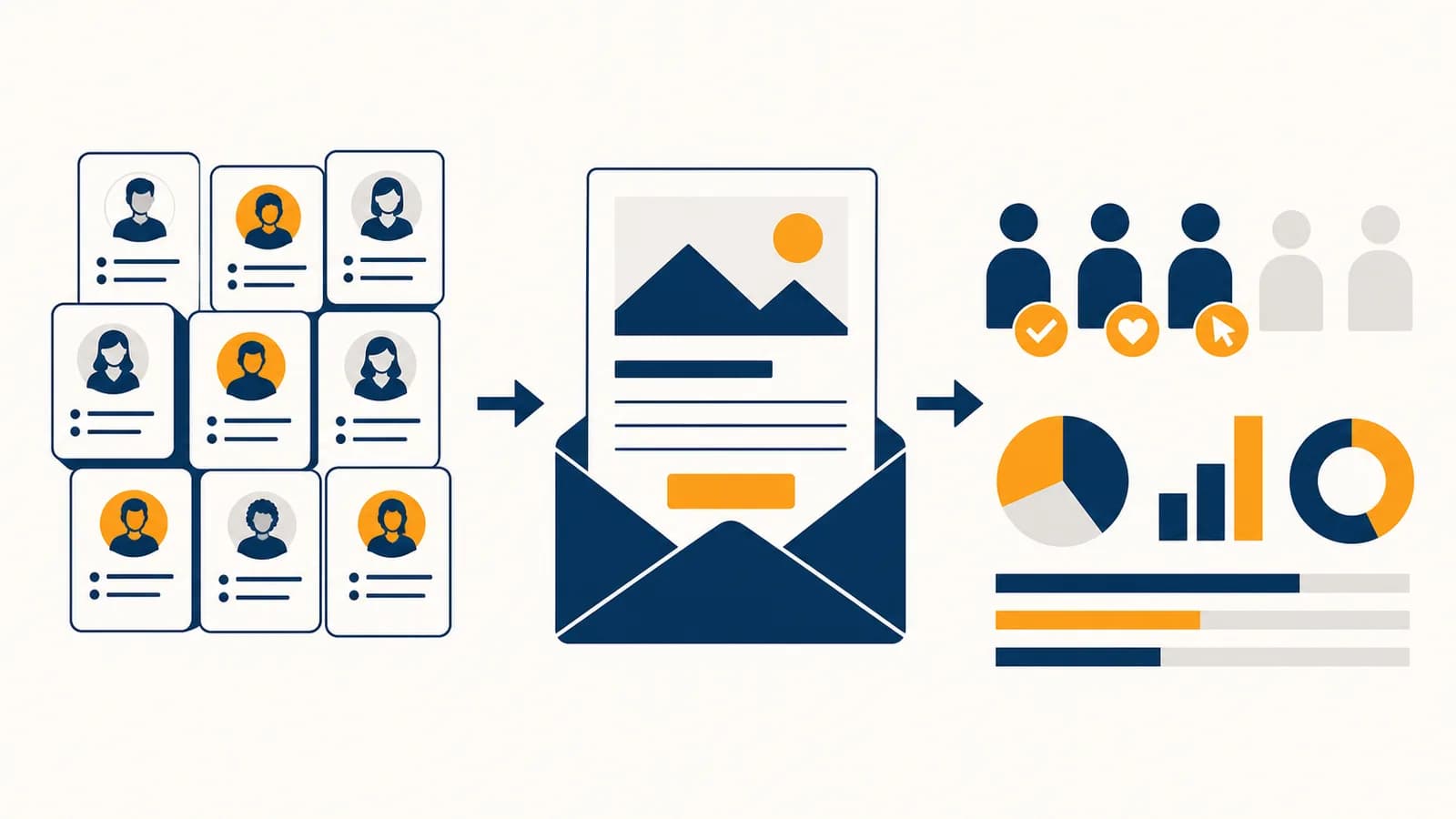
Email marketing is a communication method that uses permission-based email messages to build customer relationships and prompt measurable action, in the context of marketing. It includes email campaigns, newsletters, promotional emails, welcome messages, and automated reminders sent to a subscriber list. Learning how email marketing works means understanding why a message reaches one inbox, what makes someone open or ignore it, and how a sender measures the result. The method exists because a person who has asked to hear from an organization can be served more directly than a broad audience that may have no interest.
What email marketing actually is
Email marketing is the planned use of email to inform, persuade, retain, or reactivate people who have a relevant relationship with a sender. Its defining features are an identifiable audience, a business purpose, permission or another valid basis for contact, and results that can be measured.
An email from a friend is personal correspondence. An automatic receipt is mainly a transaction record. An email marketing message tries to affect a customer relationship. It may introduce a product, teach a useful skill, invite a renewal, announce an event, or remind a shopper about an unfinished purchase. The message can still be useful or enjoyable, but it has a marketing job.
That job is not always an immediate sale. A museum newsletter may announce a new exhibition so members remember to visit. A software company may teach a feature so customers get more value and keep their subscriptions. A local plumber may send a cold-weather checklist that makes the company easier to recall when a pipe freezes. Email can support awareness, consideration, purchase, use, loyalty, and return.
The words, images, offer, links, sender name, and subject line that a recipient sees.
The audience rules, consent records, sending technology, delivery checks, timing, and measurement behind the message.
A polished email is only the visible surface. The system matters because the same message can be helpful to a recent buyer, irrelevant to a stranger, and annoying to someone who already declined it. Good email marketing matches the message, person, purpose, and moment.
How permission and list building work
Permission-based list building turns a voluntary sign-up into a usable audience record. A form collects an address and explains what will be sent; the sender stores the source and preferences, confirms the address when appropriate, and gives the subscriber a clear way to leave.
A list is not simply a spreadsheet of addresses. Each useful record has context. The sender may know when the person subscribed, which form they used, what they asked to receive, which region they selected, and whether delivery has repeatedly failed. That context determines which messages fit.
Consider a bakery form that says, “Get Friday's menu and occasional class announcements.” A person who submits it has been told the likely content and frequency. If the bakery later sends daily messages for unrelated financial products, the address is still technically present, but the original expectation has been broken.
Some organizations use a confirmation message that asks the subscriber to click before joining. This extra step helps catch mistyped addresses and proves that the inbox owner can receive the message. A single-step sign-up creates less friction, but it can admit more invalid or unwanted addresses. The right choice depends on the risk, the audience, and applicable rules.
A purchased address is not a relationship. Buying a list removes the context that makes an email relevant and can produce complaints, failed delivery, and damage to the sender's reputation.
Consent and marketing rules differ by place and by type of message. A responsible sender records where addresses came from, honors opt-outs, identifies the sender honestly, and checks the rules that apply to the organization and recipient. Those practices also make commercial sense: keeping people who do not want the email wastes attention and distorts results.
How an email campaign works
An email campaign works by connecting one defined objective to one audience, one message, and one measurable next action. The sender plans the offer, builds and checks the email, sends it through an email service, watches delivery and response, then uses the evidence to improve.
Name the change the campaign should cause, such as class registrations, product trials, repeat purchases, or event attendance. “Send a newsletter” is an activity, not an objective.
Select people for whom the message is permitted and relevant. Exclude unsubscribed addresses, known delivery failures, and customers whose situation makes the offer unsuitable.
Write a subject line that represents the contents. Explain the value, supply enough evidence, and make the next step visible. The landing page must continue the same promise.
Proofread names, prices, dates, links, tracking parameters, display on small screens, plain-text content, sender details, and the unsubscribe route. Send test copies before releasing the campaign.
Monitor delivery failures, complaints, clicks, conversions, and unsubscribes. Compare the outcome with the objective, then record what should change in the next campaign.
Suppose a community theatre has 800 subscribers and wants to fill a Saturday workshop. It sends only to people near the venue who asked for education updates. The email names the instructor, explains the skill being taught, gives the time and cost, and links to a registration page. If the page uses different dates or hides the price, the campaign fails even if the email itself looks excellent.
A shoe shop receives a new waterproof walking boot. Instead of emailing every customer, it selects subscribers who asked for outdoor product news or previously bought hiking gear. The email explains the sole, fit, and return policy, then links to the exact product. Relevance comes from the audience choice before a single sentence is written.
The message should also fit the wider offer. Email cannot repair weak positioning. If recipients cannot tell who a product is for or why it differs, the sender needs the ideas behind matching products with a clear market position, not a louder subject line.
How segmentation and personalization work
Segmentation divides a list into groups using relevant shared facts, while personalization changes content for an individual record. Both methods aim to reduce mismatch, but they work only when the data is accurate, the distinction matters, and the resulting message is genuinely different.
A segment may be based on stated interests, location, customer status, purchase category, engagement, or stage in a process. A university could separate prospective students from enrolled students because each group needs different deadlines. A bicycle shop could separate service customers from people browsing children's bikes. The dividing line earns its place when it changes what should be said or offered.
Personalization can be simple, such as inserting a first name, but useful personalization often changes substance. A receipt can show the actual order. A course platform can remind someone about the lesson they started. A travel company can show information about a booked destination. Calling someone “Alex” while promoting something unrelated is decoration, not relevance.
Use data to remove irrelevant content. The strongest personalization often comes from leaving out an offer that does not fit, not adding more personal details to the copy.
Every data field can be wrong, old, incomplete, or unexpectedly sensitive. A missing name can produce “Hello, [First Name].” An old purchase may no longer represent an interest. Shared family accounts make individual assumptions unreliable. Marketers therefore need fallback text, limits on inference, and a reason for collecting each field.
Segmentation often connects email to a customer database. The page on how customer relationship records organize interactions explains how contact history, preferences, service cases, and purchase information can support coordinated communication.
How deliverability works
Deliverability is the ability of a legitimate email to reach the intended inbox rather than fail or be filtered elsewhere. It depends on valid addresses, sender authentication, reputation, complaint patterns, message construction, sending behavior, and each receiving service's private filtering decisions.
Delivery and deliverability are related but different. A server may accept a message, which counts as delivered by many systems, while placing it in a junk folder. A hard bounce means the address cannot receive the message, often because it does not exist. A soft bounce describes a temporary failure, such as a full mailbox or short-lived server problem.
| Signal | What it tells the sender | Sensible response |
|---|---|---|
| Hard bounce | The address has a lasting delivery problem | Stop repeated sending to that address |
| Soft bounce | Delivery failed for a reason that may be temporary | Retry within sensible limits, then suppress persistent failures |
| Spam complaint | A recipient marked the message as unwanted | Suppress the recipient and investigate source, expectation, and frequency |
| Unsubscribe | A recipient explicitly asked to stop marketing mail | Honor the request and keep the suppression record |
Email authentication gives receiving systems evidence about who is allowed to send for a domain and whether a message was altered in transit. Common standards include SPF, DKIM, and DMARC. They do not guarantee inbox placement, but missing or incorrect authentication makes identity harder to verify.
List quality matters more than tricks. Sending expected mail to active, valid recipients produces better evidence than changing a word to dodge a filter. Sudden volume changes, deceptive sender names, hidden opt-outs, and repeated sending to dead addresses can all make a sender look less trustworthy.
Email marketing versus spam
Email marketing is relevant, identifiable communication sent within permission and applicable rules; spam is unsolicited, deceptive, indiscriminate, or persistently unwanted bulk email. The difference is not that one sells and the other does not. The difference lies in expectation, targeting, honesty, and control.
The recipient can explain why the message arrived. The sender is recognizable, the content matches the sign-up, and leaving is clear.
The address was scraped, bought, guessed, or reused outside its expected purpose. Identity or intent may be hidden, and stopping the messages may be difficult.
A message can become unwanted even if the first contact was welcome. Frequency may rise, the subject may shift, or the subscriber's needs may change. Permission is therefore maintained through honest expectations and easy choice. It is not a permanent claim over an inbox.
Transactional email is another source of confusion. A password reset, order receipt, or service alert performs an operation the user requested or needs. Adding a large promotion to an essential service notice mixes purposes and can affect how the message must be handled. Teams should decide which content is operational and which is marketing before they choose the audience or template.
The practical test is simple: identify the relationship, the expectation, the message's purpose, and the recipient's control. If any part is vague, the sender should fix the basis for contact before working on the creative design.
How email performance is measured
Email performance is measured by following the chain from attempted sends to delivery, response, and business outcome. Useful metrics answer a decision question, use clearly defined denominators, and account for technical limits such as automated image loading, privacy protection, and bot-generated clicks.
The basic counts are attempted sends, delivered messages, opens, clicks, conversions, bounces, complaints, and unsubscribes. Their rates depend on the denominator. A click-through rate commonly divides unique clickers by delivered emails, while a click-to-open rate divides clickers by recorded openers. These answer different questions and should never be compared without checking the formula.
If 900 emails are delivered and 45 recipients click, the rate is .
Now suppose 18 of those clickers complete a purchase. The click-to-purchase conversion rate is . The delivered-email-to-purchase rate is . Both are correct. One evaluates the landing experience after a click; the other evaluates the full email path.
Opens are especially imperfect. Many systems detect an open when a tiny image loads. An email can be read with images blocked, and some privacy systems load images without a human reading the message. Open data can still help with cautious comparison, but it is not a direct count of human attention.
Revenue also needs context. If a campaign costs $600 in staff time and software and produces $2,400 in gross profit attributable to the campaign, the profit after campaign cost is $1,800. A simple return on investment calculation is . Using sales revenue instead of profit would answer a different question. Attribution also becomes uncertain when a person sees an email, waits, and buys through another channel.
How testing separates evidence from opinion
Email testing compares controlled versions to learn which choice causes a better result. A useful test changes one meaningful variable, assigns similar recipients fairly, chooses the success metric in advance, and waits for enough observations before treating random movement as a lesson.
An A/B test might compare two subject lines while holding the audience, sender, send time, offer, and email body constant. If version A promises “Saturday pottery workshop details” and version B says “Make your first bowl this Saturday,” the sender can compare the chosen outcome. Opens might assess the subject line, but registrations are closer to the business objective.
Small samples produce unstable results. Imagine each version reaches 50 people. Three purchases for A and one for B look like 6 percent against 2 percent, but the difference is only two people. A repeat test could easily reverse it. Testing software may estimate statistical uncertainty, yet the marketer still has to ask whether the result is large enough to matter and likely to apply again.
State the decision before the test. “If one version produces a credible increase in completed registrations without more complaints, use its approach in the next workshop campaign” is better than searching every metric for a flattering result.
Tests also need interpretation. A discount subject line may win more immediate orders but train customers to wait for discounts. A curiosity-based subject line may raise recorded opens while attracting fewer qualified clicks. Evidence becomes useful only when the measured behavior connects to the marketing goal.
How email marketing shows up in real settings
Email marketing appears wherever an organization maintains an ongoing relationship with people at different stages. Retailers announce products, charities report impact, schools share course opportunities, publishers distribute ideas, service firms prompt renewals, and event organizers coordinate interest before and after attendance.
A welcome sequence sets the first expectation
A welcome sequence is a timed set of messages sent after sign-up. The first email confirms what the person requested and delivers any promised resource. Later emails might explain the service, answer a common obstacle, or ask for a preference. Each message should earn the next one.
For a language-learning app, message one confirms the account. Message two helps the learner choose a daily practice goal. Message three demonstrates a feature tied to that goal. The sequence responds to the new user's situation rather than repeating a general sales pitch.
A newsletter builds repeated contact
A newsletter is a recurring email organized around a consistent value proposition. A useful edition may contain one main idea and a few supporting items, but the reader should know what kind of benefit to expect. Editorial consistency is part of the product.
A gardening shop might send seasonal planting advice linked to products it stocks. The teaching has to work even for someone who does not buy that day. This is where using useful content and stories to build attention connects with email distribution.
Lifecycle messages respond to a change
A lifecycle email is triggered by an event or stage in the customer relationship. Examples include an expiring trial, an unfinished application, a replenishment estimate, or a period of inactivity. The trigger supplies context, but the sender must still avoid false assumptions.
A reminder about an abandoned basket should not claim an item is “almost gone” unless inventory evidence supports the claim. A reactivation email should recognize that the person may no longer be interested. Accurate context creates trust; invented urgency spends it.
Service businesses use email to reduce uncertainty
For appointments, courses, and events, email can explain preparation, location, schedule, and follow-up. These messages support the experience as well as promoting another purchase. Clear operational information can reduce missed appointments and prevent customer frustration.
The relationship between promotion and the event itself becomes clear when the person arrives. An email promise is tested by the actual experience. If the event does not match it, no follow-up sequence can erase the mismatch.
Five mistakes people make with email marketing
The most damaging email mistakes break the chain between audience, promise, experience, and evidence. They usually come from treating the address list as a possession, optimizing a visible metric without context, or sending before the team has checked what the recipient will actually encounter.
1. Sending the same message to everyone
Uniform sending assumes every subscriber has the same need. A first-time visitor, active customer, former customer, and job applicant do not belong in one sales audience merely because their addresses share a database. Select recipients according to the message's purpose.
2. Writing a subject line the email cannot support
A subject line wins attention by setting an expectation. If “Your account needs action” leads to an ordinary sale, the mismatch may produce an open, but it weakens confidence. Represent the contents accurately and make the benefit specific enough to judge.
3. Measuring activity instead of outcome
A high open count cannot prove that customers understood an offer, completed a purchase, or stayed satisfied. Choose the action that reflects the objective, then use earlier metrics to diagnose where people stopped. Metrics form a chain, not a scoreboard of isolated numbers.
4. Ignoring the page after the click
The landing page completes the email's sentence. It must repeat the relevant offer, work on the recipient's device, answer obvious objections, and make the promised action possible. A broken form can make strong email copy look ineffective.
5. Treating unsubscribes as failure to prevent
An unsubscribe protects the recipient's choice and cleans the active audience. Hiding it may reduce the visible count temporarily, but it can increase complaints and resentment. The useful question is why people leave, not how to trap them.
How often should a business send email?
A business should send as often as it can provide expected value without exhausting attention, and no universal frequency fits every list. The sensible schedule depends on the sign-up promise, urgency of the information, buying cycle, message quality, and recipient response over time.
A daily news briefing and an annual tax reminder solve different problems. Frequency should be stated at sign-up when possible and adjusted by preference. A subscriber may want immediate service alerts, a weekly teaching email, and no promotional sale messages. One address can hold several choices.
Watch for patterns across multiple sends. Falling engagement, rising complaints, and rapid unsubscribes after a schedule change can signal fatigue or expectation mismatch. Silence is not automatically better, either. If a sender disappears for a year, subscribers may forget the relationship and treat the next message as suspicious.
What tools does email marketing need?
Email marketing needs a system that stores permission and audience data, builds accessible messages, sends at controlled volume, authenticates the sender, records delivery and response, handles opt-outs, and connects outcomes to the intended goal. The brand name of the tool matters less than these functions.
A small club may use one email service with sign-up forms and basic segments. A large retailer may connect a customer database, product catalogue, web analytics, experimentation system, and several sending services. More connections create more capability and more ways for data to become inconsistent.
Automation is a rule, not magic. A rule might say: when a trial begins, wait one day; if the user has not completed setup, send help; if setup is complete, skip that email. The team must define the trigger, delay, eligibility, exit condition, and message. It must also test unusual cases, such as a person finishing setup during the delay.
A customer cancels a paid plan, then receives a cheerful message saying, “You are halfway through your free trial.” The sending software followed an old rule correctly, but the underlying customer state was wrong. Automation increases the speed of both good logic and bad logic.
Useful tool selection begins with the process. Ask who owns consent records, how customer changes reach the sending system, how quickly opt-outs apply, which events trigger messages, and which report answers the business objective. A long feature list cannot replace clear ownership.
Email marketing connects customer attention to marketing decisions
Email marketing makes the wider subject of marketing visible as a working system: a chosen audience receives a positioned offer through a controlled channel, responds or does not, and leaves evidence. Each send tests what the organization knows about customer needs and trust.
The craft includes writing, design, data, technology, law, and measurement, but those parts serve one relationship. An inbox is personal space. The sender earns continued access by being recognizable, relevant, accurate, and easy to refuse. That standard is useful even before a campaign has any performance data.
To connect this topic with how marketing decisions fit together across channels, notice what changes before and after the send. The product determines what can honestly be promised. The audience determines which details matter. The landing experience fulfills or breaks the promise. The results then inform the next choice.
The takeaway: Pick one real email you receive and trace its system. Identify why you got it, what the sender wants, what evidence supports the promise, where the link leads, how you can leave, and which result the sender can actually measure.